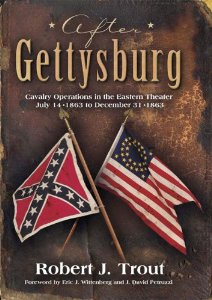
Book Review: After Gettysburg

Tags

, ,

ImageI received this book for Christmas, but just read it recently.  I wasn’t sure what to expect, as I haven’t read Mr. Trout’s studies of Stuart’s staff and horse artillery, but all have been highly recommended.  After reading this book, I have ordered them.

In After Gettysburg, Robert Trout provides the first comprehensive and detailed look at the activities of the Army of the Potomac and the Army of Northern Virginia between the end of the Gettysburg campaign and the winter halt to campaigning for 1863.  Most books treat these activities with a few sentences between brief paragraphs on the Bristoe Station and Mine Run campaigns.  This is the first book to my knowledge to look at the actions from a campaign perspective.

Mr. Trout’s narrative skillfully blends primary and secondary sources to produce an engrossing tale.  This had not previously been a period of great interest to me, but I had a difficult time putting the book down.  I was very impressed by his ability to provide very detailed information consistently without bogging down his narrative with minutiae.  For those desiring more depth on the action as it unfolded, he provides very comprehensive endnotes that provide additional information and context in additional to source notations.

I was thrilled to at last see detailed maps of areas south of the Rappahannock, but had trouble following them at times.  This was partly an issue of transitioning between maps, and is likely a personal issue.  Certainly the 25 maps provide excellent opportunity for the reader to visualize the activities in the text.

Content aside, this is an absolutely beautiful book.  The publisher, Eagle Editions, Limited, produced a gem.  From cover art to page weight to binding it is a work of art.

I strongly recommend this book to anyone interested in the less publicized periods of the war and cavalry enthusiasts.  Given the author’s placing of context for the campaign, I think it could be enjoyed by anyone from a Civil War novice to a veteran researcher.

5th Cavalry at Gaines Mill article

Tags

, , ,

This month’s e-version of Armor magazine has an excellent article on one of the companies of the 5th US Cavalry at the battle of Gaines Mill. It is entitled “A Hard Duty Given This Half of the 5th Cavalry,” by Donald McConnell and Gustav Person. The link for it is here. The authors do an excellent job of setting the table for the reader leading up to the battle, then provide a very detailed look at the battle and its aftermath for Company H, 5th US Cavalry. I found it a very entertaining and informative read.

On the shelf and on the market!

Tags

, ,

book cover

I was both thrilled and humbled to receive the authors’ (and forewordist’s!) copies of the book in the mail today. I’m very pleased with the way it turned out, and it’s definitely nice to finally have the closure of a fully completed project. All in all, I think we did a good job of telling the regiment’s story in a coherent fashion, with enough visual aids for the average reader to follow the story and the action of the unit’s actions. Eric’s foreword is excellent, and I was very pleased with the way the maps from both Steven Stanley and Blake Magner turned out. The roster is more compact than I had visualized, and very user-friendly. Photos for stories about regulars are always tough, but I think we found enough to help humanize the story. I like the way they’re spread through the text instead of grouped in a few pages in the center of the book.

Just what I needed to energize the research effort for the next book, assuming I can find someone to publish it. Initial feedback from a very small sample has been positive so far. I would imagine it will depend on how the reviews go for this one.

I should have signed copies for sale by late next week. If you’d like one, please email me at dccaughey AT aol DOT com.

Private John Saville, Co. K, 1st U.S. Cavalry

Tags

,

I had a request recently to see what I could find out about this gentleman, and thought I’d post it here in case anyone’s curious.  He was a much more difficult nut to crack than most queries I attempt. I certainly learned a few things, most of them unexpected.  It is very likely that John is featured in the banner photo for the blog, as this was his company in early 1864 near Brandy Station.

John Saville was born in County Limerick, Ireland about 1841.  He immigrated to the United States, and was living near Chicago when the Civil War broke out.  He enlisted as a private into Company G, 23rd Illinois Infantry regiment on June 15, 1861 at the age of 21. He served with this unit for the first year and a half of the war, in what appears to be a singular experience.

The 23dr Illinois was mustered in the same day John enlisted, June 15, 1861.  Upon completion of their training, they marched to garrison Lexington, Missouri in September.  After a brief siege, they surrendered the town to militia under Confederate General Sterling Price and were captured and paroled.  The regiment was mustered out by order of General Fremont on October 8, and ordered restored by General McClellan on December 10th.  For the first half of 1862, the regiment guarded prisoners at Camp Douglas outside of Chicago.  In June they moved to Harpers Ferry, where they served as part of the Railroad District, 8th Corps, Middle Department.  They served at various locations in the vicinity of Harpers Ferry for the duration of the year, marching to the relief of Parkersburg and Clarksburg in September.   

On December 24, 1862, he transferred from his volunteer regiment into the regular army at New Creek, Virginia.  He was sworn into Company K, 1st U.S. Cavalry by Lieutenant Judson Haycock.  His enlistment documents describe him as 5’ 11” tall, with blue eyes, black hair and a dark complexion.  He served the remainder of the war in the company without any major issues.  He was discharged at the expiration of his enlistment in New Orleans, Louisiana on December 24, 1865 as a private.

John returned home to Chicago, but must not have been too pleased with his homecoming.  On January 27, 1866, barely a month after he left the army, he re-enlisted.  He was sworn into company A, 18th U.S. Infantry, which later became Company A, 36th U.S. Infantry, by Lieutenant Kirkland.  This enlistment did not go well at all.  He deserted on July 3, 1867, only to be apprehended six days later.  Apparently things continued to go poorly, for he was dishonorably discharged as a private on January 27, 1869, per General Order 38, Department of the Platte at Camp Douglas, Utah.

John returned to Chicago, where he worked as a laborer.  He evidently suffered the effects of his military service.  He was admitted to the Northwestern Branch, National Home for Disabled Volunteer Soldiers in Milwaukee, Wisconsin in 1877 for disability due to rheumatism.  He was expelled a few months later on February 28, 1878 with the note, “refused to work.”   He filed a pension as a veteran invalid on May 3, 1879.  He was in and out of the Northwestern Branch and the Western Branch for the next several years, then disappeared from records after December 1889.  I could locate no marriage records, and he was listed as single in the National Home entries.

So ends our tale of John Saville, a common soldier.

The proofs are in the … index?

Tags

I’m afraid you will have to excuse a brief hiatus from posting. Yesterday I received the proofs from McFarland for The 6th United States Cavalry in the Civil War, and am currently neck-deep (but still afloat) in proofreading and indexing. The break shouldn’t be very long, and I still hope to get my post on Marcus Reno at Kelly’s Ford up by Sunday evening. Things may just be a little slower for a week or two. As soon as I’ve finished the index, the link will be posted here for ordering info from McFarland or autographed copies from me directly.

Thank you for your indulgence. Now, where did I put that red pen….

6th U.S. Cavalry Regimental Staff

Tags

As with the staffs of the other regiments, there are a few items of note with this one. Created at the beginning of the war, it still had as many issues with field grade officers as the older regiments. David Hunter never served a day with his regiment, though he did review them once as a general during the winter of 1861-1862. Emory trained the regiment and led it to war, but he was a general himself by the end of the Peninsula campaign. He was nominally followed by Sturgis, who never served in the same theater as the regiment during the war.

Neither of the two initial majors served with the regiment either. Williams served with the regiment on the Peninsula, only to be relieved for suspected treason, while Morris was with the 3rd U.S. Cavalry in New Mexico until late 1863. Despite the dates listed below, Starr served with the regiment for less than a month during the war, and led it to its worst defeat.

With the exception of Audenreid, who spent nearly the entire war as an aide de camp, every adjutant was a former enlisted man. Other than Hutchins, so were the quartermasters.

Colonels

David Hunter May 14, 1861 – July 31, 1866

Lieutenant Colonels

William H. Emory May 14, 1861 – October 27, 1863
Samuel D. Sturgis October 27, 1863 – May 6, 1869

Majors

E.H. Wright May 14, 1861 – April 25, 1863
James H. Carleton September 7, 1861 – July 31, 1866
Lawrence A. Williams September 7, 1861 – March 11, 1863
Robert M. Morris March 11, 1863 – February 21, 1873
Samuel H. Starr April 25, 1863 – December 15, 1870

Adjutants

John W. Spangler July 1, 1861 – October 1, 1861
Curwen B. McLellan October 1, 1861 – November 30, 1861
J.C. Audenreid December 1, 1861 – July 21, 1862
Albert Coats July 21, 1862 – May 18, 1863
Joseph Kerin May 18, 1863 – October 25, 1863
Tullius C. Tupper October 25, 1863 – November 11, 1864
Adna R. Chaffee November 11, 1864 – December 12, 1866

Quartermasters

Benjamin T. Hutchins July 1, 1861 – October 1, 1861
John W. Spangler October 1, 1861 – February 1, 1863
James A. Irwin February 1, 1863 – May 18, 1863
Stephen S. Balk June 28, 1863 – August 22, 1863
James A. Irwin August 22, 1863 – November 5, 1865

Commisaries

Ira W. Claflin August 27, 1862 – September 5, 1862
Frederick Dodge September 5, 1862 – October 20, 1862
Henry Tucker October 26, 1862 – August 6, 1865

Sources: Heitman, pg 35

Birth of the Reserve Brigade, Part 3

Tags

, , , , , , , ,

The 2nd U.S. Cavalry had the only field grade officer present with his regiment, Major Charles J. Whiting.  He led the famous charge of the 5th Cavalry at the battle of Gaines Mill the previous July as a captain. Seventeen other officers were present with the regiment, four captains and thirteen lieutenants.  Five of the thirteen were former enlisted men, a sergeant major, three first sergeants and a sergeant.  Ten of the regiment’s twelve companies were present at Falmouth with the brigade.  Company C was with Grant’s army at Memphis and Company M was still recruiting and training at Carlisle Barracks.  February’s muster rolls showed 556 men present for duty.

The 5th U.S. Cavalry was led by Captain James E. Harrison, another veteran.  Only 16 officers were present with the regiment, one other captain and 14 lieutenants.  Junior in rank, it may have been the most experienced group in the brigade.  Ten of the 14 were former soldiers in the regiment – a sergeant major, three quartermaster sergeants, five first sergeants and a sergeant.  Nominally all twelve companies were present with the regiment, but Companies L and M were not manned during the war and existed only on paper.  617 men were present for duty in February.

The 6th U.S. Cavalry was led by Captain James Brisbin, wounded at the first battle of Manassas and another veteran of the previous year’s campaigning.  The youngest of the four regiments, the 6th had served in every campaign with the Army of the Potomac, and was part of the army’s advance guard for much of the Peninsula campaign.  Brisbin was the sole captain present with the regiment this month.  Thirteen lieutenants led the regiment’s twelve companies, half of whom were enlisted soldiers prior to receiving their commissions.  The largest of the regiments as it had been since campaigning started, the 6th U.S. Cavalry mustered 817 men in February.

Birth of the Reserve Brigade, Part 2

Tags

, , ,

As mentioned earlier, the five regiment organization of the brigade was not nearly as powerful as it looked on paper.  At authorized strength in early 1863, a regiment consisted of 42 officers and roughly 1,000 troopers, giving the brigade a theoretical strength as described in the order of 5,000.  This unfortunately was never the case.  Its primary strength lay in its disciplined and experienced officers and men.

Almost immediately it became four regiments.  The sole squadron of the 4th U.S. Cavalry serving with the Army of the Potomac was already on its way west to join the rest of the regiment when the order was issued.  I have not seen any indications of plans in 1863 to bring the regiment east, so it appears that assigning them to the Reserve Brigade was simply an oversight.

The 1st U.S. Cavalry, the oldest of the regiments, was commanded by Captain Richard S.C. Lord in February 1863.  Lord, only a second lieutenant when the war started, had been with the regimental main body only a few short months.   He was already a veteran commander, however, leading a squadron of the 1st Cavalry during the New Mexico campaign the previous year.  Only nine officers were present with the regiment in February, four captains and five lieutenants. All were veterans of the previous year’s campaigns, and two were former first sergeants in the regiment.  Lord’s former squadron, Companies D and G, was still in New Mexico.  With Company L still recruiting and training at Carlisle Barracks, only nine of the regiment’s twelve companies were present with the Army of the Potomac.  The February muster rolls showed only 593 men present for duty.

Birth of the Reserve Brigade, Part 1

150 years ago today, the Reserve Brigade was born.  In Cavalry Corps, Army of the Potomac General Order No.4, Brigadier General George Stoneman laid out the organization of the newly-created Cavalry Corps.  He was assigned command of the corps five days before on February 7th.  The order was written by Assistant Adjutant General A. J. Alexander, on detached duty from his position as a captain in the 3rd U.S. Cavalry.  I have omitted the sections that do not apply to the Reserve Brigade.

“February 12, 1863.  General Orders No. 4, Headquarters Cavalry Corps.

“II. The cavalry of the corps shall be organized as follows: …  The Reserve Brigade, Brig. Gen. John Buford commanding. – First United States, Second United States, Fourth United States, Fifth United States, and Sixth United States.”

This formation wasn’t nearly as powerful as it looked on paper.  Only one squadron of the 4th Cavalry was present with the army, the remainder serving in the western theater.  The remaining regiments were understrength and led by junior officers.  This will be examined in a separate post.

The idea of a cavalry reserve was not a new one in the Army of the Potomac.  Under McClellan, it appeared to mean simply, where to put the cavalry regiments he hadn’t given to someone else.  During the previous year’s campaigning, it had consisted primarily of the regular regiments and a select few volunteer regiments.  The two small brigades of the cavalry reserve had borne the brunt of the campaigning on the peninsula.

“III. The Reserve will be encamped in the vicinity of general headquarters.”

At the time the order was published, Cavalry Corps headquarters was located near White Oak Church.  Its picket posts extended over twenty miles from this location, as far as Banks and United States Fords on the Rappahannock River.

“IV. A detail of one squadron will be furnished to each of the corps of this army to act as orderlies, messengers, &c. … The details for these and general headquarters will be furnished from the Reserve Brigade.”

The creation of the Cavalry Corps did not immediately ease the burden of the multitude of orderly taskings to commanders of the infantry formations.  The burden of the squadron details for Cavalry Corps headquarters and headquarters, Army of the Potomac fell on the Reserve Brigade initially.  Army Headquarters duty was performed by Companies A & E, 4th U.S. Cavalry.  Cavalry Corps headquarters duty rotated among the other regiments.

“V.  The general commanding the corps is desirous that every legitimate means within the reach of the officers and men under his command may be made use of to fit and perfect themselves for the most vigorous and rapid movements.  Requisitions have been made for pack-saddles sufficient to supply the wants of the whole command, and the general gives this timely notice to all that it is his intention to dispense with the use of wagons in all active field service of cavalry.”

This paragraph was more a statement of intention to wield the corps as an active and offensive organization than a set of instructions to subordinate units.  The pack-saddle concept, though attempted during Stoneman’s Raid in May, never really came to fruition.

“VI. All horses permanently disabled, or which cannot by the means of treatment be made available within a reasonable time, will be turned over to the quartermaster’s department after proper condemnation by competent authority.”

I am really not sure why this was included in the order, unless it had become a problem.  Reporting numbers of unserviceable horses per company in each regiment was a requirement in the regular regiments prior to the war, and hadn’t been discontinued.

Sources: OR, Vol. 25, pt. 2, pgs. 71-72

Frank Welcher, The Union Army, pg 516