2008: A Way Ahead

No, sorry, no deep, emotional reflections on the year past. I just wanted to take a few minutes after having a week or so to review ‘the state of the blog,’ and look at where I’d like to see it go in 2008.

2007 was very enlightening, as I started on this new project with very little preparation. I think it’s been reasonably successful thus far, though there’s definitely room for improvement. Thanks to Eric Wittenberg, J.D. Petruzzi, Brian Downey, Drew Wagenhoffer and a host of others who have provided tips, comments and other support, both publicly and privately. Special thanks to those family members who have been gracious enough to send information on your ancestors. It was greatly appreciated, and hopefully I did them and you justice with my posts.

I ended the year with 176 posts and 7,543 visits. I must conclude I did something right, because at least a few of you keep coming back. 8^) I would like to get the visits up from 25-30 per day, and the best way that I can think of is to improve the content.

I decided over the holidays that I’d like to be a little more deliberate in my approach to the blog in 2008, for my own piece of mind with a very busy schedule and also in hopes of gaining and retaining readers. So in addition to the topics that just seem to pop up, there will be some planned offerings as well.

The Fiddler’s Green series will continue. They have been the most popular posts on this blog by far, and they’re a lot of fun to research and write. I may implement the “three day rule,” however, since almost without exception new material pops up within that period no matter how diligent my research has been. I’ll finish the officers of the 6th Cavalry this year, as well as some others at random. I haven’t yet decided which regiment will be next, most likely the 2nd or the 4th.

The Charles E. Bates series of letters will continue. There are ten letters for 1863 and a few others for 1864, so that project will definitely finish this year.

A new series will begin this month following one of the regular cavalry regiments through each month of a year of the war, primarily via theirregimental muster rolls. 2008 will feature the 6th U.S. Cavalry in 1862. I’ll introduce the regiment in a few days, and then begin following their activities in January 1862. I’m also doing this as a forcing function to make myself thoroughly review the binders of material that have somehow accumulated over the last year or so.

I plan to do more exploring of the western theater of the war this year, particularly with the 4th Cavalry, but also with the 3rd. I lacked the references to do so effective;y last year, but my library has made some serious strides in that direction over the last few months.

I also hope to investigate the summer of 1864 and how it affected the Regular Brigade. This was a critical time for the regiments, and saw their strength numbers plummet due to expiring enlistments. This seriously limited their contributions through the remainder of the war.

The Harpers Ferry and First Bull Run projects continue, and will hopefully also wrap up soon.

Hopefully this year will bring more interesting and more engaging posts. Together we’ll find out. Thank you as always for stopping by, and I’ll see you on the high ground.
6th US Cavalry Annual Return for 1861

It seemed appropriate on the last day of the year to post information from one of the annual returns for one of the regiments. Since I’ve decided to follow the 6th Cavalry through 1862 with a series of posts next year, I decided to use their 1861 returns.

A more detailed introduction to the regiment will follow in a few days, but it had been authorized by presidential proclamation in May of 1861. Recruiting started in earnest in mid-June, and the end of year found the regiment encamped in Washington, D.C.

The regiment had three homes during the year: Camp Scott, just outside of Pittsburgh, PA; Bladensburg, MD; and Camp East of the Capitol, in Washington, D.C.
Ten of the regiment’s authorized twelve companies were formed, lacking only companies C and L.

By the end of 1861, 34 officers had been assigned to the regiment, 23 appointed from the Army and 11 from civilian life. One lieutenant had died, and seven were promoted during the year.

A total of 1,011 enlisted men had joined the regiment. 993 joined from general depots, and 14 transferred from other units. Many of these transfers later became officers. A total of 19 enlisted men were discharged by year’s end. Two were minors who lied initially lied about their age and were subsequently discharged by order. Eight were discharged for disability, and nine were discharged for transfer. Four of these transfers were to other units, and four were discharges for officer appointments. Of the officers, three remained in the regiment: Andrew Stoll (Sergeant, Co. F), Daniel Madden (F&S, Commisary Sergeant), and Samuel M. Whitside (F&S, Regimental Sergeant Major). The fourth, Byron Kirby, was appointed to the 6th U.S. Infantry Regiment.

19 troopers deserted during the year. The first, Nicholas Semple of Company F, deserted in August, but rejoined the regiment the following month. Two of the other eighteen were apprehended and reassigned to other companies. The nineteen deserters were Semple, John Purcell, Charles Northrup, James O’Connell, William Hults, John McClelland, John Boyd, Edward Heakin, Washington Laughlin, William Ferguson, John Schmuckler, Jacob Bock, Thomas Steen, James Warnesut, Lawrence Shay, Thomas Powers, Norman O. Hastings, Patrick Purcell and Charles Jackson. I’m unsure if the two Purcells were related. They were in the same company, but deserted three months apart.

Six troopers from the 6th Cavalry died in 1861, none of them combat-related and all of them at Washington, D.C. J.W. Manson of Company K was the regiment’s first casualty, dying in the hospital in Washington on November 6. George Scheide of Company F died in hospital the following day, and Samuel Brocker of Company D on November 10th. James Gargen of Company F died of fever on December 3rd, and Joseph H. Bakeley of Company D also died of fever two days later. Hamilton Hardy of Company B was the regiment’s last casualty of 1861, dying of smallpox on December 13th.

Interestingly, horses were not included on regimental annual returns in 1861.

Yea, more references

Thanks to a visit from Santa Higginson, several Amazon elves and various family members, more Civil War reference books arrived over the holidays. Among them were the histories of the 8th New York Cavalry and the “College Cavaliers”, so other than a few National Tribune articles that Eric has kindly put me on the trail of, I think I have all of the tools to finish up the Harpers Ferry project.

Among other new arrivals are Volume III of The Union Cavalry in the Civil War (hadn’t realized until recently I was missing that one), Beatie’s Army of the Potomac series thus far, and a History of the 16th PA Cavalry for 1863. That last one will hopefully add to my knowledge of the St Patrick’s Day Battle of Kelly’s Ford in 1863.

So much reading, so little time….

Fiddler’s Green: Francis C. Armstrong

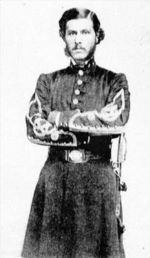
Frank Armstrong is one of the unusual few soldiers who had the distinction of leading both Union and Confederate troops into battle during the war.

Francis Crawford Armstrong was born on November 22, 1835, at the Choctaw Agency near Scullyville, Indian Territory. His father, Frank W. Armstrong, was an Army officer serving at the agency until his death during Frank’s childhood. His mother remarried soon after, to General Persifor Smith, a Mexican War veteran. He was educated at Holy Cross Academy in Worcester, Massachusetts, enrolling in his studies on January 19, 1845.

Frank accompanied his stepfather on a military tour of Texas in 1854. During an encounter with hostile Indians in New Mexico Territory near El Paso, Frank so distinguished himself that he was awarded a direct commission into the Army upon his graduation from Holy Cross the following year.

Frank Armstrong was appointed a second lieutenant in the 2nd U.S. Dragoons from Texas on June 7, 1855. He was initially assigned to Fort Riley, Kansas, where he served until June, 1857. He later served at Fort Leavenworth and on the Utah expedition until August 1858. Armstrong was promoted to first lieutenant, 2nd Dragoons on March 9, 1859. After a brief leave of absence, he was assigned to Fort Kearny as the aide-de-camp to General Harney until May 1861. Armstrong was promoted to captain, 2nd Dragoons, a month later on June 6th.

Captain Armstrong commanded Company K, 2nd U.S. Dragoons during the first Battle of Bull Run, and was attached to Colonel Hunter’s division. Disillusioned following the battle, he resigned on August 13, 1861 and enlisted in the Confederate Army.

Armstrong served initially as an assistant adjutant general on the staff of General Ben McCulloch until he was killed at the Battle of Pea Ridge. Promoted shortly thereafter to Major, he then served briefly on the staff of General James McIntosh. Armstrong was elected Colonel of the 3rd Louisiana Infantry, but served very briefly with them before he was given command of General Sterling Price’s cavalry.

He effectively covered Confederate retreats following defeats at Iuka and Corinth at the end of 1862, and was promoted to brigadier general in the Confederate Army on January 30, 1863.

He served through the majority of 1863 under General Nathan B. Forrest, effectively leading his brigade. He commanded a dismounted cavalry division under Forrest with distinction at the battle of Chickamauga. “The charges made by Armstrong’s brigades while fighting on foot would be creditable to the best drilled infantry,” said Forrest in his report on the battle.

In February 1864, Armstrong requested a transfer to the command of Stephen D. Lee, and was assigned command of a brigade of Mississippi cavalry. This brigade consisted of the 1st, 2nd, 28th and Ballentyne’s Mississippi cavalry regiments, and served under Armstong’s command until the end of the war.

Armstrong’s brigade was very active during the Atlanta campaign, then afterwards during Hood’s Tennessee campaign. He led much of Forrest’s rear guard during the army’s long retreat from its disastrous defeat at Nashville.

His last battle of the war was at Selma, Alabama on April 2, 1865. His hopelessly outnumbered command was overwhelmed by Union cavalry under General James H. Wilson. Armstrong escaped after the battle and later surrendered in Macon, Georgia.

After the war, Armstrong worked with the Overland Mail Service in Texas. He was later a U.S. Indian Inspector from 1885 to 1889, and served as an Assistant Commissioner of Indian Affairs from 1893 to 1895.

Frank Armstrong died at his daughter’s summer home in Bar Harbor, Maine after a long illness on September 8, 1909. He is buried in Rock Creek Cemetery, Washington, D.C.

Sources:

Evans, Clement, ed. Confederate Military History, Volume VIII, (Atlanta: Confederate Publishing Company, 1899)

Evans, David. Sherman’s Horsemen. (Bloomington: Indiana University Press, 1999)

Foreman, Carolyn Thomas. “The Armstrongs of Indian Territory” in Chronicles of Oklahoma, Volume 31 (http://digital.library.okstate.edu/Chronicles/v031/v031p056.pdf)

Heitman, Francis B. Historical Register and Dictionary of the United States Army (Washington: Government Printing Office, 1903), page 292.

Rodenbough, Theophilus F. From Everglade to Canyon with the Second United States Cavalry (New York: D. Van Nostrand, 1875)

Warner, Ezra. Generals in Gray. (Baton Rouge: Louisiana State University Press, 1959), pages 12-13.

What Do You Want To See More Of?

As I review my entries for the year, assess the State of the Blog, and make plans for where it’s going in 2008, I thought I’d solicit the opinions of my readers on what you would like to see more of here in the future.

All opinions are equally valid, so request away. Ironically enough, one of the things I discovered while reviewing entries is that posts soliciting questions have a pretty poor return rate. However, several bloggers are already taking their “holiday break”, so maybe there’s a chance.

The Fiddler’s Green series seem to be the most popular entries so far, and Brian Downey was even kind enough to make mention of them in his year end entry over on Behind Antietam on the Web. I have some roads to war and lost companies posts to finish up as well as a few other projects (Harry, I’m getting there with the cavalry at 1st Bull Run project, honest), and I’ve noticed that other than biographical entries I’ve left the 6th US Cavalry alone so far. But again, I’m looking for what YOU would like to see.

Recommendations for how to improve the site wouldn’t hurt my feelings either….

Bates letters – August 10, 1862

Note: In which we learn that the Union Army, or at least those parts of it near McClellan’s headquarters, ate quite well during the Peninsula campaign. Seidlity powders and a grand effervescence are also mentioned.

Harrisons Landing Va
August 10th 1862
Dear Home Circle,

I will try to write you a letter, or at any rate a few lines, enough to let you know that I am not well, but still I am worth a dozen dead men yet. I was taken pretty severely with Diarreah but am over it now and in a few days shall “resume my sword” if providence permits. One good effect of my illness has been a change of quarters, for my tent is now right over the water at high tide making it a great deal cooler. For bathing , too, it is much handier, but in this I can’t think, for it is impossible for me to keep my feet and my hands off the bottom at the same time, but it is all for the best perhaps if I could swim. I should get the cramps some-time in deep water. My paddling is played out, as Johnson guessed it would be even if I had not been sick for we have to be ready to start at any time. Part of the troops did start three days ago and took “Malvern Hill” with some loss. I cant get the particulars but you will in the papers. I also hear what you will probably not hear; that Genl McClellan is not pleased with the conduct of his Generals in the affair, and that of Genl Heintzelman especial, but this is only camp talk it may be so and it may not.

I accumulated $270 from my “Spec” and have taken a Treasury check for it. Perhaps I shall have a chance to make some more before long. If I do, I’m in.

I wonder the Horses don’t go crazy with the biting of the flies, for they are terrible think, and as the Irishman said of the Hornet, “their feet are hot as the Devil’s fingers.” They are not the quiet little brown fellows you have at home, but great blue-headed, blood-sucking, back-biting (and for that matter they are not particular about where they bite) sleep-disturbing torments, and like the evil spirits in the swine (or was it in a man) their name is legion.

I received Johnsons last with the postage stamps all right two days since, and am very thankful for them, he gives a sad picture of the morals of Oakville as exemplified in a “wordy war, and a challenge to combat,” among the Abolitionists. If I was down among you now I shouldn’t think myself safe without an edition of Colts “peace maker” in my pocket.

There has been considerable moving among the gun-boats here lately. I don’t know but some-thing is going to be done shortly, at present however “everything is quiet along the lines.”

I shall have to stop for supper I willl just give you my bil of fare for supper, we don’t eat dinner these hot days. 1st then comes tea, then some condensed milk for the tea, soft bread, butter, currant jelly, green peas, ham, preserved fruits of all kinds, cheese, lemons, tamarinds, oysters, lima beans, tomato catsup, and several other things that I can’t see from here and am too lazy to move, to look after, and to settle my stomache after this “small brunch” I have 3 boxes of seidlity powders; you need not think I am going to eat all this, but some of my old stock of goods is on hand yet, and I am going to have some of the luxuries.

The seidlity powders are a clear loss to me, I had four dozen of the boxes and in spite of all the logic I could use to persuade the soldiers they are unhealthy, and needed them to regulate their system they would not be convinced, well let them live in their perversity, or die from want of the “Asserism effervescing draught, invaluable in hot climates,” (so reads the lable) for I have determined to make a grand effervescence in the James river with these same powders.

I expect the next word I hear from home some of you will be drafted, well so be it. The Army is not a prison house or a grave for every-one although many a poor fellow finds it so. If any of my old chums come out here I want them to come right to Genl McClellan’s headquarters and enquire for the Fourth Cavalry, and then in the Fourth for me.

Give my love to all.
I remain your affectionate son
Charles E. Bates