• About

Regular Cavalry in the Civil War

Regular Cavalry in the Civil War

Category Archives: Uncategorized

Bates Letters – January 26, 2863

18 Friday Jan 2008

Posted by dccaughey in Uncategorized

≈ 4 Comments

Note: In which we learn about desertions and methods of crossing the Potomac for deserters in the wintertime. I checked for William Gallemoreon on CWSS, but couldn’t find any information on him.

Port Tobacco, Md.
Jany 26th 1863
Dear Parents,

I have been so busy since I wrote last Wednesday that writing was out of the question, but if my time has been occupied by duty and mud is in abundance. I have had fun enough to make me amends for everything. Our duty is to scout the country between Great Mills and Piscataway Creek to catch deserters from the other side of the Potomac and stop Smugling (sic). The Smuglers have so perfect an organization that as yet we have only caught one, but judging from the deserters we catch I should say the Army of the Potomac was rather demoralized. We have got two hundred and nine deserters since we came over last Wednesday. They come over every night, some on logs, some on rafts and a few lucky ones have managed to appropriate some of Uncle Sam’s boats and get over in them. There is a suspicion that some of the ferry-boats in Government employ bring loads of them over but as yet we have no proof. And “still they come.” One of our men “surrounded” seven of them in one party last night and marched them into camp. Pretty well done for one man want (sic) it. I think of recommending him for a commission. We are having good weather now but it did rain awful last week and the roads are in good condition for a bootjack.

I forgot to mention in my last that William Gattemore is in the 2nd Cavalry band at General Burnsides, a leter directed to him at “Headquarters Army of the Potomac Washington DC” would reach him.

Given in my last will most likely will be delayed for a short time on account of the mud but it will be true in the course of time. As for our part in the capacity of Body-guard, we can say with Othello, “Our occupation is gone.” The company must have done something wrong while I was away or perhaps Burnside thinks so much of us , he is unwilling to take us into danger; well we are quite willing to be left behind.

We only get a mail every other day and all the army news we get from deserters, so you will have to trust to the papers for news. And here let me recommend the New York Herald for your news budget.

You will please to remember me to all friends. Give my love to all the family and I take my leave for a few days, as

Your Affectionate Son,
Charles E. Bates

P.S. There is no use in writing for a few days I don’t know where I may be when you get this, as soon as we get settled I shall let you know.
Affectionately,
Charles

Andrew Olmsted update

07 Monday Jan 2008

Posted by dccaughey in Uncategorized

≈ 2 Comments

I’m still receiving hundreds of hits from people seeking more information about Andrew Olmsted’s death. More information on exactly what happened was released this morning, and can be found here.

Thank you to those who have expressed their condolences, both publicly and privately.

Regular posting will resume here on Thursday.

A Devastating Loss

05 Saturday Jan 2008

Posted by dccaughey in Uncategorized

≈ 9 Comments

The world is a little darker place today, as one of the best people that I have ever known is no longer in it.

Major Andrew Olmsted was killed by small arms fire in an ambush while leading his Mobile Training Team in Diyala province, Iraq on Thursday. He was one of my best friends.

In accordance with his last wishes and my own inclinations, there will be no political commentary here. It would be inappropriate. I simply want to take a few minutes and utilize my forum to remember my friend.

I wish I could post something worthy of the man and his life, but I lack his eloquence. As he would smile and point out, however, it is what it is.

Andy was quite simply one of the best people that I’ve ever met. We met just before OIF started, commanding companies in the same battalion at Fort Carson. He was one of those people that no one disliked — pleasant, funny, self-effacing. He was a great leader because when at work two things were uppermost in his mind at all times, determination to do his job well and to take care of his folks while he was doing it. Even to the point of growing a mustache that he absolutely detested because he read that Iraqi men were suspicious of men without facial hair and thought it might interfere with his ability to help them. Such was Andy the soldier.

But Andy the human being was so much more. He was a writer. He wanted to be a professional writer, and he was well on his way. He was one of the most prolific and dedicated blog writers that I’ve known. He had to stop his personal blog in February when he went back on active duty. He posted under a pseudonym for a couple of months, as not blogging was bugging him. Since last May, he’d been writing a blog with the Army’s permission on his experiences in Iraq for the Rocky Mountain News (the blog link is here). He was quite good at it, and getting noticeably better over time.

It is ironic that Andy was killed on the day of the Iowa Caucuses, because he loved politics. Not in any kind of rabid or obnoxious way, but through well-reasoned discussion. His countless blog posts illustrate this far better than I could. While I didn’t always agree with him, I could never deny the logic of his thought process. I was really looking forward to hearing his insights on the races as they progressed.

Andy and his wife loved Disney World, and visited at least once every year. This was the dedicated Red Sox fan since childhood who finally got to see his team win the World Series. I’d say twice, but he was too busy to be able to catch all of the games this year. He was absolutely dedicated to his wife, and it was obvious to any observer that they were extremely close and very much in love.

As I thought back on it last night after I heard the news, I kept thinking how often Andy was around or had input on significant happenings in my life the last few years. Andy was the guy who helped me craft the strategy for the marriage proposal to my wife during our many drives from El Paso to Colorado Springs. The same drives that sparked what we jokingly referred to as “The Don and Andy Show.” He had a wonderful, droll sense of humor, and we’d spend hours poking fun at each other. And Andy, should you somehow be able to see this, Gina finally admitted last night that we WERE funny…sometimes.

When we discovered in the middle of a deployment to Louisiana that I’d been promoted three days before, Andy was the guy who happily renewed my oath and pinned on my oak leaf. He and Amanda flew back east because he’d never been to Gettysburg, and we spent two days touring the battlefield. He and his wife attended our wedding, and they came to our welcome home party that unexpectedly became a party celebrating the birth of our son just before he deployed. It was the last time that I saw him.

He was always there, always positive, always supportive. He would gently point out errors in logic or provide advice, always available yet never pushy. He was, quite simply, an excellent friend.

As one who knew him might expect, Andy of course managed to have the calm, well-reasoned and eloquent last word. The link to his final blog post, left with a friend before he deployed, is linked here. I confess to not being in the most objective state of mind at the moment, but I was touched by its eloquence.

His words concerning his won death speak for themselves: “On a similar note, while you’re free to think whatever you like about my life and death, if you think I wasted my life, I’ll tell you you’re wrong. We’re all going to die of something. I died doing a job I loved. When your time comes, I hope you are as fortunate as I was.”

Fare thee well, my friend. You will be sorely missed.

2008: A Way Ahead

01 Tuesday Jan 2008

Posted by dccaughey in Uncategorized

≈ 6 Comments

No, sorry, no deep, emotional reflections on the year past. I just wanted to take a few minutes after having a week or so to review ‘the state of the blog,’ and look at where I’d like to see it go in 2008.

2007 was very enlightening, as I started on this new project with very little preparation. I think it’s been reasonably successful thus far, though there’s definitely room for improvement. Thanks to Eric Wittenberg, J.D. Petruzzi, Brian Downey, Drew Wagenhoffer and a host of others who have provided tips, comments and other support, both publicly and privately. Special thanks to those family members who have been gracious enough to send information on your ancestors. It was greatly appreciated, and hopefully I did them and you justice with my posts.

I ended the year with 176 posts and 7,543 visits. I must conclude I did something right, because at least a few of you keep coming back. 8^) I would like to get the visits up from 25-30 per day, and the best way that I can think of is to improve the content.

I decided over the holidays that I’d like to be a little more deliberate in my approach to the blog in 2008, for my own piece of mind with a very busy schedule and also in hopes of gaining and retaining readers. So in addition to the topics that just seem to pop up, there will be some planned offerings as well.

The Fiddler’s Green series will continue. They have been the most popular posts on this blog by far, and they’re a lot of fun to research and write. I may implement the “three day rule,” however, since almost without exception new material pops up within that period no matter how diligent my research has been. I’ll finish the officers of the 6th Cavalry this year, as well as some others at random. I haven’t yet decided which regiment will be next, most likely the 2nd or the 4th.

The Charles E. Bates series of letters will continue. There are ten letters for 1863 and a few others for 1864, so that project will definitely finish this year.

A new series will begin this month following one of the regular cavalry regiments through each month of a year of the war, primarily via theirregimental muster rolls. 2008 will feature the 6th U.S. Cavalry in 1862. I’ll introduce the regiment in a few days, and then begin following their activities in January 1862. I’m also doing this as a forcing function to make myself thoroughly review the binders of material that have somehow accumulated over the last year or so.

I plan to do more exploring of the western theater of the war this year, particularly with the 4th Cavalry, but also with the 3rd. I lacked the references to do so effective;y last year, but my library has made some serious strides in that direction over the last few months.

I also hope to investigate the summer of 1864 and how it affected the Regular Brigade. This was a critical time for the regiments, and saw their strength numbers plummet due to expiring enlistments. This seriously limited their contributions through the remainder of the war.

The Harpers Ferry and First Bull Run projects continue, and will hopefully also wrap up soon.

Hopefully this year will bring more interesting and more engaging posts. Together we’ll find out. Thank you as always for stopping by, and I’ll see you on the high ground.

Happy New Year

01 Tuesday Jan 2008

Posted by dccaughey in Uncategorized

≈ Leave a comment

From my family to all of my readers and theirs, we send best wishes for a healthy, happy and prosperous 2008. 2007 was a really good year, and we look forward to many improvements this year.

Initial Cavalry Training

27 Thursday Dec 2007

Posted by dccaughey in Uncategorized

≈ Leave a comment

Well, he’s admittedly not quite ready for saber, pistol or carbine yet, but Connor sure seems to like the horse….

Merry Christmas!

25 Tuesday Dec 2007

Posted by dccaughey in Uncategorized

≈ Leave a comment

I’d like to wish all of my readers a very Merry Christmas from my family to yours. Hopefully you’ll enjoy the day with family as I plan to. Best wishes to all of you for a happy 2008 as well.

What Do You Want To See More Of?

23 Sunday Dec 2007

Posted by dccaughey in Uncategorized

≈ 5 Comments

As I review my entries for the year, assess the State of the Blog, and make plans for where it’s going in 2008, I thought I’d solicit the opinions of my readers on what you would like to see more of here in the future.

All opinions are equally valid, so request away. Ironically enough, one of the things I discovered while reviewing entries is that posts soliciting questions have a pretty poor return rate. However, several bloggers are already taking their “holiday break”, so maybe there’s a chance.

The Fiddler’s Green series seem to be the most popular entries so far, and Brian Downey was even kind enough to make mention of them in his year end entry over on Behind Antietam on the Web. I have some roads to war and lost companies posts to finish up as well as a few other projects (Harry, I’m getting there with the cavalry at 1st Bull Run project, honest), and I’ve noticed that other than biographical entries I’ve left the 6th US Cavalry alone so far. But again, I’m looking for what YOU would like to see.

Recommendations for how to improve the site wouldn’t hurt my feelings either….

Bates letters – August 10, 1862

22 Saturday Dec 2007

Posted by dccaughey in Uncategorized

≈ Leave a comment

Note: In which we learn that the Union Army, or at least those parts of it near McClellan’s headquarters, ate quite well during the Peninsula campaign. Seidlity powders and a grand effervescence are also mentioned.

Harrisons Landing Va
August 10th 1862
Dear Home Circle,

I will try to write you a letter, or at any rate a few lines, enough to let you know that I am not well, but still I am worth a dozen dead men yet. I was taken pretty severely with Diarreah but am over it now and in a few days shall “resume my sword” if providence permits. One good effect of my illness has been a change of quarters, for my tent is now right over the water at high tide making it a great deal cooler. For bathing , too, it is much handier, but in this I can’t think, for it is impossible for me to keep my feet and my hands off the bottom at the same time, but it is all for the best perhaps if I could swim. I should get the cramps some-time in deep water. My paddling is played out, as Johnson guessed it would be even if I had not been sick for we have to be ready to start at any time. Part of the troops did start three days ago and took “Malvern Hill” with some loss. I cant get the particulars but you will in the papers. I also hear what you will probably not hear; that Genl McClellan is not pleased with the conduct of his Generals in the affair, and that of Genl Heintzelman especial, but this is only camp talk it may be so and it may not.

I accumulated $270 from my “Spec” and have taken a Treasury check for it. Perhaps I shall have a chance to make some more before long. If I do, I’m in.

I wonder the Horses don’t go crazy with the biting of the flies, for they are terrible think, and as the Irishman said of the Hornet, “their feet are hot as the Devil’s fingers.” They are not the quiet little brown fellows you have at home, but great blue-headed, blood-sucking, back-biting (and for that matter they are not particular about where they bite) sleep-disturbing torments, and like the evil spirits in the swine (or was it in a man) their name is legion.

I received Johnsons last with the postage stamps all right two days since, and am very thankful for them, he gives a sad picture of the morals of Oakville as exemplified in a “wordy war, and a challenge to combat,” among the Abolitionists. If I was down among you now I shouldn’t think myself safe without an edition of Colts “peace maker” in my pocket.

There has been considerable moving among the gun-boats here lately. I don’t know but some-thing is going to be done shortly, at present however “everything is quiet along the lines.”

I shall have to stop for supper I willl just give you my bil of fare for supper, we don’t eat dinner these hot days. 1st then comes tea, then some condensed milk for the tea, soft bread, butter, currant jelly, green peas, ham, preserved fruits of all kinds, cheese, lemons, tamarinds, oysters, lima beans, tomato catsup, and several other things that I can’t see from here and am too lazy to move, to look after, and to settle my stomache after this “small brunch” I have 3 boxes of seidlity powders; you need not think I am going to eat all this, but some of my old stock of goods is on hand yet, and I am going to have some of the luxuries.

The seidlity powders are a clear loss to me, I had four dozen of the boxes and in spite of all the logic I could use to persuade the soldiers they are unhealthy, and needed them to regulate their system they would not be convinced, well let them live in their perversity, or die from want of the “Asserism effervescing draught, invaluable in hot climates,” (so reads the lable) for I have determined to make a grand effervescence in the James river with these same powders.

I expect the next word I hear from home some of you will be drafted, well so be it. The Army is not a prison house or a grave for every-one although many a poor fellow finds it so. If any of my old chums come out here I want them to come right to Genl McClellan’s headquarters and enquire for the Fourth Cavalry, and then in the Fourth for me.

Give my love to all.
I remain your affectionate son
Charles E. Bates

Fiddler’s Green: Adna R. Chaffee

19 Wednesday Dec 2007

Posted by dccaughey in Uncategorized

≈ 6 Comments


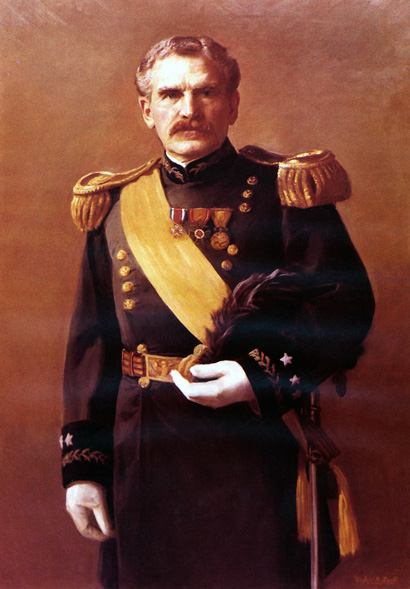
Adna Chaffee’s story is a very interesting one. Despite the fact that he was the first soldier to rise from the rank of private to the position of Chief of Staff of the Army, and the first Army Chief of Staff who had not graduated from West Point, his accomplishments are much less well known than those of his son, the “Father of the Armor Branch.” This Fiddler’s Green entry will attempt to even the score a bit. The picture of Chaffee is from a 1973 oil on canvas painting by Cedric Baldwin Egeli.

Adna Romanza Chaffee was born on April 14, 1842 in Orwell, Ohio, where there is a historical marker documenting his accomplishments. One of twelve children, he was educated at a nearby country school. He determined to join the Union Army at the outbreak of the Civil War. While on his way to join a volunteer regiment at the outbreak of the Civil War, he encountered a recruiting party for the 6th U.S. Cavalry and enlisted as a private on July 22, 1861. He was promoted to sergeant in October and served in the Peninsular and Antietam Campaigns in 1862. In September 1862, he was promoted to first sergeant of Company K, 6th US Cavalry. Chaffee was promoted to 2nd lieutenant in the 6th Cavalry by direction of the secretary of war on March 13, 1863, but due to administrative delays he wasn’t discharged to receive the appointment until May 12th.

Chaffee was seriously wounded by a gunshot wound to the thigh at the battle of Fairfield during the Gettysburg campaign. He led a dismounted squadron on the left flank of the regiment which was overrun during the battle. Initially captured by the Confederates, he refused parole as a prisoner and they abandoned him when he could not be transported due to his wounds. He was treated by regimental assistant surgeon William Forwood, and returned to duty in early September. Chaffee received a brevet promotion to first lieutenant on July 3, 1863 for gallant and meritorious service during the battle.

On October 11, 1863, the 6th U.S. Cavalry was caught in an exposed position near Brandy Station and engaged by superior numbers of Confederate cavalry. They were able to fight their way back across the Rappahannock, but Lieutenant Chaffee was again wounded while commanding his company.

Lieutenant Chaffee served as the regimental adjutant for the 6th Cavalry from November 11, 1864 to December 12, 1866. He was promoted to first lieutenant, 6th U.S. Cavalry in February 1865. He was brevetted captain for gallant and meritorious service at the battle of Dinwiddie Court House, Virginia on March 31, 1865.

Chaffee remained in the Army after the war, and was posted with his regiment initially to Austin, Texas. He briefly resigned his commission while his commanding officer was on leave, but was persuaded to remain in the army upon his superior’s return after only a week as a civilian. Chaffee served as the regimental quartermaster from December 12, 1866 to October 12, 1867, when he was promoted to captain, 6th Cavalry. He fought in the Indian wars against various central plains and southwestern tribes from 1867 to 1894.

In February 1868, Chaffee and I Troop were assigned to Fort Griffin, Texas. On March 7h he was brevetted major for “gallant and effective service in an engagement with Comanche Indians at Paint Creek, Texas.” Later that year, he married Kate Haynie Reynolds on September 19th in Austin, Texas. They had two sons who both died in their infancy before she died the following year. Chaffee served the next three years in Texas pursuing hostile Indians and outlaws.

He spent the next three years on assignments in Kansas, Mississippi and the Indian Territory until the Red River War broke out in 1874. Chaffee and his Troop I were attached to Colonel Nelson A. Miles’ column in actions against the Cheyenne Indians. On August 30, 1874, he was cited for bravery for leading his troops in a charge against a superior number of Cheyenne warriors at Palo Duro Canyon, Texas.

On March 31, 1875 he married his second wife, Annie Frances Rockwell, in Junction City, Kansas. They had a son and three daughters, one of whom also died in infancy.

In the early 1880s, Chaffee moved to Arizona and New Mexico, where he had several engagements with the Apache Indians. He and Troop I bested the Apaches at the battle of Big Dry Wash, Arizona in July 1882, and accompanied General George Crook during his pursuit of the Apaches into Mexico on the Sierra Madre campaign of 1883. Finally, Chaffee co-commanded the 1886 expedition that led to the capture of Apache leader Geronimo.

On July 7, 1888, Chaffee was promoted to major in the 9th Cavalry, and spent the next two years constructing Fort Duchesne in southern Utah. He was brevetted lieutenant colonel on February 27, 1890 “for gallant service in leading a cavalry charge over rough and precipitous bluffs held by Indians on the Red River, Texas on August 30, 1874 and gallant service in action against Indians at the Big Dry Wash, Arizona on July 17, 1882. Chaffee served as the acting inspector general for the Department of Arizona from 1890 to 1893 and for the Department of Colorado until the fall of 1894. In 1895 he conducted the restoration of the Bannock Indians to the Fort Hall reservation in Idaho. He served as an instructor of tactics at the Army’s Infantry and Cavalry School at Fort Leavenworth from November 1896 to June 1897.

In June 1897, he was promoted to lieutenant colonel of the 3rd Cavalry, and served as commandant of the Cavalry School at Fort Riley, Kansas until 1898. He was promoted to Colonel of the 8th US Cavalry in early 1899.

At the outbreak of the War with Spain, he was appointed a brigadier general of volunteers on May 4, 1898 and assigned command of the 3rd Brigade of the 2nd Division of volunteers. His brigade was active in the Santiago campaign and effectively ended the campaign with the capture of El Caney in July, 1898. As a result of his performance during the campaign, Chaffee was promoted to major general of volunteers that same month. At the cessation of hostilities, he served as the chief of staff to the military governor of Cuba, General Leonard Wood, from 1898-1900. Chaffee was honorably discharged from volunteer service and promoted to brigadier general of the regular army on April 13, 1899.

When the Boxer Rebellion broke out in China in June 1900, General Chaffee commanded the 2,500 man U.S. China Relief Expedition sent to rescue Western citizens and put down the rebellion. His second in command was Major General James H. Wilson, another Civil war veteran who had won his first stars when Chaffee was a second lieutenant. The expedition consisted of six troops of the 6th Cavalry, a battalion of Marines, Riley’s Battery of six rifled guns, and the 9th and 14th Infantry regiments. His force played a key role in the rapid advance to the imperial capital of Beijing and its capture on August 14, 1900, relieving the siege of the embassy staffs and other Western nationals. Chaffee’s force was also very active in establishing order and halting looting in the city following its capture. The success of his mission made him somewhat of a celebrity among the Chinese as well as his troops and fellow commanders.

Chaffee was promoted to major general in the regular army on February 4, 1901. From July 4, 1901 until October 1902, he served as the military governor of the Philippines, succeeding General Arthur MacArthur. This period included the beginning of the second phase of the Philippine-American War, and his actions have been criticized in some circles as being less than enlightened. He conducted an Indian-style campaign instead of the “humanitarian warfare” approach used by MacArthur. Chaffee subsequently served as the commander of the Department of the East from October 1902 to October 1903. Following this assignment he helped organize the General Staff Corps of the army.

Chaffee was promoted lieutenant general in January 1904, and served as the Army Chief of Staff from January 9, 1904 to January 14, 1906. During his tenure, he oversaw a far-reaching transformation of doctrine, planning and organization in the Army. He served as grand marshal for President Theodore Roosevelt’s inaugural parade on March 4, 1905, which also included former adversaries such as Geronimo and Quanah Parker. He also went on a good-will tour of Europe on behalf of President Roosevelt. Chaffee also was awarded the honorary civil law degree of LL.D. from Tufts College in 1905.

Among his other accomplishments as Army Chief of Staff was the creation of campaign medals for the army. The move towards government-issued medals for campaign service actually started in China during the Boxer Rebellion. General Chaffee came into contact with military personnel from other countries who were also involved in the campaign, and was particularly impressed with the campaign medals worn by the British. In 1904, Chaffee wanted to explore the possibility of obtaining similar medals for American soldiers. A proposal was made through the acting Secretary of War to the president to authorize the use of badges to denote the wearer as a veteran of a specific campaign, and that these badges be prescribed and worn as part of the uniform. The important point was that the “badges” were to be designated as part of the uniform, not personal awards for individual veterans. The proposal was approved, and the first Army campaign medals (Spanish-American War; Philippine Insurrection; and the China Relief Expedition) were officially established on January 12, 1905. They were followed by campaign medals for the Civil War and Indian Campaigns on January 21, 1907.

General Chaffee was retired at his own request on February 1, 1906, after a 45 year career. His son, Adna R. Chaffee, Jr., graduated from West Point that same summer. After his retirement, Chaffee moved to Los Angeles, where he was appointed President of the Board of Public Works for the city. He was also named a member of the Board of Visitors of West Point, and served as the first president of the Southwest Museum. Additionally, he was an original member of the District of Columbia Commandery of the Military Order of the Loyal Legion of the United States. He died of typhoid pneumonia in Los Angeles, California on November 1, 1914, and is buried with his second wife at Arlington National Cemetery.

Sources:

Carter, William G. From Yorktown to Santiago with the Sixth U.S. Cavalry (Austin, TX: State House Press, 1989)

Carter, William G. Life of Lieutenant General Chaffee (Chicago: University of Chicago Press, 1917).

Heitman, Francis B. Historical Register and Dictionary of the United States Army (Washington: Government Printing Office, 1903), page 292.

Henry, Guy V. Military Record of Civilian Appointments in the United States Army, Volume I (New York: D. Van Nostrand, 1873), pgs 142-143.

Military Order of the Loyal Legion of the United States (http://suvcw.org/mollus/)

Muster Rolls, 6th U.S. Cavalry Regiment, NARA.

Webster’s American Military Biographies (Springfield, MA: Merriam, 1978)

Who Was Who in America, Volume I: 1897-1942, page 206.

← Older posts
Newer posts →

Recent Posts

  • 5th U.S. Cavalry at the Stone Fence
  • Thomas Montgomery, 1st U.S. Cavalry
  • Thomas Corbett, 2nd US Cavalry
  • Charles W. Canfield, 2nd U.S. Cavalry
  • Michael Shaughnessy – 2nd U.S. Cavalry

Meta

  • Create account
  • Log in
  • Entries feed
  • Comments feed
  • WordPress.com

Blogs I Follow

  • Maine at War
  • Emerging Civil War
  • History Radar
  • A Meaningful Finale
  • The Task at Hand
  • Bull Runnings
  • Army at Wounded Knee
  • Crossroads
  • Campaigns of the U. S. Civil War
  • Irish in the American Civil War
  • To the Sound of the Guns
  • Daydreams of the Soul

Enter your email address to follow this blog and receive notifications of new posts by email.

Join 195 other subscribers

Regular Cavalry in the Civil War

Regular Cavalry in the Civil War

Buy a copy of my book!

From McFarland & Company or contact me directly.

Enter your email address to follow this blog and receive notifications of new posts by email.

Join 195 other subscribers

Don

dccaughey@aol.com
1-719-310-2427

Blog at WordPress.com.

Maine at War

Maine at War explores the Civil War as experienced by the men and women from Maine who lived during the tumultuous period.

Emerging Civil War

Providing fresh perspectives on America's defining event

History Radar

A Meaningful Finale

A 28-year Army veteran takes to the Appalachian Trail to contemplate a life well served & the road ahead

The Task at Hand

Powered by Human Intelligence

Bull Runnings

A Journal of the Digitization of a Civil War Battle

Army at Wounded Knee

A blog dedicated to documenting through primary sources, the Army's actions at Wounded Knee

Crossroads

Where history, scholarship, the academic life, and other stuff meet.

Campaigns of the U. S. Civil War

Campaigns of the U. S. Civil War

Irish in the American Civil War

Exploring Irish Emigration in the 19th Century United States

To the Sound of the Guns

Military History

Daydreams of the Soul

  • Subscribe Subscribed
    • Regular Cavalry in the Civil War
    • Join 65 other subscribers
    • Already have a WordPress.com account? Log in now.
    • Regular Cavalry in the Civil War
    • Subscribe Subscribed
    • Sign up
    • Log in
    • Report this content
    • View site in Reader
    • Manage subscriptions
    • Collapse this bar