• About

Regular Cavalry in the Civil War

Regular Cavalry in the Civil War

Category Archives: Uncategorized

Samuel M. Whitside letter, Part 1

06 Tuesday Aug 2013

Posted by dccaughey in Uncategorized

≈ 3 Comments

Samuel Whitside, courtesy of the David Perrine collection.

Samuel Whitside, courtesy of the David Perrine collection.

In a recent trip to the National Archives, friend Samuel Russell came across this letter from his ancestor, Samuel M. Whitside, and was kind enough to pass it along with his permission to post it.  While it doesn’t necessarily shed any new light on Whitside’s career beyond what we included in our book on the 6th U.S. Cavalry, I think it’s very interesting as a junior officer’s firsthand account of the war.

In February 1865, 1st Lt. Samuel M. Whitside was ordered to appear before a medical retiring board to determine if he was fit for duty with his regiment.  In the file, Whitside provides a six page letter to the board detailing his service in the Army from November 1858 up to the date of the board.  I have left all punctuation as I received it, but added clarification in parentheses.  Part 1 covers from his enlistment through the end of 1862, and Part 2 will cover the remainder of the war.

Wilmington, Delaware

January 31st, 1865

Major General W. B. Franklin President of the Retiring Board Wilmington, Del.

General:

I have the honor to submit the following as a report of my Military History since entering the service of the United States.

I enlisted in New York City November 28th, 1858, as a recruit for the General Mounted Service.  I was sent to Carlisle Barracks, Pa., with a detachment of recruits about Dec. 1st, where I was immediately assigned to a company, and instructed in the drill of the Cavalry branch of the service.  After being drilled about three months, I was transferred to the Permanent Company, and appointed a corporal in the company, and in the Spring of 1859, I was selected by Capt. A. Gibbs of the Mtd. Rifles, to instruct new recruits in the Manual of Arms and in the Mounted Drill. About August of the same year, I was relieved from duty at Carlisle and ordered to report to 1st Lieutenant W. T. Magruder, 1st Dragoons and Recruiting Officer, at Baltimore, Md. I remained on the Recruiting Service in Baltimore until about August 1860, when I was relieved by directions of the Dept. of the Mounted Recruiting Service, and ordered to return to my company for duty at Carlisle, where I was again assigned to duty as instructor of new recruits and continued on this duty until November 1860 when I was ordered to report to 1st Lieutenant Geo. B. Anderson, Recruiting Officer, for duty as Clerk at Louisville, Ky. In May 1861 the recruiting party, under the command of Lieut. N. B. Sweitzer, Recruiting Officer, was ordered to open a recruiting office in Cincinnati, Ohio. In June I was appointed Recruiting Sergeant of the party by the Supt.

About the 15th July, by special orders from the War Dept. Adjutant General’s Office, I was transferred from the General Service to the 3rd Reg. Cavalry (now 6th Cavalry). I reported to Lieut. Colonel Wm. H. Emory Commanding the Regt. with Headquarters at Pittsburg, Penn., who immediately appointed me Sergeant Major of the Regiment. About Sept. 1st 1861, the regt. was ordered to Bladensburg, Md. At which place the men were mounted and drilled, about Oct 1st, Colonel Emory recommended very strongly to the Secretary of War for a commission as Lieutenant in the Regiment. About Oct 15, the regt. was ordered into Winter quarters at Camp East of the Capitol Washington, D.C. Nov. 4th 1861 I received an appointment from the Secty of War of Second Lieutenant in the U.S. Cavalry and on the following day I was appointed Adjutant of the Regt. which duty I performed for about two months, when I was at my own request relieved from the duty of Adjutant and assigned to Co. K. March 10th 1862 the regiment was ordered in Virginia and assigned to the regular Brigade under the command of General Cook. The regt. advanced into Virginia as far as Warrenton Junction, when it was ordered to return to Alexandria and embarked with the Army of the Potomac to the vicinity of Yorktown, where we remained in camp until the evacuation of the place by the Rebels about May 2d.

At this time the 6th Cav. Was ordered to the front and was put in the advance of our army, and closely followed the rebels in their retreat, and drove them pell-mell into the fortifications in front of Williamsburg. My regt. charged up to within one hundred yards of Fort Magruder, when the Rebels turned their guns on us, which caused us to retreat from the field with a loss of some fifteen men. After the battle of Williamsburg, the 6th Cav was again ordered to take the advance and move forward rapidly after the retreating Rebels. We had orders to keep close to the Rebels, but not to bring on a general engagement. About May 10th we came up to a large force of the Rebels at Slatersville and three companies of my Regt charged into two Regiments of Virginia Rebel Cavalry and drove them from the field. One lost about eighteen men in this charge, the Rebels about forty-five. For my services in this action General Stoneman mentioned me in his report and I was informed that he afterwards recommended me for a brevet. On the following day I was directed to take part of my company and to open communications with General Franklin at West Point, which I succeeded in doing, and in capturing 4 Rebel infantrymen of Whitings Division. On or about May 24th my Regt took part in the battle of Hanover Court House.  During the seven days fighting I was with General Stoneman, who was cut off from the Army, and retreated down the Peninsula by way of the White House. The command arrived at Fortress Monroe July 2d where we rested till about 8th when we embarked in transports and arrived at Harrisons Landing on the 9th and went in camp near the River or Westover House. July 15th I was confined to my tent by a severe attack of fever. I was on the sick report till about Aug 7th when my regt was ordered to report to Genl Hooker. Was in the second battle of Malvern Hill on the 10th. I was again taken down with the fever, and was sent to the Hospital near Hd Qrs Army of the Potomac. Aug 12 received a sick leave for twenty days.  Sept 3rd I again reported to my regt for duty. Sept 6th while on the march through Maryland I was taken very sick with the bilious fever and a severe pain in my left side.

I was sent from Poolsville, Md. By Asst Surg Duboise U.S.A. to Washington D. C. and reported to Surgeon Barns U.S.A. for medical treatment. About Sept 20 I was able to do light duty and by special orders from Hd Qrs Army of the Potomac I was assigned to duty at Headquarters Defences of Washington as A.A.D.C. to the General Commanding. About Nov 10th I was relieved from duty in Washington by special orders and directed to report to Major General N. P. Banks at New York City as Aide-de-Camp on his staff. Dec 4th 1862 we sailed from New York City in the steamer North Star, arrived in New Orleans, Dec 14th.
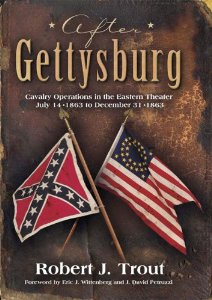
Book Review: After Gettysburg

28 Sunday Apr 2013

Posted by dccaughey in Uncategorized

≈ 1 Comment

Tags

After Gettysburg, book reviews, cavalry

ImageI received this book for Christmas, but just read it recently.  I wasn’t sure what to expect, as I haven’t read Mr. Trout’s studies of Stuart’s staff and horse artillery, but all have been highly recommended.  After reading this book, I have ordered them.

In After Gettysburg, Robert Trout provides the first comprehensive and detailed look at the activities of the Army of the Potomac and the Army of Northern Virginia between the end of the Gettysburg campaign and the winter halt to campaigning for 1863.  Most books treat these activities with a few sentences between brief paragraphs on the Bristoe Station and Mine Run campaigns.  This is the first book to my knowledge to look at the actions from a campaign perspective.

Mr. Trout’s narrative skillfully blends primary and secondary sources to produce an engrossing tale.  This had not previously been a period of great interest to me, but I had a difficult time putting the book down.  I was very impressed by his ability to provide very detailed information consistently without bogging down his narrative with minutiae.  For those desiring more depth on the action as it unfolded, he provides very comprehensive endnotes that provide additional information and context in additional to source notations.

I was thrilled to at last see detailed maps of areas south of the Rappahannock, but had trouble following them at times.  This was partly an issue of transitioning between maps, and is likely a personal issue.  Certainly the 25 maps provide excellent opportunity for the reader to visualize the activities in the text.

Content aside, this is an absolutely beautiful book.  The publisher, Eagle Editions, Limited, produced a gem.  From cover art to page weight to binding it is a work of art.

I strongly recommend this book to anyone interested in the less publicized periods of the war and cavalry enthusiasts.  Given the author’s placing of context for the campaign, I think it could be enjoyed by anyone from a Civil War novice to a veteran researcher.

150 Years Ago Today – April 28, 1863

28 Sunday Apr 2013

Posted by dccaughey in Uncategorized

≈ Leave a comment

Tags

Reserve Brigade, Stoneman's Raid

150 years ago today, the regiments of the Reserve Brigade left their camps near Warrenton and encamped near Bealeton Station.  The waters of the Rappahannock were dropping at last, and it appeared Stoneman’s Raid would finally begin the next day. 

Private John Saville, Co. K, 1st U.S. Cavalry

09 Tuesday Apr 2013

Posted by dccaughey in Uncategorized

≈ 2 Comments

Tags

1st U.S. Cavalry, 23rd Illinois Infantry

I had a request recently to see what I could find out about this gentleman, and thought I’d post it here in case anyone’s curious.  He was a much more difficult nut to crack than most queries I attempt. I certainly learned a few things, most of them unexpected.  It is very likely that John is featured in the banner photo for the blog, as this was his company in early 1864 near Brandy Station.

John Saville was born in County Limerick, Ireland about 1841.  He immigrated to the United States, and was living near Chicago when the Civil War broke out.  He enlisted as a private into Company G, 23rd Illinois Infantry regiment on June 15, 1861 at the age of 21. He served with this unit for the first year and a half of the war, in what appears to be a singular experience.

The 23dr Illinois was mustered in the same day John enlisted, June 15, 1861.  Upon completion of their training, they marched to garrison Lexington, Missouri in September.  After a brief siege, they surrendered the town to militia under Confederate General Sterling Price and were captured and paroled.  The regiment was mustered out by order of General Fremont on October 8, and ordered restored by General McClellan on December 10th.  For the first half of 1862, the regiment guarded prisoners at Camp Douglas outside of Chicago.  In June they moved to Harpers Ferry, where they served as part of the Railroad District, 8th Corps, Middle Department.  They served at various locations in the vicinity of Harpers Ferry for the duration of the year, marching to the relief of Parkersburg and Clarksburg in September.   

On December 24, 1862, he transferred from his volunteer regiment into the regular army at New Creek, Virginia.  He was sworn into Company K, 1st U.S. Cavalry by Lieutenant Judson Haycock.  His enlistment documents describe him as 5’ 11” tall, with blue eyes, black hair and a dark complexion.  He served the remainder of the war in the company without any major issues.  He was discharged at the expiration of his enlistment in New Orleans, Louisiana on December 24, 1865 as a private.

John returned home to Chicago, but must not have been too pleased with his homecoming.  On January 27, 1866, barely a month after he left the army, he re-enlisted.  He was sworn into company A, 18th U.S. Infantry, which later became Company A, 36th U.S. Infantry, by Lieutenant Kirkland.  This enlistment did not go well at all.  He deserted on July 3, 1867, only to be apprehended six days later.  Apparently things continued to go poorly, for he was dishonorably discharged as a private on January 27, 1869, per General Order 38, Department of the Platte at Camp Douglas, Utah.

John returned to Chicago, where he worked as a laborer.  He evidently suffered the effects of his military service.  He was admitted to the Northwestern Branch, National Home for Disabled Volunteer Soldiers in Milwaukee, Wisconsin in 1877 for disability due to rheumatism.  He was expelled a few months later on February 28, 1878 with the note, “refused to work.”   He filed a pension as a veteran invalid on May 3, 1879.  He was in and out of the Northwestern Branch and the Western Branch for the next several years, then disappeared from records after December 1889.  I could locate no marriage records, and he was listed as single in the National Home entries.

So ends our tale of John Saville, a common soldier.

The proofs are in the … index?

13 Wednesday Mar 2013

Posted by dccaughey in Uncategorized

≈ 3 Comments

Tags

6th U.S. Cavalry

I’m afraid you will have to excuse a brief hiatus from posting. Yesterday I received the proofs from McFarland for The 6th United States Cavalry in the Civil War, and am currently neck-deep (but still afloat) in proofreading and indexing. The break shouldn’t be very long, and I still hope to get my post on Marcus Reno at Kelly’s Ford up by Sunday evening. Things may just be a little slower for a week or two. As soon as I’ve finished the index, the link will be posted here for ordering info from McFarland or autographed copies from me directly.

Thank you for your indulgence. Now, where did I put that red pen….

6th U.S. Cavalry Regimental Staff

06 Wednesday Mar 2013

Posted by dccaughey in Uncategorized

≈ Leave a comment

Tags

6th U.S. Cavalry

As with the staffs of the other regiments, there are a few items of note with this one. Created at the beginning of the war, it still had as many issues with field grade officers as the older regiments. David Hunter never served a day with his regiment, though he did review them once as a general during the winter of 1861-1862. Emory trained the regiment and led it to war, but he was a general himself by the end of the Peninsula campaign. He was nominally followed by Sturgis, who never served in the same theater as the regiment during the war.

Neither of the two initial majors served with the regiment either. Williams served with the regiment on the Peninsula, only to be relieved for suspected treason, while Morris was with the 3rd U.S. Cavalry in New Mexico until late 1863. Despite the dates listed below, Starr served with the regiment for less than a month during the war, and led it to its worst defeat.

With the exception of Audenreid, who spent nearly the entire war as an aide de camp, every adjutant was a former enlisted man. Other than Hutchins, so were the quartermasters.

Colonels

David Hunter May 14, 1861 – July 31, 1866

Lieutenant Colonels

William H. Emory May 14, 1861 – October 27, 1863
Samuel D. Sturgis October 27, 1863 – May 6, 1869

Majors

E.H. Wright May 14, 1861 – April 25, 1863
James H. Carleton September 7, 1861 – July 31, 1866
Lawrence A. Williams September 7, 1861 – March 11, 1863
Robert M. Morris March 11, 1863 – February 21, 1873
Samuel H. Starr April 25, 1863 – December 15, 1870

Adjutants

John W. Spangler July 1, 1861 – October 1, 1861
Curwen B. McLellan October 1, 1861 – November 30, 1861
J.C. Audenreid December 1, 1861 – July 21, 1862
Albert Coats July 21, 1862 – May 18, 1863
Joseph Kerin May 18, 1863 – October 25, 1863
Tullius C. Tupper October 25, 1863 – November 11, 1864
Adna R. Chaffee November 11, 1864 – December 12, 1866

Quartermasters

Benjamin T. Hutchins July 1, 1861 – October 1, 1861
John W. Spangler October 1, 1861 – February 1, 1863
James A. Irwin February 1, 1863 – May 18, 1863
Stephen S. Balk June 28, 1863 – August 22, 1863
James A. Irwin August 22, 1863 – November 5, 1865

Commisaries

Ira W. Claflin August 27, 1862 – September 5, 1862
Frederick Dodge September 5, 1862 – October 20, 1862
Henry Tucker October 26, 1862 – August 6, 1865

Sources: Heitman, pg 35

Birth of the Reserve Brigade, Part 2

21 Thursday Feb 2013

Posted by dccaughey in Uncategorized

≈ Leave a comment

Tags

1st US Cavalry, 4th U.S. Cavalry, Reserve Brigade, Richard S.C. Lord

As mentioned earlier, the five regiment organization of the brigade was not nearly as powerful as it looked on paper.  At authorized strength in early 1863, a regiment consisted of 42 officers and roughly 1,000 troopers, giving the brigade a theoretical strength as described in the order of 5,000.  This unfortunately was never the case.  Its primary strength lay in its disciplined and experienced officers and men.

Almost immediately it became four regiments.  The sole squadron of the 4th U.S. Cavalry serving with the Army of the Potomac was already on its way west to join the rest of the regiment when the order was issued.  I have not seen any indications of plans in 1863 to bring the regiment east, so it appears that assigning them to the Reserve Brigade was simply an oversight.

The 1st U.S. Cavalry, the oldest of the regiments, was commanded by Captain Richard S.C. Lord in February 1863.  Lord, only a second lieutenant when the war started, had been with the regimental main body only a few short months.   He was already a veteran commander, however, leading a squadron of the 1st Cavalry during the New Mexico campaign the previous year.  Only nine officers were present with the regiment in February, four captains and five lieutenants. All were veterans of the previous year’s campaigns, and two were former first sergeants in the regiment.  Lord’s former squadron, Companies D and G, was still in New Mexico.  With Company L still recruiting and training at Carlisle Barracks, only nine of the regiment’s twelve companies were present with the Army of the Potomac.  The February muster rolls showed only 593 men present for duty.

5th US Cavalry Casualties at Bull Run, July 21, 1861

01 Tuesday Jan 2013

Posted by dccaughey in 2nd/ 5th Cavalry, 5th Cavalry, battle of Bull Run, Casualties, Uncategorized

≈ Leave a comment

Tags

5th US Cavalry

On July 19th, Company I, 2nd Cavalry was elected for General McDowell’s escort, Company E was attached to General Heintzleman’s division, the company of 2nd Dragoons was attached to General Hunter’s division, and the remaining squadrons – one of the First Cavalry and Companies B and G of the Second Cavalry – under the command of Major Innis Palmer, were attached to Colonel Andrew Porter’s brigade of General Hunter’s division.  By the 21st, all seven companies were consolidated as a battalion under Major Palmer.

These companies were chiefly employed during the battle as supports for artillery batteries.  Those with General Hunter’s division crossed Bull Run at one of the upper fords and assisted in turning the enemy’s left flank.  On August 3, 1861, the regular army’s mounted regiments were redesignated in order of seniority, the 2nd U.S. Dragoons becoming the 2nd U.S. Cavalry, and the 2nd U.S. Cavalry became the 5th U.S. Cavalry.

The following troopers from the 2nd/ 5th U.S. Cavalry were wounded in the battle: Privates James Brierly and Charles P. Thurston of Company B, Privates James Dowd and William McGee of Company E, two privates, names unknown, of Company G, and three privates, names unknown, of Company I.  Twenty horses were killed as well.

James Dowd was enlisted into Company E by Lieutenant Robert Eagle in New York City on January 8, 1861.  According to his enlistment documents, he had gray eyes, fair hair, a ruddy complexion, and stood 5’5” tall.  Born in Galway, Ireland, he worked as a laborer before enlisting.  He was discharged for disability as a private at Camp Cliffbourne, D.C. on December 28, 1861, most likely a result of his wound.

Charles P. Thurston was enlisted into Company B by Lieutenant Magruder in Baltimore, Maryland on September 20, 1859.  Born in Fishkill, New York, he worked as a machinist prior to his enlistment.  His enlistment documents describe him as 5’6” tall, with gray eyes, brown hair, and a fair complexion.  He was discharged for disability as a private at Camp Cliffbourne on May 2, 1862.

William McGee was enlisted into Company E at the age of 17 by Captain George Stoneman on May 30, 1860 in Edinburg, Texas.  Born in Milwaukee, Wisconsin, he worked as a laborer prior to his enlistment.  His enlistment documents describe him as 5’4” tall, with blue eyes, light hair, and a fair complexion.  He was dishonorably discharged in the field by sentence of a general court martial on June 15, 1862, per Special Order 50, Cavalry Division, as a private.

Only James Brierly served through the war.  He was enlisted into Company B by Lieutenant Anderson in Louisville, Kentucky on December 21, 1860.  Born in Maysville, Kentucky, he worked as a cabinet maker prior to his enlistment.  His enlistment documents describe him as 5’8 ½” tall, with gray eyes, brown hair, and a ruddy complexion.  He reenlisted as a private at City Point, Virginia on July 1, 1864.  After the war, he was enlisted into the 7th U.S. Cavalry by Captain O’Connell in Cincinnati, Ohio on July 24, 1867, and was discharged on April 5, 1869.  On June 29, 1875, he enlisted again.  This time he was sworn into Company G, 17th U.S. Infantry by Lieutenant Cunningham at Newport Barracks, Kentucky.  Infantry life apparently did not appeal to the veteran cavalryman, as he deserted on October 1, 1876.

Sources: George F. Price, Across the Continent with the Fifth Cavalry, pages 102, 103 and 668.

National Archives, U.S. Register of Enlistments, 1798-1914 (accessed on Ancestry.com)

We’ve moved!

01 Tuesday Jan 2013

Posted by dccaughey in Uncategorized

≈ Leave a comment

After much deliberation, I have decided to move this blog to WordPress. This blog can now be found under the title Regular Cavalry in the Civil War at https://regularcavalryincivilwar.wordpress.com. I hope to see you there soon.

1st U.S. Cavalry Regimental Staff

26 Sunday Aug 2012

Posted by dccaughey in Uncategorized

≈ Leave a comment

Tags

1st US Cavalry

I’m in the midst of figuring out the composition of the Reserve Brigade staff during the war, and thought the regimental staffs would make a good starting point.

Colonels

T. T. Fauntleroy                       July 25, 1850 – May 13, 1861

B.L. Beall                                May 13, 1861 – February 15, 1862

George A. H. Blake                 February 15, 1862 – December 15, 1870


Lieutenant Colonels

B. L. Beall                               March 3, 1855 – May 13, 1861

George A. H. Blake                 May 13, 1861 – February 15, 1862

W. N. Grier                              February 15, 1862 – August 31, 1866


Majors

George A. H. Blake                 July 25, 1850 – May 13, 1861

Enoch Steen                            October 23, 1855 – September 28, 1861

Henry H. Sibley                        May 13, 1861 – May 13, 1861

Andrew J. Smith                      May 13, 1861 – May 9, 1864

Llewellyn Jones                       September 28, 1861 – November 5, 1861

Washington L. Elliott               November 5, 1861 – August 31, 1866

Albert G. Brackett                    July 17, 1862 – June 9, 1868


Adjutants

William D. Pender                   August 31, 1860 – January 31, 1861

David McM. Gregg                  April 12, 1861 – May 14, 1861

Samuel McKee                        August 7, 1861 – November 14, 1861

Josiah H. Kellogg                     January 13, 1862 – May 20, 1862

Clifton Comly                          July 19, 1862 – May 28, 1863

Henry Ogilvie                          September 1, 1863 – October 13, 1863

F. C. Ogden                             November 1, 1863 – June 11, 1864

J. G. Trimble                            July 1, 1864 – October 1, 1864

Thomas McGregor                   October 1, 1864 – April 1, 1865

A. S. Clarke                             April 2, 1865 – September 10, 1865


Quartermasters

H. B. Davidson                        December 6, 1858 – May 13, 1861

E. M. Baker                             November 14, 1861 – January 6, 1862

J. A. Hall                                 March 19, 1862 – June 18, 1862

J. C. Hunt                                June 18, 1862 – January 30, 1863

J. A. Hall                                 January 30, 1863 – May 21, 1863

J. C. Hunt                                May 21, 1863 – October 18, 1863

William Dean                           October 18, 1863 – February 2, 1865

C.C.C. Carr                              February 2, 1865 – April 19, 1865


Commisaries

Henry Ogilvie                          November 4, 1862 – September 1, 1863

J. H. Nichols                            September 1, 1863 – April 13, 1864

J. S. Walker                             April 13, 1864 – August 14, 1864

John Barry                               August 14, 1864 – July 20, 1866


Source: Heitman, pgs 31-32

← Older posts
Newer posts →

Recent Posts

  • 5th U.S. Cavalry at the Stone Fence
  • Thomas Montgomery, 1st U.S. Cavalry
  • Thomas Corbett, 2nd US Cavalry
  • Charles W. Canfield, 2nd U.S. Cavalry
  • Michael Shaughnessy – 2nd U.S. Cavalry

Meta

  • Create account
  • Log in
  • Entries feed
  • Comments feed
  • WordPress.com

Blogs I Follow

  • Maine at War
  • Emerging Civil War
  • History Radar
  • A Meaningful Finale
  • The Task at Hand
  • Bull Runnings
  • Army at Wounded Knee
  • Crossroads
  • Campaigns of the U. S. Civil War
  • Irish in the American Civil War
  • To the Sound of the Guns
  • Daydreams of the Soul

Enter your email address to follow this blog and receive notifications of new posts by email.

Join 195 other subscribers

Regular Cavalry in the Civil War

Regular Cavalry in the Civil War

Buy a copy of my book!

From McFarland & Company or contact me directly.

Enter your email address to follow this blog and receive notifications of new posts by email.

Join 195 other subscribers

Don

dccaughey@aol.com
1-719-310-2427

Blog at WordPress.com.

Maine at War

Maine at War explores the Civil War as experienced by the men and women from Maine who lived during the tumultuous period.

Emerging Civil War

Providing fresh perspectives on America's defining event

History Radar

A Meaningful Finale

A 28-year Army veteran takes to the Appalachian Trail to contemplate a life well served & the road ahead

The Task at Hand

Powered by Human Intelligence

Bull Runnings

A Journal of the Digitization of a Civil War Battle

Army at Wounded Knee

A blog dedicated to documenting through primary sources, the Army's actions at Wounded Knee

Crossroads

Where history, scholarship, the academic life, and other stuff meet.

Campaigns of the U. S. Civil War

Campaigns of the U. S. Civil War

Irish in the American Civil War

Exploring Irish Emigration in the 19th Century United States

To the Sound of the Guns

Military History

Daydreams of the Soul

  • Subscribe Subscribed
    • Regular Cavalry in the Civil War
    • Join 65 other subscribers
    • Already have a WordPress.com account? Log in now.
    • Regular Cavalry in the Civil War
    • Subscribe Subscribed
    • Sign up
    • Log in
    • Report this content
    • View site in Reader
    • Manage subscriptions
    • Collapse this bar
 

Loading Comments...