Stuart’s Successor

I read an intriguing article yesterday in this month’s America’s Civil War by Tonia J. Smith. The article discusses a controversial letter written by Stuart in early 1864 about who should succeed him as the leader of the cavalry of the Army of Northern Virginia. I won’t retell the article here, as I couldn’t do it the justice she did, but I was truck by what occurred after the letter was written.

In a letter to George Washington Custis Lee, aide de camp to Jefferson Davis, Stuart expressed specifically who should succeed him as the cavalry’s leader. Before the letter was acted upon, Stuart was killed at Yellow Tavern. What the article does not explore is why the letter then remained confidential. Lee retained the letter briefly before returning it to Flora Stuart.

It seems to me that when he was killed, the letter should have been forwarded to General Lee. This could have helped him make a decision on one leader to succeed Stuart instead of the cumbersome system that actually resulted. Although numbers and resources were clearly on the decline in the Confederate cavalry at this point in the war, centralized leadership could have made them far more effective. Given the proximity of the army to Richmond, such a delivery could have been easily effected.

Then again, it is possible that mention of the letter’s contents was made by Custis Lee to his father and General Lee chose not to act on it. Once General Lee made and announced his decision, knowledge of the letter’s existence would have done more harm the good.

First Clash in Virginia

Credit for the first skirmish in Virginia goes to Second Lieutenant Charles H. Tompkins of Company B, 2nd (later 5th) US Cavalry. He crossed over the Potomac via the Long Bridge on May 24, 1861 and advanced up the Leesburg road towards the Loudoun and Hampshire Railroad, where he captured a passenger train. No shots were fired, and the passengers were released later that afternoon. One week later, he and his men would be involved in the first skirmish of the war in northern Virginia.

2ndLt Tompkins led his company, numbering approximately 50 men, on a scouting mission on the night of May 30th to reconnoiter in the vicinity of Fairfax Courthouse. They departed their camp after 10pm, and approached the town approximately 3am. They were able to surprise and capture the pickets before entering the town.

Unbeknownst to Tompkins, Fairfax at the time was home to three companies of Confederate soldiers under the command of LtCol Richard S. Ewell (late of the 1st Dragoons). A charge by Company B initially drove a company of mounted rifles from town, with the Union cavalrymen passing completely through the town before turning. The other two companies arrived as they passed back through the town, and a brief skirmish took place. Outnumbered, Tompkins made the decision to retreat, and was able to outrace his pursuit.

Casualties were pretty light on both sides. Tompkins reported the loss of nine horses and four men wounded, while capturing five enemy soldiers and two horses. Two of the horses lost were reportedly shot out from under Lt Tompkins, and he injured his foot when one of them fell on him. The Confederates reported one man killed, two wounded (one of them LtCol Ewell), and the loss of four men captured. The Confederate reports included requests for weaponry for the two companies of cavalry involved in the skirmish.

Although seemingly a successful engagement, 2ndLt Tompkins was chastised for exceeding the limits of his orders. In the words of BrigGen McDowell:

“The skirmish has given considerable prestige to our regular cavalry in the eyes of our people and of the volunteer regiments, but the lieutenant acted without authority, and went further than he was desired or expected to go, and frustrated unintentionally, for the time, a more important movement. He has been so informed by me, verbally; and whilst in the future he will not be less gallant, he will be more circumspect.” (OR, Ser I, Vol 2, pg 61)

It is not surprising that Tompkins exceeded his orders. He was appointed a 2ndLt in Company D from civilian life on March 23rd, less than two months before. Although listed throughout the reports (including his own) as a 2ndLt, Tompkins was actually a 1stLt at the time of the skirmish. He was promoted to 1stLt with a date of rank of April 30th and assigned to Company B, vice 1stLt Jenifer who had resigned. Although the reassignment had taken place, the orders (dated May 22nd) apparently hadn’t caught up with the forces in the field. It must have appeared to the casual onlooker that he was promoted as a result of this skirmish.

Things continued to go well for Tompkins during the war. He was appointed an assistant quartermaster with the rank of captain in November 1861, and vacated his regimental commission on July 17, 1862. He had a good reason for doing so, as he’d been serving as the Colonel of the 1st Vermont Cavalry since May 23rd. He assumed command of the regiment following the death of its previous commander, Captain Jonas Holliday of the 2nd Dragoons, in battle near Strasburg in early April. Although he resigned his commission in the 1st Vermont in September 1862, he continued to serve and was a brevet Colonel by the end of the war. Following President Lincoln’s assassination, he too was assigned to the military commission which tried the conspirators.

Cavalry Review in Washington, October 8, 1861

I found an account of a Grand Review of troops in Washington DC in the October 26, 1861 edition of Harper’s Weekly yesterday. McClellan reviewed a large portion of the cavalry and artillery assigned to his army on a broad plain east of the Capitol, some 5,500 cavalry and 18 batteries of artillery. According to the report, there had been an earlier cavalry review approximately one fourth the size of this one had taken place previously. Apparently it hadn’t gone as well, as the reporter mentions McClellan stating that on this occasion he “noticed a marked improvement.”

In addition to McClellan, the President and Mrs Lincoln, Secretary Seward and several other generals were present. One of them, interestingly enough at this point in the war, was General Hooker, who would later be so integral to the restructuring the cavalry in the Army of the Potomac.

Among the regular cavalry units present for the review were all ten companies of the 5th Cavalry, eight companies of the 6th, two companies of the 4th, and one of the 2nd.

It is surprising that the 6th Cavalry was able to field eight companies at this time, since the orders authorizing the creation of the regiment and the beginning of recruiting were dated June 16, 1861.

The two companies of the 4th Cavalry were most likely Companies A and E, which had served under McClellan during the Peninsula campaign. Their strength in April 1862 at the beginning of the campaign had been 4 officers and 104 men between the two companies. Captain McIntyre commanded the squadron. This must have been a last hurrah in the eastern theater for these two companies, as they reported back to regimental headquarters in Tennessee later in the month.

I was also very surprised by the following words of the article over a year into the war. In fairness to Stoneman they are a quote of the article and not his words. “In many of the squadrons of the cavalry all the horses were of one color, which will be universally the case as soon as General Stoneman, Chief of Cavalry, can arrange it. He will also brigade the various regiments, and number them as volunteer cavalry, ignoring States.”

Obviously neither of these two things ever happened, but the fact that they were considered or mentioned says something about the understanding of the cavalry at this time. Personally, I find it much more likely that this was the reporter’s idea than something an experienced cavalryman would consider.

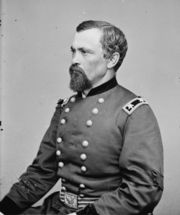
Fiddler’s Green: August V. Kautz

August Valentine Kautz was born on January 5, 1828, in Ispringen, Baden, Germany. His parents immigrated to the United States the same year, and settled in Brown County, Ohio in 1832.

He enlisted as a private in the First Regiment of Ohio Volunteers at the outbreak of the Mexican War, and served in this regiment throughout the war. He received an appointment to the United States Military Academy upon his return, and graduated in 1852. He was assigned to the 4th Infantry Regiment as a second lieutenant upon graduation.

He served with the 4th Infantry in the Washington and Oregon territories during the 1850s, where he was twice wounded during engagements with Indians during the Snake River and Rogue River campaigns. He was promoted to first lieutenant in the 4th Infantry in 1855. In July of 1857, he attempted an ascent of Mount Rainier with a party of four soldiers, an Indian guide and the post doctor of Fort Bellingham. They were forced to turn back before reaching the summit. He was commended during this same year for gallantry by General Scott. Kautz traveled in Europe during 1859 and 1860, returning prior to the outbreak of the Civil War.

Kautz was appointed a captain in the 6th US Cavalry when that unit formed in 1861. He served with the unit from its formation through the Peninsula Campaign, commanding it during the Seven Days Battles.

On September 2, 1862, Kautz was appointed colonel of the 2nd Ohio Cavalry Regiment, and transferred to the western theater of operations just before the battle of South Mountain. His regiment took part in the capture of Monticello, Kentucky on May 1, 1863, and he was brevetted major in the regular army for actions near that location on the 9th of June. The 2nd Ohio was also engaged in the pursuit and capture of Confederate General John Hunt Morgan in July 1863, preventing him from escaping across the Ohio River. He served under the command of Major General Ambrose Burnside during the Knoxville campaign of September to December 1863.

He returned to the eastern theater in 1864, where he initially served as the assistant chief of the Cavalry Bureau to Brigadier General James H. Wilson. He very briefly served as chief of the bureau when Wilson departed to the Army of the Potomac in April, before receiving new orders himself. He commanded the cavalry division of the Army of the James between April and June 1864, and was appointed brigadier general of volunteers on May 7. Kautz entered Petersburg briefly with his command on June 9, 1864, for which he was brevetted lieutenant colonel.

His command led the advance during the Wilson raid in late June 1864 to destroy track on the two railroads leading into Petersburg from the south. Although the raid caused a great deal of damage, its perpetrators suffered greatly as well. Eventually cut off and surrounded, Kautz and Wilson lost nearly a third of their force as casualties and prisoners before returning to Union lines.

He was brevetted brigadier general in the regular army on March 13, 1865 and assumed command of a division of colored troops, First Division, XXV Corps. He marched them into Richmond April 3rd. His command was active in the pursuit of Lee’s army until the surrender at Appomattox Court House. He was also brevetted brigadier and major general of the Regular Army or gallant and meritorious service in the field during the war.

When President Lincoln was assassinated, President Andrew Johnson ordered the formation of a military commission to try the accused conspirators. Kautz served as one of the nine officers assigned to the commission until they reached their verdict on June 29, 1865. In July 1865 he briefly served as the military governor of New Orleans to quell rioting there before returning to the western states.

Kautz served the remainder of the career in the southwestern United States. He was appointed lieutenant colonel of the 14th Infantry in 1867, and transferred to the 15th Infantry in 1869. He commanded this regiment on the New Mexico frontier until 1874, establishing the Mescalero Apaches on their reservation from 1870 to1871. In June 1874 he was promoted to colonel of the 8th Infantry, and was placed in command of the Department of Arizona in 1875. He served in California from 1878 to 1886, and in Nebraska from 1887 until his retirement.

Kautz retired from the army in 1892 and moved to Seattle, Washington. He lived there until his death on September 4, 1895, and is buried in Arlington National Cemetery.

He published several books on army duties and customs during and immediately after the Civil War. These included The Company Clerk (1863), Customs of Service for Non-commissioned Officers and Soldiers (1864), and Customs of Service for Officers (1866).

Roads to War, 1st Cavalry

As mentioned in a previous post, the 1st Dragoons was the farthest and most dispersed of the five mounted regiments in January 1861. Primarily located along the west coast, its companies served in three different departments. As a result, the regiment spent the majority of 1861 involved in skirmishes with hostile indians and consolidating for shipment to the east coast.

The regiment was transferred to Washington DC during November and December 1861, with the exception of Companies D and G. The regiment arrived at Camp Sprague just outside of the city by the end of January 1862. They were eventually assigned to 2nd Brigade, Cavalry Reserve, Army of the Potomac for the Peninsula campaign. As the senior regimental commander, Colonel George A. H. Blake also commanded the brigade. He was the third regimental commander in a year, as Col Fauntleroy resigned in may 1861 and Col B.S. Beall retired in February 1862.

It was two long years before the regiment fought at full strength. Companies D and G remained in New Mexico until June 1863, when the two companies were dissolved. The officers and noncommissioned officers transferred to Carlisle Barracks, where they reorganized the two companies. Both joined the regiment at Camp Buford, Maryland, in October 1863.

Regular Cavalry in the West

There was a good deal of discussion on Rantings of a Civil War Historian last week about cavalry in the Western Theater. While the majority of the Regular regiments served in the Eastern Theater, there was a good bit of Regular action in the west as well, particularly involving the 3rd and 4th US Cavalry. Elements of several regiments were involved in early battles such as Wilson’s Creek and Valverde, as companies tried to return to their consolidating regiments.

The 3rd Cavalry served in New Mexico the first two years of the war, then spent 1863 fighting in Tennessee and Alabama. They fought in Arkansas in 1864, then the Chattanooga campaign.

Split between theaters in the early stages of the war, the 4th Cavalry eventually consolidated in the Western Theater and fought the remainder of the war there. Major battles that they participated in (not in order) include: Wilson’s Creek, Murfreesboro, Chickamauga, Atlanta, Franklin, Nashville, Mississippi, Tennessee, Alabama and Georgia.

So the Western Theater will definitely be addressed here, I’m just not sure when.

Delays

In retrospect, I should have labeled one of last week’s posts “Coming Soon.” There have been delays in several posts in the making, all of which readers should see here in the near future. The initial Fiddler’s Green entry on August V. Kautz is nearly finished, for example. There was more information there than I’d expected, including an attempted ascent of Mount Rainier before the war. The comparison of resignations in the two dragoon regiments and the two cavalry regiments is still in the works, as is the road to war entry for the 1st Dragoons/1st Cavalry. All of these are still in the works, they’re just not finished yet.

An article that I read on Dimitri Rotov’s blog while looking for information on Stephen Sears’ To The Gates of Richmond led me to The Medical and Surgical History of the War of the Rebellion. This work is actually available in its entirety online. I must caution the casual explorer, however. Each volume consists of two parts, and all three that I looked at yesterday were greater than 100MB in size. There is some very interesting information in there, though.

Pictures?

Another question that has been puzzling me recently — where do all of the digital Civil War pictures come from? I know of the online collection at the Library of Congress, but that doesn’t seem to account for all of those that I see online.

Is there a copyright issue similar to printed works? Some that I see are attributed, generally to the Library of Congress. Many, however, aren’t. The numerous Wikipedia articles, particularly the biographies, come to mind. Is it as simple as a right-click, copy and paste? This doesn’t seem right. Or are some folks simply not doing the right thing?

Best single volume battle studies?

The discussion last week on Hoofbeats and Cold Steel about personal libraries caused me to review my shelves a little more closely, and I found them a bit wanting in a few areas. Not wanting as in I can think of a few dozen more that I’d like to own (a permanent condition), but wanting in that there are several large gaps in the war that I have very little reference material on.

The biggest of these is the area of specific battles. I own very few works focused on specific battles or campaigns. I was fortunate enough to find a copy of John Hennessy’s Return to Bull Run in a local store this weekend, which started me thinking about the area of specific battles and campaigns. I actually own very few of these. Reference works, unit histories, tomes on the cavalry and the war in general, yes, but very few on specific battles.

Given the quantity of what’s available out there, I thought I’d ask for some input on quality. What are the best single volume battle studies out there right now? I’m specifically thinking about the Peninsula campaign and the Wilderness at the moment, but am certainly open to other suggestions. A quick search of Drew Wagenhoffer’s site didn’t turn up anything specific, although I’m now very interested in Michael Hardy’s Battle of Hanover Court House after reading the review posted there.

Officers of the 2nd/5th US Cavalry in 1861

No, this isn’t the launch of another series of posts listing officers. The purpose of this post is to illustrate attrition among the officers of the 2nd (later 5th) US Cavalry during 1861. I’ve found the numbers thus far intriguing. Complaints about Secretary of War Davis filling the two cavalry regiments with southerners appear to be justified. I’m still working on the two dragoon regiments, but resignation numbers appear to be significantly higher within the cavalry regiments.

The 2nd Cavalry was hit particularly hard by resignations, and arguably had the highest concentration of military talent of any army regiment at the outbreak of the war. A list of those assigned on January 1, 1861 follows at the end of the post. Of the 34 officers assigned to the regiment, eighteen resigned and one died during the regiment’s exodus from Texas. Another, 1stLt Kenner Garrard, was captured and subsequently prevented from serving with the regiment due to the terms of his parole until 1862. He was then appointed LtCol of the 146th NY Infantry, and merely occupied a captain’s billet on the rolls.

Twelve of the eighteen officers who resigned from the regiment later became generals in the Confederate Army. Among their number were Albert S. Johnston, Robert E. Lee, John B. Hood, Earl Van Dorn, Fitzhugh Lee and Edmund K. Smith. Another commanded a brigade, but was only promoted to Colonel.

Of the fifteen who remained with the regiment, four were generals of volunteers by the end of the year: George H. Thomas, George Stoneman, Innis N. Palmer and Richard W. Johnson. Another, Albert G. Brackett, served as Colonel of the 9th Illinois Cavalry and was away from the regiment. By year’s end, only six of these fifteen officers were still present for duty with the regiment.

Eben Swift’s entry on the regiment in Rodenbough’s 1896 The Army of the United States told the tale of officers in the Regular cavalry regiments quite well.

“A regular regiment, during the war, was under many disadvantages. Its field officers, and many others, were commanding volunteers and serving on important duty elsewhere. The Fifth Cavalry, with the exception of a few months, was commanded by captains and lieutenants. The command of the regiment changed thirty-four times, and, curiously enough, it frequently served under men who had been in its ranks not very long before. It was often difficult to get one officer to a squadron.”

Officers assigned to the 2nd US Cavalry on January 1, 1861 (* indicates resignation later in the year):

Col (Brevet Brig Gen) Albert S. Johnston*
LtCol Robert E. Lee*
Major Earl Van Dorn*
Major George H. Thomas
Company A
Captain (unknown)
1stLt George B. Cosby*
2ndLt A. Parker Porter
Company B
Captain Edmund K. Smith*
1stLt Walter H. Jenifer*
2ndLt Fitzhugh Lee*
Company C
Captain Innis N. Palmer
1stLt William B. Royall
2ndLt Wade H. Gibbes*
Company D
Captain James Oakes
1stLt William P. Chambliss
2ndLt George A. Cunningham*
Company E
Captain George Stoneman
1stLt James B. Wetherell
2ndLt Joseph F. Minter*
Company F
Captain Richard W. Johnson
1stLt John T. Schaaf*
2ndLt Charles W. Phifer*
Company G
Captain William R. Bradfute*
1stLt Kenner Garrard
2ndLt Manning M. Kimmel*
Company H
Captain Nathan G. Evans*
1stLt Robert N. Eagle
2ndLt James E. Harrison
Company I
Captain Albert V. Brackett
1stLt Charles W. Field*
2ndLt Wesley Owens
Company K
Captain Charles J. Whiting
1stLt John B. Hood*
2ndLt James A. Major*