A Mystery at Shirley, Part I

I recently came across the following passage while reading Fighting Rebels and Redskins by George B. Sanford. Sanford was an officer in the 1st Cavalry during the Civil War, and a career Army officer. The incident that he refers to occurred during the Peninsula campaign in 1862, after McClellan had moved his army’s headquarters to Harrison’s Landing on the James River. The story appealed to me because of the courteous, gentlemanly way the situation was handled. The quotes are somewhat lengthy, but I think them necessary to fully appreciate the situation.

“At that period of the war and more especially in the Potomac Army while under McClellan’s command, it was not the policy of the government to interfere with the citizens of the Southern States when they were not actually aiding the enemy, and while their slaves were not actually forbidden to enter our lines, it was well understood in that army that they were not wanted. The result was that on most of those noble estates, life went on very much as it did before the attack on Fort Sumter, and the opportunity of observing it even superficially was one of which I eagerly availed myself.

“One of the finest of these beautiful places was “Shirley” belonging to the Carters, among the most distinguished of the old Virginia families. It was situated on the James river on the left bank and not far below City Point. It was between our lines and the enemy’s and exposed of course to the depredations of marauders from either army. Mr. Hill Carter the proprietor must have been at that time not far from sixty years of age, a thorough gentleman of the old school, loyal to his state, but quite willing to live at peace with our people provided they would allow him to occupy his property. Gen. McClellan was determined that the rights of property owners should be respected, as long as they remained quiet and obedient to the laws, directed that an officer should be sent up there to examine the condition of affairs and report as to their appearance. I was accordingly ordered up on this duty, and Lieut. Sumner of my regiment — now Lt. Colonel Sumner of the 8th Cavalry (1893) offered to accompany me.”

After this Sanford continues with descriptions of the house and grounds before describing his encounters with the Carter family that evening.

“Mr. Carter received us with great courtesy and introduced us to the ladies of his family, who were polite but reserved, and I thought seemed singularly anxious. At first I attributed this only to embarrassment at meeting those whom they of course regarded as the enemies of their country, but later I found they had a much more serious cause of disturbance. We were shown over the grounds and a portion of the estate, which extended for miles along the river. Afterwards we were invited to dinner, which was elegantly served, and a most delightful change from the rough comforts of camp life, to which we were accustomed. I ascertained from Mr. Carter that he was occasionally visited by small parties of our soldiers and that as a rule they were civil enough in their manner, and quite willing to pay for any supplies they took. But of course it kept the family in a state of anxiety and he would be glad if Gen. McClellan would furnish him with a small guard for the purpose of protection. He was quite willing to promise that they should be exempt from any molestation by the enemy, and that he would himself live at peace with the Government; but he said nothing about taking the oath of allegiance and indeed did not attempt to conceal the fact that he considered his first duty as due to his State.

“After dinner he excused himself for a few moments, first inviting us to smoke our cigars in a beautiful glass enclosed porch overlooking a noble stretch of grass and woodland bordered by the beautiful waters of the James. Sumner and I were deeply impressed with the beauty of the scene and were commenting on it with enthusiastic admiration when a door opened, and a young man not much older than ourselves, but dressed in the full uniform of an officer of the Confederate army appeared. He looked very pale and weak and was evidently taken by surprise at seeing us. For a moment he seemed about to withdraw, but changing his mind, came forward and apologized for disturbing us, disclaiming any knowledge of our presence. He went on to say that we must pardon him for not attempting to entertain us, as we could see ourselves that he was weak and wounded, and he would leave us to ourselves. Then bowing to us both, he went back as he had come. Sumner and I were struck with astonishment. Here was a situation. Ought we to arrest this man — evidently an officer of the enemy — and take him back with us to camp? That would seem the first thing to do; but on the other hand, we were these people’s guests, had been kindly entertained by them, and were to a certain extent prevented by the claims of hospitality. The gentlemen was evidently a son of the family, who had been wounded in one of the recent battles and had returned to his home for the care and treatment which would be given to him there. I for one was entirely determined to let the matter alone, at all events until I could get advice from my Colonel, and Sumner agreed with me. In a few moments Mr. Carter returned, but made no allusion to what happened. Indeed I am satisfied that he had no knowledge of what had occurred. Of course we said nothing, and shortly afterward we bade him good-bye, and returned to our camp. I had no doubt, after thinking it over, that the young officer hearing his father leave the room after dinner, supposed we had accompanied him out into the grounds, and had accordingly gone into the smoking room where he found us, supposing he would be safe from observation. I felt bound to report the matter to my commanding officer, but was very glad that he did not think it necessary to carry the matter farther. Probably the young fellow returned to his command very soon. At all events I never heard anything more of him, though a safe guard was sent to Mr. Carter’s place as he had requested.”

Who was this young Confederate officer? The footnote on that page says that the editor of the book, Professor E.R. Hagemann of my alma mater, University of Louisville, was unable to identify the officer. Since Shirley plantation is nearby and open to the public, Gina and I will venture out there today to see if we can solve this mystery and perhaps report more on the plantation itself.
Book Review: Rush’s Lancers

Since the beginning of this project a couple of months ago, there has been a great deal of the acquisition and reading of material on Civil War cavalry, both primary and secondary sources. Once or twice a month, I will take the opportunity to review selected sources. This entry will focus on Eric Wittenberg’s Rush’s Lancers.

Regimental histories aren’t currently much in vogue, most likely because of the perception that a single regiment’s scope of experience was too limited to be of much historical value. Far more attention has been paid to various armies of the Civil War, and more recently to brigades in military histories. Rush’s Lancers illustrates the errors of this perception.

Wittenberg does a wonderful job of telling the tale of how a Civil War regiment was raised and trained, and describing the difficulties in keeping mounted troopers in the field. There are countless details derived from the words of soldiers of all ranks from the regiment, without bogging the reader down in minutiae. He skillfully blends many personal accounts into a single story without losing the story of the regiment as a whole in the many individual points of view. Although obviously a labor of love, his history of the unit is both even-handed and painstakingly complete. He tells the entire story of the regiment and its soldiers, not simply lingering on the high points and the regiment’s successes.

The enormous amount of time and research are clearly evident in the many endnotes listed in the book. It averages nearly 100 endnotes per chapter; many of them previously unpublished personal accounts. The book is richly illustrated with photographs of dozens of the regiment’s soldiers taken from both public and private collections. Once again Blake Magner’s excellent maps provide the reader easy clarity for the prose accounts of movements and battles.

On the whole, this is an excellent book. The style of writing is very easy to follow, and the pace of the book makes it a joy to read. I think this work will serve for years to come as an essential reference for the study of Civil War cavalry.

1,000? Already?

Not such a milestone when compared to more established and successful blogs, but I just noticed that the sitemeter for Crossed Sabers went over 1,000 visits this afternoon. That wasn’t a number that I thought I’d see for quite a while yet. Thanks to all of my visitors, and I hope you enjoy what there is to read here.

Christmas in April

It’s been a very good couple of days for new books and resources around here, so much so it seems like the holidays. Four of my recent book orders (Sherman’s Horsemen, Glory Enough For All, The Civil War Papers of George B. McClellan and The Cavalry at Appomattox) all showed up day before yesterday, courtesy of the postal service. Another delivery from my researcher at USAMHI at Carlisle arrived yesterday, including a couple of interesting first person accounts.

I was fortunate enough to find a copy of George Price’s Across the Continent With the Fifth Cavalry in a nearby library yesterday, so I have a couple of weeks to see how much information I can wring out of it. I’m finally starting to feel like I’m getting somewhere in gathering sources for this project. Counting Price’s work, that gives me regimental histories for the 2nd (2), 4th, 5th and 6th US Cavalry. These and the personal accounts from USAMHI should definitely get me started.

As if this wasn’t enough, I discovered the internet whereabouts of George Cullum’s Biographical Register of the Officers and Graduates of the United States Military Academy on Brian Downey‘s blog, who had in turn received it from Harry Smeltzer at Bull Runnings.

Now, if only it was holiday break so I had extra time to read through all of this….

Resignations by Regiment

I finally managed to winnow through all of the resignations and compare them by regiment. Some of the results were interesting.

Of the 171 officers assigned to the three mounted arms at the beginning of 1861 (1 brigadier general and 34 officers assigned to each regiment), a total of 74 resigned, or 43%. Three of the five regiments lost 50% or more of their officers, and these were the last two regiments to reach the major theaters of fighting.

Despite claims in 1855 (and later) that they were formed to accommodate southern officers, the two cavalry regiments were not the hardest hit by resignations. The most resignations came from the 2nd Dragoons/2nd Cavalry with 19. Interestingly enough, the least number of resignations came from the other dragoon regiment with 9. As I derived these numbers only from 1861, I have to wonder how many 1st Dragoon/1st Cavalry officers wanted a free ride home from the west coast before tendering their resignations. The regiment didn’t completely close on Washington DC until the end of January 1862.

The results by regiment:
1st Dragoons/1st Cavalry: 9 of 34
2nd Dragoons/2nd Cavalry: 19 of 34
Regiment of Mounted Rifles/3rd Cavalry: 10 of 34
1st Cavalry/4th Cavalry: 17 of 34
2nd Cavalry/5th Cavalry: 18 of 34

Why Novice Regular Recruiters?

Last week’s post about Charles Russell Lowell’s trials as a recruiter in Ohio piqued my curiosity about recruiting for regulars. Why on earth would Lowell, someone who was a civilian a mere three weeks before and a “Regular” in name only, be sent to raise a company for a regiment of regulars?

‘Why’ was the question, not how. How is easy, since it was basically the same way that the volunteer regiments were raised. For the raising of the new cavalry regiment in 1861 (and Companies L and M for each of the other five regiments in 1862), the primary difference in the mechanics of raising a unit between regulars and volunteers was that the officers had already been determined. Units were assigned a city location for the headquarters of the forming unit, then surrounding counties or states from which to recruit their personnel. As the 6th Cavalry formed, for example, the regimental headquarters was Pittsburgh, and recruiting was authorized in the states adjoining Pennsylvania.

A bit of investigating turned up the following section from War Department General Orders No. 48, dated July 21, 1861.

“That the enlistments for the regiments authorized by this act shall be in the charge of the officers detailed for that purpose who are appointed to said regiments from civil life; and that in the meantime the officers appointed to the same from the regular army, shall be detailed by the commanding general to such service in the volunteer regiments now in the field, as will, in his judgment, give them the greatest military instruction and efficiency; and that the commanding general may, in his discretion, employ said officers with any part of the regular forces now in the field until the regiments authorized by this act shall have been fully recruited, and detail any of the officers now in the regular army to service with the volunteer regiments now in the field, or which may hereafter be called out, with such rank as may be offered them in said volunteer regiments, for the purpose of imparting to them military instruction and efficiency.”

This, then, is how a gentleman from Massachusetts with neither military experience nor even a horse to his name finds himself dwelling in a tavern in Ohio recruiting cavalrymen. It would seem to be a matter of simple military efficiency. Newly-appointed, inexperienced officers recruited while more experienced officers focused on training volunteer units already in the field. Once units were filled and available to train and fight, these officers returned to duties with their assigned regiment.

In Lowell’s defense, he went on to serve very well with the 6th Cavalry on the Peninsula. Despite his relative youth and inexperience, he led a squadron with distinction before his appointment as Colonel of the 2nd Massachusetts Cavalry. And ironically he was back with the regulars in command of the Reserve Brigade as well as his volunteer regiment when he was killed in the Shenandoah Valley in 1864.

Errors in Dyer’s Compendium

The discussion Drew Wagenhoffer and I had about regimental numbering a week or so ago made me wonder if any of the regimental histories were effected by the change. Sure enough, one was.

For those who didn’t know, Congress ordered the mounted regiments consolidated into a single arm of cavalry on August 3, 1861. The War Department issued the appropriate orders on August 10, the same day as the Battle of Wilson’s Creek. Prior to the order, each of the three arms were treated as separate entities for assignments, promotions, etc. If you were a dragoon, you stayed a dragoon and could only be assigned to one of the two dragoon regiments. The same for the two cavalry regiments formed in 1855. Those in the single regiment of mounted rifles were apparently stuck with one another (there was briefly a second regiment of mounted rifles, but it didn’t survive the Mexican War).

As a result of the order, all five regiments (and the 3rd Cavalry, which was recruiting at the time) were numbered sequentially as cavalry regiments in order of seniority. The 1st Dragoons became the 1st cavalry, 2nd Dragoons the 2nd Cavalry, the Mounted Rifles the 3rd Cavalry, the 1st Cavalry the 4th Cavalry, the 2nd Cavalry the 5th Cavalry, and the new 3rd Cavalry became the 6th Cavalry. As one might imagine, this created a good bit of confusion for records keepers.

Checking Dyer’s Compendium of the War of the Rebellion, I found that Volume 1 was correct for all six regiments. In Volume 3, there was an error in the 1st Cavalry entry. It shows Companies A and E in the advance on Manassas and the Battle of Bull Run in July 1861. This is incorrect. It should read Companies A and E of the 4th Cavalry. The farthest east any of the 1st Dragoons/Cavalry were in July 1861 was the Department of New Mexico, where Companies D and G served before they were disbanded and reformed later in the war.

Quibbling? Possibly, but listings are supposed to contain the unit’s history, not the history of the unit’s title. As you can see, it’s confusing enough already.

I apologize for not answering any comments to this post promptly, but I’ll be away from computers from early this afternoon until Sunday.

Wanted: A Couple of Good Books

If anyone happens to see either of the following two books at a decent price in their travels, please let me know. Both are rather expensive on Amazon, and I haven’t lucked across them in local libraries or used bookstores. I understand the Price book being expensive, but the Davis book was last published in 1994. I’ll need both of them eventually to pursue this project. Unfortunately the Price book hasn’t been digitized yet.

Davis, Sidney M. Common Soldier, Uncommon War: Life as a Cavalryman in the Civil War. 1994.

Price, George F. Across the Continent with the Fifth Cavalry. 1883.

Any assistance would be greatly appreciated. I have one line on the Price book at the moment, but it’s pretty tenuous.

The Joys of Recruiting Duty

As I continue to gather information on the raising of the 6th Cavalry after the war began, I came across a letter from Charles Russell Lowell to his mother in July 1861. At the time he was a newly appointed Captain sent to the “Western Reserve” in Ohio to raise his company, Trumbull County if I’m not mistaken. I’m not one to revel in the misery of others, but this really struck me as amusing. Lowell accepted his appointment in Washington only 21 days earlier, but quickly mastered the tradition of ‘hurry up and wait.’

“I write out of sheer dullness; a mounted officer without a horse, a Captain without a Lieutenant or a command, a recruiting officer without a Sergeant and with but one enlisted man, a human being condemned to a country tavern and familiar thrice a day with dried apples and “a little piece of the beef-steak” — have I not an excuse for dullness? I am known here as “the Agent of that Cavalry Company” — and the Agent’s office is the resort of half the idle clerks and dageurreotype artists in town — but those fellows don’t enlist.”

A Trip to Gaines Mill

Frustrated in attempts to reach Maryland earlier in the weekend, my wife and I hopped in the car and drove to Gaines’ Mill yesterday afternoon. It shouldn’t have taken me this long to travel 40-odd miles, but I wasn’t sure until recently whether there would be anything there to see or not.

Unsurprisingly, there is indeed National Park Service coverage of the battlefield, as well as most of the Seven Days battlefields. What was surprising is how difficult it is to find information on them. For the uninitiated, there is no park dedicated to any of the battles of the Peninsula Campaign. The various Peninsula battlefields are part of Richmond National Battlefield Park. The NPS does have pretty good coverage of the battlefields, it’s simply a matter of knowing where to look. Although Yorktown is covered, the Civil War activities there are addressed only in passing.

The Gaines Mill battlefield is more or less co-located with the Cold Harbor battlefield, or at least the portions owned by the NPS are. There is a small visitor center there which supports both battles. It has a small bookstore, which has several copies of Michael Hardy’s Battle of Hanover Court-House. There is a 180 acre parcel for Cold Harbor which includes both walking trails and a driving tour, while the Gaines Mill portion consists of a 60 acre parcel with a parking lot and walking trails.

The purpose of my visit was to find the site of the cavalry charge by the 5th US Cavalry near the end of the battle. They attempted a long (roughly 275 yards) charge against advancing infantry, and it didn’t turn out well for them. Of the 220 troopers who made the charge, 58 were killed, wounded or captured. There was a good bit of controversy over the charge after the battle and after the war, so I wanted to take a look at the ground.

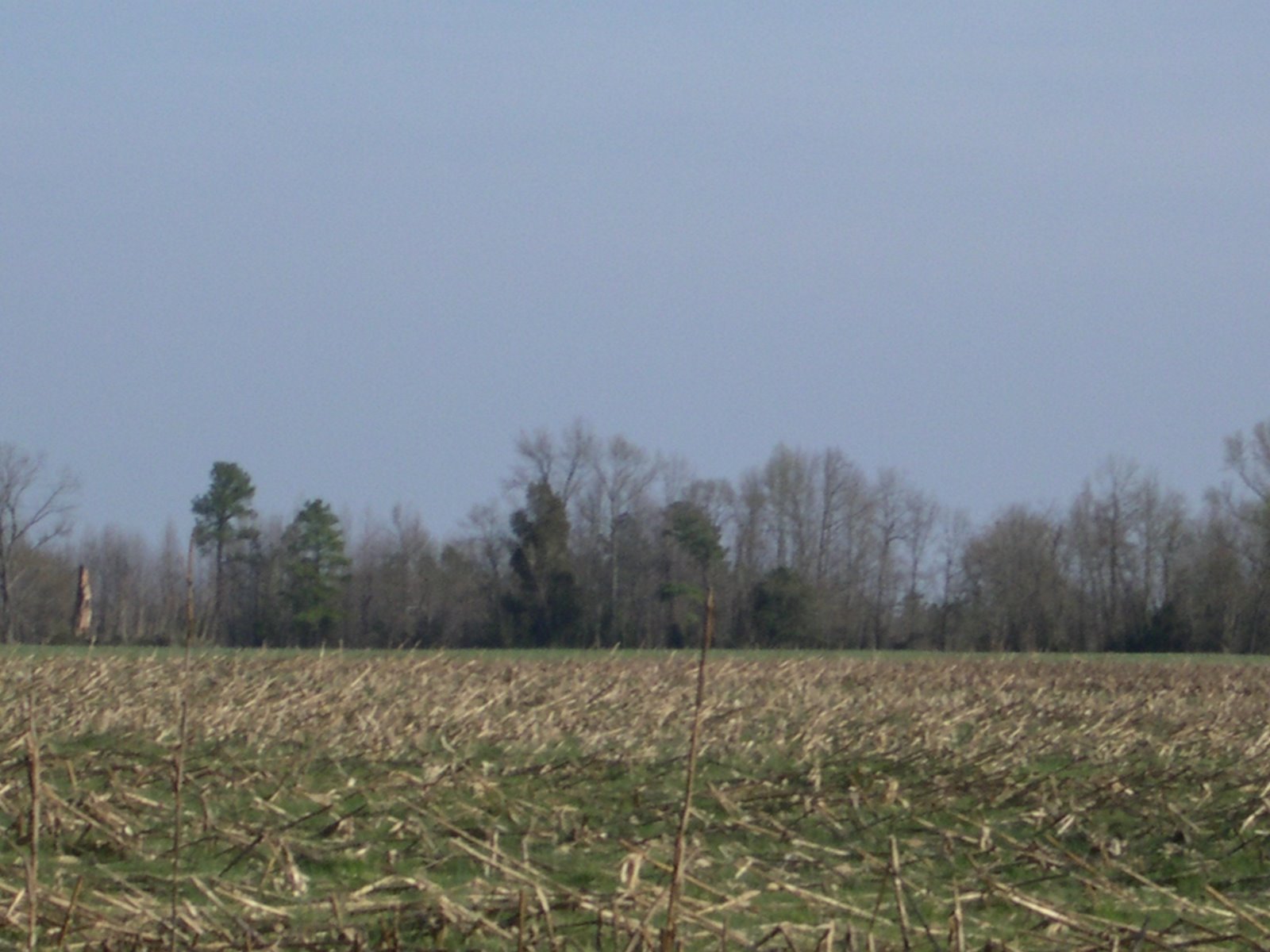
Unfortunately, the site of the charge isn’t included in the Park Service parcel, but the park ranger on duty was very helpful and went above and beyond in drawing a map for me and showing me how I could get to a vantage point to see where that land is (located on the Adams farm, which is still in the family as it was during the battle). The family’s house at the time was located next to where the charge took place, and one of the chimneys is still standing. The ground itself has since sprouted trees, so it is difficult to get a feel for what the area looked like. The picture is taken from north to south, and the charge would have taken place from left to right from the chimney just inside the woods as you look at the picture.

The park ranger, Randy Cleaver, was very knowledgeable about the battlefield, patiently answering my many questions. He greatly improved my understanding of the battle, and his map and explanation made understanding the ground at the time of the battle much easier. He was even kind enough to steer us toward a historic bookseller in Richmond that I hadn’t known of.

Although brief, it was an enjoyable and educational trip. There will be more here about the charge in the coming weeks as I work my way through the material. Thanks again, Randy, for all of your help.