Civil War Magazines

I’ve watched the blog discussions over editing and ownership shifts of a couple of Civil War magazines during the past week with a great deal of interest and very little expertise. I don’t see it as my place to weigh in on changes good or bad, but the discussion has prompted a question: which is the best Civil War magazine, in the opinions of my readers? (both of you)

I realize each has a different focus and to some extent a different audience, but which one is the best publication? Why do I ask, you ask? For a couple of reasons. First, I’m curious what you think. Second, while I don’t intend to subscribe to all of them, I do plan to subscribe to one or two in the near future. It’s both more economically sound and a great deal less frustrating than trying to find them in the local bookstores since my return to the mountains (I’m still looking for that September 07 N&S issue, is it out in stores yet?).

So, what do you think?

Bates Letters, April 1862

Note: I found a private soldier’s estimates of the numbers involved on the Peninsula interesting, considering the debates over them over the years. I wonder if Prince John Magruder would have been flattered to be mistaken for Albert Sidney Johnston?

Camp before Yorktown
April 13th, 1862
Dear Parents,

I don’t suppose you have received a letter from me since last December but you must not blame me for it. The fault lies with the P.O. Dept. I have written several times, but yesterday I discovered, or rather a poor Dutchman, whom I didn’t think had sense enough to last him till he made his exit from this world, found out for me that my postage stamps were no good, being of the old style which were in use before the days of Secession. Thank Good my health has been tip-top since I wrote my last letter from Washington but you must have thought I had gone to Davy Jones locker from my silence.

Since I left Washington (last Dec.) I have been pretty constantly on the move but save a clear day occasionally nothing remarkable has happened. I think however something will happen next week. We have had three clear days in succession, and such a thing must be the forerunner of something remarkable.

Our Squadron (Cos “A” and “E” 4th Cavly) is Genl McClellan’s body-guard and we have a fine time of it. If there is any fighting the General will be in as much danger as we will, but I think that will not be much. There is an army of about ninety five thousand federal troops here and the papers say there are one hundred thousand secesh (sic) with five hundred cannon, but I think forty thousand is the outside of their strength. There has been considerable skirmishing here for the last week but the mud is too deep for us to bring our heavy artillery into position. Several Prisoners have been taken by our boys and they tell so many stories nobody believes them. The prevailing opinion is that Yorktown is held by fifty thousand troops under General A.S. Johnston and that they will be whipped within seven days.

A large boat bridge has been built across the (York) river just opposite us (our camp is on the same side of the river Yorktown is, and about two and a half miles below it). The roads have all been filled up with rails and logs to make them passable for artillery and I think about everything is ready for the ball to be opened. If I am so lucky as to escape having the lamp of my existence snuffed out by a secesh (sic) bullet I expect to write a full account of the battle at Yorktown in exactly one week from this day and write from Richmond.
Till then Adios.
Chas. E. Bates

Accidental Tourist

I had several planned stops on my long drive home to see Civil War sites of note, but I think I had more luck with the places that I stumbled upon accidentally than the planned ones. My wife usually navigates on our trips, and I definitely missed her presence on this trip.

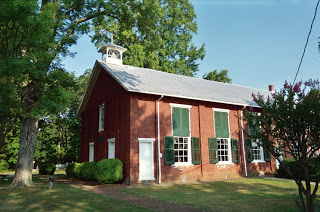
Hartwood Church was my first stop. I was driving north on highway 17 just north of Fredericksburg, when I noticed a sign that said Hartwood. Just after that a large truck pulled out in front of me, forcing me to slow down. The next road was Hartwood Church Road, so I had to make a quick stop. The church was the site of an engagement between Confederate and Union cavalry forces on February 25, 1863. Confederate Brigadier General Fitzhugh Lee, with elements of the 1st, 2nd and 3rd Virginia Cavalry, conducted a raid on the Union encampment here. He thoroughly surprised the Union forces, capturing over 150 men and numerous horses before escaping unscathed back across the Rappahannock. The best description of the engagement that I’ve seen is in Eric Wittenberg’s The Union Cavalry Comes of Age. It was nice to get to see the place after reading about it; it hadn’t occurred to me that it might still be intact. Although it was damaged severely over the course of the war, it was repaired and is still intact today as illustrated by the picture below.
My next stop was Harper’s Ferry, one of the planned halts. I’d hoped to find out more information on the breakout of the Union cavalry forces during the siege of the town by Jackson’s forces just prior to the battle of Antietam. I found the place rather disappointing, but this may have been because I was there for a specific purpose and they didn’t have what I was looking for. It just seemed to me that there wasn’t a great deal of energy amongst the staff there, and that given the history of the site there was potential for a lot more. If I was advising a traveler, I’d have to recommend it as a possible side trip, but not a destination.

The next leg was the fun part of the drive, from Harper’s Ferry to the Antietam battlefield. It was here that I missed my wife’s presence the most. I was so busy looking at the historic buildings in Boonsboro that I missed my turn. This actually turned out to be fortunate, as I realized that I’d missed it when I reached the site of the battle of Funkstown. Seeing the site gave me a better appreciation for the battle, as did the brief stop at the site of the cavalry skirmish at Boonsboro on my way back to the missed turn. The countryside is very pretty around there, well worth the drive even if one isn’t looking for skirmish sites.

I really enjoyed Antietam, and think it is one of the best Civil War battlefields to visit, along with Chickamauga and of course Gettysburg. It was great to see it in such good condition. Alas, I didn’t get the chance to meet Ranger Mannie, but the tips Brian Downey sent for touring the battlefield proved to be a great help. Thanks again, Brian.

Putting Antietam behind me, I turned my trusty steed towards Gettysburg. Not always one for the shortest distance between two points, I also stopped on South Mountain, and was surprised to discover that it’s only 1200’ high. I’d thought it was bigger for some reason.

Upon arrival at Gettysburg, I visited South Cavalry Field for the first time. I’d never quite made it there on previous visits. I managed to find all of the Regular cavalry markers, even the two down in the low ground off of Ridge Road. And I finally got a picture of my own of the 6th Pennsylvania Cavalry monument nearby.

After my visit to South Cavalry Field, I stopped at the Nat ional Cemetery to find the graves of the 6th Cavalry troopers buried there. I don’t know where the few men killed from the other regular cavalry regiments are buried, but I couldn’t find a record of them there. I did find an intriguing reference to a diary of a 6th Cavalry soldier that I hadn’t heard of before, but I’m still in the process of trying to track it down.

A brief visit to the bookstore across the street at the visitor center revealed that Gettysburg’s Forgotten Cavalry Actions is indeed sold out, and has been for some time. Eric, if you still have a few copies stashed away, you might want to send them their way. It sounds like the book is missed on the bookshelves there.

I made a quick tour of the battlefield, trying to get pictures of all of the cavalry monuments. I didn’t make it to East Cavalry Field this time, but I think I already have pictures of those from my last trip. The only one from the rest of the battlefield that I know that I missed is the marker for Company A, 1st Pennsylvania Cavalry, as I ran out of film. I even found the markers for the 5th New York and the 1st Vermont that bloggers were discussing last week. I’ll have an entry soliciting votes for the best Gettysburg cavalry monument in the near future.

After dinner, I was able to walk Gamble’s and Devin’s lines as the sun set before returning to my hotel. It was a full day, but a very enjoyable one. The rest of the trip was faster, but not nearly as much fun.

The Journey Begins

Well, the horse being fixed, my foot being fixed, and the last of the silly Army paperwork over with, I shall start for home today. Despite the previous bad luck, I will once again attempt the Harper’s Ferry/ Antietam/ Gettysburg trip today (the differences between foolishness, stubbornness and perseverance seem to be in the eyes of the beholder). Posting is liable to be infrequent through the weekend as I make my way back to Colorado, but hopefully I’ll have some good pictures to post next week.

Lost Companies: Companies G and I, 2nd Dragoons

During the consolidation of the Regular regiments at the beginning of the Civil War, several companies were lost in the shuffle and greatly delayed in rejoining their regiments. The 1st Dragoons left two companies behind, and the 2nd Dragoons left three. Over the next few weeks, I will try to tell the tales of these “lost companies.”

Company G, 2nd Dragoons remained in New Mexico territory when the regiment began its consolidation. It participated in the campaign that culminated in the battle of Valverde, serving as artillerymen in McRae’s Battery along with members of the 3rd US Cavalry. They manned the battery with skill commended by General Crook, though the battery’s commander, Captain Alexander McRae of the 3rd Cavalry, was killed during the battle. The company returned to Fort Leavenworth in October 1862, where it was joined by Company I.

Company I remained at Fort Garland, Colorado at the outbreak of the war, tasked with protecting civilians from hostile Indians until volunteer units could be organized and trained. Once the two companies were united, they marched to Washington, where they arrived together on November 23, 1863.

6th Cavalry Dead at Andersonville

During the course of my research, I recently discovered 13 troopers of the 6th Cavalry who were captured and died at Andersonville. I haven’t yet discovered when they were captured, though the dates make it unlikely that any of them were captured at Fairfield. Since I’m in the process of trying to transcribe that list from the muster rolls now, I should be able to confirm that by the end of next month. The troopers are listed below. I haven’t found any data to suggest that the two deaths on the same day were anything other than coincidence.

Bird, Morris H. Private Co. E August 23, 1864
Blossom, Charles Private Co I May 22, 1864
Bradman, Alvah M. Sergeant Co M August 23, 1864
Clifford, Jeremiah Private Co B September 17, 1864
Doney, John W. Sergeant Co C May 21, 1864
Dunn, John Private Co A May 6, 1864
Ferguson, Joseph Private Co E March 13, 1864
Furl, George W. Private Co D July 7, 1864
Johnson, Peter Private Co F May 15, 1864
McClellan, Jonathan Private Co D March 31, 1864
Meadow, John Private Co E June 25, 1864
Miller, Charles H. Private Co E July 5, 1864
Robinson, William R. Private Co H June 30, 1864

6th Cavalry Database Update

After a good bit of fiddling, tweaking, adjusting, reformatting and several other -ings, the 6th US Cavalry database is functional. There is a great deal more information to be added to it, but it’s finally in a format that I’m content with (for now) that is searchable. Of the 2800+ names currently in the database, most have at least a little information with them other than name and regiment. The search of volunteer regiments for more names continues. This week it’s Pennsylvania and New Jersey.

I discovered that Excel worked well as a format for the enlisted soldiers, but am going with Word for the officers for now. There are two reasons for this. One is that the numbers are much smaller, so it’s manageable as a Word document. The second is that there is a LOT more text for each entry with the officers. There’s simply more information available on them.

I’d like to take the search to the genealogy forums next, but won’t have time to do so for a little while yet.

Bates Letters, November 1861

Note: Charlie’s describing McClellan’s Grand Review in this letter, from a rather opportune vantage point. I hadn’t seen a description of the aqueduct bridge over the Potomac before this. I recall quite a number of troops using it for the move toward Manassas, so I was surprised to see it described as so small. I had two questions from this one that I’m hoping readers can answer. “Munson’s hill” was my best guess from his handwriting, I’m not sure where it’s located. Any ideas? What was “Frank Leslie’s” it sounds like some sort of news periodical, perhaps local to Connecticut where Bates is from?

Washington D.C.
Headquarters, 4th Regt Co “E”
Camp Nov. 21st, 1861
Dear Parents,

It is a long time since I have wrote to you, but the reason is I have had nothing to write about. We have the normal amount of rainy days and windy days, but yesterday there was something came off worth writing about. General McClellan reviewed over 70,000 troops. Our company was on the escort of the General so I had a good chance to see them as they passed by. The column started to pass in review before the General at half past twelve, marching two companies abreast, and it was five o’clock when the last went by. They all looked like “Regulars”, everybody was in their place, and what was stranger for Volunteers are generally not very military. Everyone kept time with the music ands looked to the “front” when they passed the reviewing staff. It was the largest column which ever passed in review either in this country or in Europe, and the best (underlined).

I caught an awful cold looking at them, but I would take two more if I could see another such a sight. Our company had the “distinguished honor” of escorting the General back to his Quarters after the review but I had rather not have the honor again. The review was beyond Munson’s (?) hill within three miles of the secesh (sic) pickets, and after it was over the General had to be about an hour telegraphing to different places before he started for home, but when he did start it wasn’t slow riding. We crossed the Potomac river on the Aqueduct bridge. It is fifty feet wide and there is only room for one man to pass at a time.

I saw somebody taking sketches of the staff and troops on the field so you will probably have a chance to see our company pictured out in Frank Leslie’s or Harper’s Weekly. Our position at the time he was taking the sketch was just behind the General, about twenty five yards from him.

I sent my likeness last week, I suppose you have got it. It looks exactly like me everybody says. Give my spects (sic) to all and tell them. I am going to sleep for a couple of hours. Goodbye.

Your Affect. Son,
C.E. Bates

Bates Letters, October 1861

Note: I hadn’t intended to use one of the letters for post number 100, but decided in the end that it really didn’t make much difference. I enjoyed the descriptions of provost guard duty in this letter, particularly the encounter of Sergeant Frye and his father. Neither Charles Bates nor Sergeant Frye nor presumably his father are listed in the CWSS, so I’ll have to look elsewhere for further information on the encounter. I imagine the scouting rides were simply for training and practice, but find it interesting that Bates doesn’t mention the constant drill that seems to have been the lot of the other regular cavalry units upon their arrival in Washington.

Washington D.C.
October 14th, 1861
Dear Parents,

I know that I have been ungrateful to you lately, but I shall try to make up for my neglect by writing very often in future. The reason of my long silence is explained by one word. Laziness (underlined). Yes it is laziness and no mistake, for there is plenty of time for me to write now. Our company is quartered within a thousand yards of the Capitol and form a part of the Provost guard for Washington city. We have to patrol the streets every other day and arrest every soldier found without a pass. It is laughable to see us sometimes give chase to a party of half drunk Sogers (sic, underlined) through back alleys and into cellars, sometimes on foot, but generally we manage to overhaul them without dismounting.

If they allow themselves to be arrested quickly there (sic) are kept overnight in the Guard house and released the next morning without further punishment but if they try to run away they are favored with a cold water shower bath three times a day for a few days before getting their liberty. Many a curse is given to us by the poor victims, but it is orders and “duty must be done,” as Sergt Frye said when he took his Father to the Guard house.

It is a great benefit to the citizens to have the patrols about the streets. Be fore they started the streets were filled with drunken Soldiers at all hours and in many cases the houses too. Now the streets are empty from nine O.clk at night until 6 in the morning and through the day they are put in limbo if they get drunk.

The provost guard now consists of three Companies of Cavalry and nine of Infantry, and the mounted patrols go in parties of 6 men and a commissioned Officer. The foot patrols have 12 men.

We have an occasional scout into Maryland but they never last more than three days, so I expect we will remain in our present quarters until spring. I shall write often to you in future and expect to hear from you soon. I have just recieved (sic) Johnson’s letters and am glad to hear that your (sic) all well. It is the first one I have had for so long, I can’t remember when. Give my love to my little niece. Tell Julia, but never mind I shall write to her tomorrow. Good bye for the present. Give my love to all.
I remain
Affectionately
Charles E. Bates

P.S. I almost forgot to tell you that the name or number of our regiment is changed. Direct to
Compy “E” 4th U.S. Cavalry
Washington D.C.
Charles

Thoughts on Cavalry Raids

I was reading David Evans’ excellent work Sherman’s Horsemen this morning when I started pondering the differing natures of cavalry raids between opposing sides and the different theaters over the course of the war.

During the Atlanta campaign, Sherman made excellent use of his cavalry to force the Confederate forces in front of him to extend their lines or reposition. He often had difficulties getting his subordinate cavalry leaders to do what he wanted them to, but I freely admit I hadn’t given him credit for the adept use of his mounted arm. Their immediate objectives were generally destructive in nature (bridges, railroads, factories, mills, etc), but his objectives for them was to shift enemy forces so he could maneuver his army. The differences between tactical and strategic objectives, to use the proper terminology.

Confederate raids in the western theater seem to me to have focused on destruction of supplies and infrastructure to inconvenience their opponents, but lacking this strategic focus. Forrest’s, Morgan’s, and Wheeler’s raids all caused damage, but I can’t recall their actions being tied to strategic moves by their higher headquarters. Admittedly, this is not my area of expertise. Please feel free to speak up if you think I’m in error.

The raids conducted by the cavalry of the Army of the Potomac also at first glance appear to be nearly universally destructive or combative in nature. Stoneman’s raid, Sheridan’s raids and his Valley campaign all targeted destruction of infrastructure or enemy forces. Like those of Sherman’s subordinates, they were tied to strategic objectives of the army’s commander. In Hooker’s/ Stoneman’s case, they weren’t necessarily well thought out, but they did have a strategic objective.

Grant’s use of his cavalry during the Overland Campaign of 1864 seems similar to Sherman’s, though I haven’t to date examined it from the army’s standpoint instead of the cavalry’s. (But I’d like to: any suggestions for a good single-volume source on the campaign?) Certainly Grierson’s raid earlier in the war was planned and executed with a higher purpose in mind.

The “raids” of the cavalry of the Army of Northern Virginia, however, seem different to me. I can’t think of a single one that was not tied to strategic decisions and/or moves to be made by the army. They almost invariably seem to be focused on reconnaissance, however, and not on destruction of enemy forces or equipment. Yes, the odd supply dump was looted when encountered in the course of a raid and extra mounts were always desirable, but that generally wasn’t the object of the raid in the first place. True, later in the war they were generally fighting better-equipped, more numerous foes. I can’t help wonder, however, what might have happened had Stuart attempted earlier in the war what Sheridan did in early 1864 — seek out the enemy’s cavalry for the purpose of forcing a fight and defeating it. He didn’t, of course, so the point is moot.

I’ll stray briefly from the original purpose of this post to pursue one more thought. I wonder if a case could be made that the Union cavalry came of age because they were allowed to. I don’t think they were ever specifically targeted by Lee or Stuart. Given the perceived dominance of Stuart’s cavalry going into the winter, there would appear to have been an opportunity there, even with the rotation of some brigades to other areas for better forage. While there was a great deal of self-imposed rigor, as they were strung out over dozens of miles of pickets for the army’s main body, I don’t think they were harassed or attacked much by Confederate forces at all. Indeed, this is one of the reasons why Fitzhugh Lee’s raid at Hartwood Church was so effective.

Enough fuzzy musings for now, back to research.