Fiddler’s Green: Daniel Madden

Daniel Madden was born in England, and immigrated to the United States prior to his enlistment in the 2nd Dragoons on December 9, 1850. He served as a private in Company E, 2nd Dragoons at Carlisle Barracks, Pennsylvania until March, 1852, when he transferred to Company H, 1st Dragoons. He served with this regiment in New Mexico until December 9, 1855, where he participated in expeditions against the Navajo and Apache Indians.

Madden rejoined the 2nd Dragoons in May 1856 at Fort Riley, Kansas. He served as a private, corporal, sergeant, and eventually first sergeant of Company B, 2nd Dragoons from May 1st, 1856 to April 28, 1861. He served with his company in Kansas until September 1857, when the regiment was ordered to Utah. He participated in the winter march of the Utah expedition, and served with the regiment in Utah until 1861.

Madden marched east with the regiment at the outbreak of the war, and was transferred to the newly forming 6th US Cavalry as the Regimental Commissary Sergeant. He served in this capacity until November 1st, when he received an appointment as a second lieutenant, 6th US Cavalry. He accepted the appointment on the 3rd, and was discharged the next day. He was assigned to Company M on November 5, 1861. He commanded the company in December, as Captain Hays was still recruiting the rest of the company in Pittsburgh.

Lieutenant Madden served with his company during the first half of 1862, moving with them to the Peninsula. He was commended by his regimental and brigade commanders for bravery during the battle of Williamsburg, and participated in actions at Slatersville, New Kent Court House, New Bridge, Mechanicsville, and battle of Hanover Court House. He also served as an aide de camp to General McClellan during the Seven Days’ Battles. Madden participated in actions at Falls Church, Charlestown, Hillsboro, Philomont, Uniontown, Upperville, Barber’s Crossroads, Amissville, and Sulphur Springs with the regiment through the spring of 1863.

He was absent with leave sick in Washington during September 1862 before returning to service with his company until January 1863. He commanded Company E in February, 1863, as Captain David McMurtry Gregg had taken command of the 8th Pennsylvania Cavalry and First Lieutenant Hutchins was absent. He was absent for a brief leave in March before commanding Company D in April, still as a second lieutenant. Of the officers assigned to the company, Captain Abert was serving on General Banks’ staff, and First Lieutenant Brown was absent sick in Philadelphia. He returned to Company M the following month.

Lieutenant Madden fought with his company at Beverly Ford during the Battle of Brandy Station on June 9, 1863, where he was wounded. He was later brevetted first lieutenant effective the same date for gallant and meritorious services during the battle. He was absent recovering from his wounds until September, when he returned to service as a mustering and disbursement officer in Boston, Massachusetts until May 1864.
Madden was promoted to first lieutenant on May 4, 1864, and returned to service with the regiment. He participated in the Army of the Potomac’s 1864 campaign, serving at the battle of Trevillian Station, the action at Darby’s Mill, and the battle of Deep Bottom. When the 6th Cavalry was assigned to the Army of the Shenandoah, he was assigned as the army’s Assistant Provost Marshall, and served in that position from November 1864 to February 1865.

He was detached from the regiment in March 1865, and served for the remainder of the war on the staff of Major General Casey in Washington DC. He was brevetted captain on April 9, 1865, “for gallant and meritorious services in the campaign terminating with the surrender of the insurgent army under Gen. R.E. Lee.”

Following the war, he accompanied the regiment to the frontier where he served in Texas and other posts in the southwest until he retired. He was promoted to captain and the command of Company C, 6th Cavalry on May 10, 1867. Madden was promoted to Major, 7th Cavalry on May 21, 1886.

Major Madden retired at his own request on October 5, 1887, with over thirty years of service. I have not been able to determine when he died or where he was buried.

I’ve determined that one needn’t have been famous or a general to be eligible for a Fiddler’s Green, merely a member of one of the regular cavalry regiments. It is a place, after all, where the shades of ALL dead cavalrymen go. Volunteers are included also, but other people write about them. It is much more difficult to find information on the lesser known troopers, though.
And The Winner Is….

Unfortunately, there was no winner, as no monument received more than one vote. Or if you’re an optimist, several monuments won. The winners are: 1st MA, 1st VT, 6th NY, 6th PA, 8th PA, and 8th NY.

I had changed my vote to the 8th New York, and my impartial judge (wife) picked the 8th Pennsylvania. I didn’t tell her what I’d voted, just included that picture in the mix. The 6th Pennsylvania nearly received the tiebreaking vote, but lost it when she discovered they didn’t have their lances at Gettysburg (I said the judge was impartial, not rational…. 8^P). Thanks to all who voted and made comments.

The Civil War Cavalry Forum

I stumbled across this site yesterday, thanks to a link on Chris Swift’s Yankee Tirade. I don’t know why I had never come across it before, but it’s definitely worth a visit. I’ll add it to the links at right when I do the much-needed site maintenance to sort the websites from the blogs over the next couple of days.

The Civil War Cavalry Forum is “a place to discuss the issues, events, and interests of those involved with the equestrian aspects of American civil War reenacting,” according to the banner on the homepage. Far from focusing solely on reenacting, however, there are discussion forums focusing on everything from history (cavalry, federal or confederate) to units and organizations to tactics to horse artillery to (of course) horses and tack.

16th Pennsylvania Cavalry Connections

Eric was kind enough yesterday to send me directions to the 16th Pennsylvania Cavalry monument at Gettysburg. This caused a few synapses to fire (or misfire, depending on one’s outlook), as I had a couple of distant relatives who served in this regiment. A bit of research turned up a couple interesting family and 6th US Cavalry connections.

The first commander of the newly-raised 16th Pennsylvania Cavalry, and its commander during the Gettysburg campaign, was J. Irvin Gregg. Gregg was detached from regular service as the captain of Company G, 6th US Cavalry, and mustered into the regiment on November 11, 1862. He was selected to command the new volunteer regiment after service in the Peninsula and Maryland campaigns. Although detached from his regiment following brevet promotions to brigadier and major general, Gregg mustered out with them on August 11, 1865. (Gregg’s life will be covered more fully in an upcoming Fiddler’s Green entry.)

Six months after taking command of the regiment, Gregg brought his former first sergeant in Company G to join him. According to the 6th US Cavalry muster rolls, Andrew F. Swan was discharged from the regiment on May 22, 1863 by order of General Pleasonton. I would imagine that his former commander had something to do with that, since Swan had apparently mustered into the 16th Pennsylvania as captain of Company C ten days earlier on May 12th. He was wounded at Hawes’ Shop on May 23, 1864, and promoted to major on September 4. He apparently never fully recovered from the wound, and was discharged on a surgeon’s certificate of disability on March 7, 1865. He received a brevet promotion to lieutenant colonel on March 13, 1865.

This is where my distant relatives join the story. Robert C. Caughey mustered into the regiment as a first lieutenant in Company C on September 6, 1862. Following Swan’s promotion to major, he was promoted to captain of Company C. He was promoted to major by brevet in the avalanche of brevet promotions on March 13, 1865 (might have to do a post on that event someday), and discharged by general order on July 24, 1865.

Lockwood Caughey mustered into the regiment as the first sergeant of Company C on the same day that Robert did. He was promoted to second lieutenant on January 2, 1863 and first lieutenant on May 21, 1864. I have no idea if these promotions were due to merit or nepotism, as I’m unsure exactly how the two were related. Lockwood was mortally wounded in a mounted charge at Deep Bottom, Virginia on June 29, 1864. He died nearly three weeks later, on August 16th.

A history of the regiment as well as company rosters can be found on Alice Gayley’s excellent Pennsylvania in the Civil War website.

And to think, all of this snowballed from an innocent comment about a monument….

Dug Springs Comment Re-post?

I was just paging back through blog entries and found a wonderful response from a reader named Allan. Unfortunately, I haven’t been able to find any contact information for him. His comments include some incredible details (with notes and references, huzzah!) that truly deserve wider dissemination. Allan, if you’re still reading and with your permission, I’d like to re-post this as an actual blog entry.

Technically challenged as I am at times, I found the function on the blog that emails me when I get comments…finally.

Bates letters, May 1862 part 1

Note: In which a cavalryman secedes from his horse.

Camp Winfield Scott
May 5th, 1862
Dear Parents,

I have been so busy since we came here that I have not had time to write to you and I only have half an hour now. You have heard before now that Yorktown is evacuated, I suppose, but you have not heard that General Keys (Keyes’) Division is at present surrounded by the secesh (sic) and a terrible fight is going on. Intenting (sic) to cut off their (sic) rear guard, or harass them on their retreat, he advanced yesterday nearly to Williamsburg and this morning he woke up and found himself in as bad a fix as the Irishman who caught a Tartar. This at least is the rumor that is about headquarters at present. It is also said that one of the aids (sic) on McClellan’s staff is killed. The General himself is reported to have actually shed tears when he heard of it, but you can believe it or not.

You need not have any fears about my being snuffed out by these secesh (sic) for I am reserved for the hangman I think, from my lucky escape from a watery grave this morning, the way I came so near going under was this. I went down to Cheeseman’s landing with six wagons after forage, and riding rather close to the edge of the landing my horse took a notion that a cold bath would be rather of an agreeable thing; or perhaps he is part sea horse. At any rate in he went taking to the water as natural as a Duck; I did not like to play Neptune in that style so I seceded from the brute, but won’t I take satisfaction from him some day.

Still later.
Its (sic) all a sham about General Keys (Keyes’) Division, at last accounts he was in possession of Williamsburg and giving them Jessie. Two secesh (sic) colors were taken yesterday by the Berdan Sharpshooters.
But I shall have to close for the present, goodbye,
Affectionate Son,
Charles E. Bates

I want you to let me know exactly how to direct anything to you by in case I send something by Adams Express Co.

Latest.
I have just heard that our Gun boats are up James river where they have the secesh (sic) fleet penned up and the retreat of the rebels cut off. I hope its (sic) so. I’ll write again soon. Direct a letter to me as follows:
Company “E”, 4th Cavlry General HeadQuarters
Yorktown, Virginia

Best Gettysburg Cavalry Monument?

As I was scrolling through my pictures of the cavalry monuments at Gettysburg, I decided to post a few. While nowere near the photographer that Mannie is, I was pretty happy with several of the shots.

At the same time, being in an interrogative frame of mind lately, I thought I’d ask peoples’ opinions on the best cavalry monument at Gettysburg. After a good bit of deliberation, I narrowed my list down to these six. All votes count, and I’ll determine who the winner is on Wednesday. If you have a nomination that isn’t shown below, simply send a picture, and I’ll add it.

The nominees are listed in numerical order, with the exception of the first one:

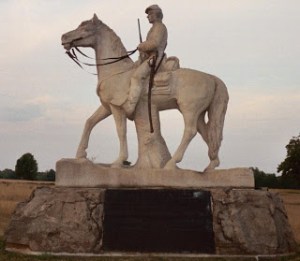
17th Pennsylvania Cavalry. The carbine barrel has been replaced, but I didn’t think it fair to hold that against it. The monument for the 16th PA is the same with the original barrel, but I can’t seem to find that one.

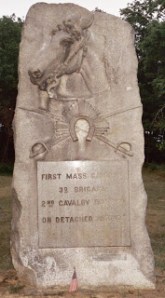
1st Massachusetts Cavalry. I liked the relief of the horse’s head, and it’s the only horseshoe that I recall seeing on one of the monuments.

6th Ohio Cavalry. I thought this image might have been more appropos on the 1st Vermont Cavalry monument, given their relative roles during the battle.


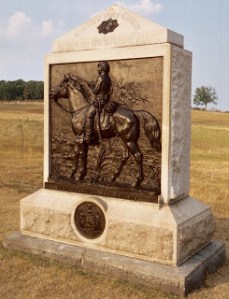
8th New York Cavalry. I liked this one, and wanted to include at least one monument with metalwork relief instead of marble. I really liked the inscribed motto of “Discovering the Enemy” as well.

8th Pennsylvania Cavalry. Definitely one of my favorites, though I’m not sure how he’s going to get his horse off of that tree stump….

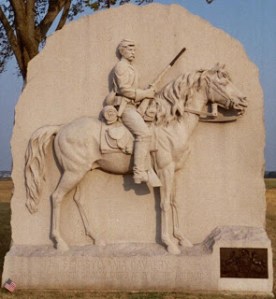
12th Illinois Cavalry. Very similar to the monument for the 8th Illinois, but I preferred the side view of the saddle to the frontal view at the top of the monument. There will be more about this regiment on this blog in the future, as they were one of the regiment that broke out of Harper’s Ferry prior to Antietam.

Once again, all votes are welcome, and feel free to nominate others. East Cavalry Field is not currently represented, I think they were eaten when my hard drive crashed.