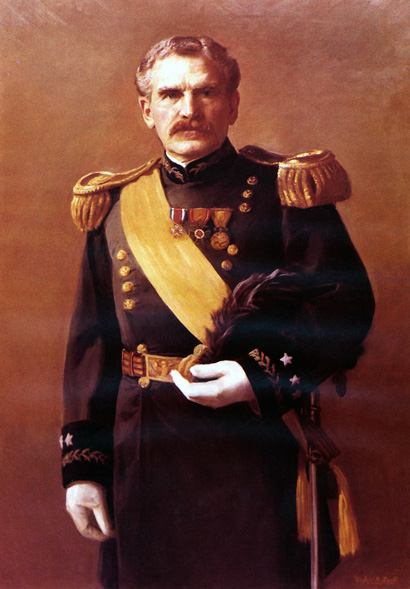
Fiddler’s Green: Adna R. Chaffee


Adna Chaffee’s story is a very interesting one. Despite the fact that he was the first soldier to rise from the rank of private to the position of Chief of Staff of the Army, and the first Army Chief of Staff who had not graduated from West Point, his accomplishments are much less well known than those of his son, the “Father of the Armor Branch.” This Fiddler’s Green entry will attempt to even the score a bit. The picture of Chaffee is from a 1973 oil on canvas painting by Cedric Baldwin Egeli.

Adna Romanza Chaffee was born on April 14, 1842 in Orwell, Ohio, where there is a historical marker documenting his accomplishments. One of twelve children, he was educated at a nearby country school. He determined to join the Union Army at the outbreak of the Civil War. While on his way to join a volunteer regiment at the outbreak of the Civil War, he encountered a recruiting party for the 6th U.S. Cavalry and enlisted as a private on July 22, 1861. He was promoted to sergeant in October and served in the Peninsular and Antietam Campaigns in 1862. In September 1862, he was promoted to first sergeant of Company K, 6th US Cavalry. Chaffee was promoted to 2nd lieutenant in the 6th Cavalry by direction of the secretary of war on March 13, 1863, but due to administrative delays he wasn’t discharged to receive the appointment until May 12th.

Chaffee was seriously wounded by a gunshot wound to the thigh at the battle of Fairfield during the Gettysburg campaign. He led a dismounted squadron on the left flank of the regiment which was overrun during the battle. Initially captured by the Confederates, he refused parole as a prisoner and they abandoned him when he could not be transported due to his wounds. He was treated by regimental assistant surgeon William Forwood, and returned to duty in early September. Chaffee received a brevet promotion to first lieutenant on July 3, 1863 for gallant and meritorious service during the battle.

On October 11, 1863, the 6th U.S. Cavalry was caught in an exposed position near Brandy Station and engaged by superior numbers of Confederate cavalry. They were able to fight their way back across the Rappahannock, but Lieutenant Chaffee was again wounded while commanding his company.

Lieutenant Chaffee served as the regimental adjutant for the 6th Cavalry from November 11, 1864 to December 12, 1866. He was promoted to first lieutenant, 6th U.S. Cavalry in February 1865. He was brevetted captain for gallant and meritorious service at the battle of Dinwiddie Court House, Virginia on March 31, 1865.

Chaffee remained in the Army after the war, and was posted with his regiment initially to Austin, Texas. He briefly resigned his commission while his commanding officer was on leave, but was persuaded to remain in the army upon his superior’s return after only a week as a civilian. Chaffee served as the regimental quartermaster from December 12, 1866 to October 12, 1867, when he was promoted to captain, 6th Cavalry. He fought in the Indian wars against various central plains and southwestern tribes from 1867 to 1894.

In February 1868, Chaffee and I Troop were assigned to Fort Griffin, Texas. On March 7h he was brevetted major for “gallant and effective service in an engagement with Comanche Indians at Paint Creek, Texas.” Later that year, he married Kate Haynie Reynolds on September 19th in Austin, Texas. They had two sons who both died in their infancy before she died the following year. Chaffee served the next three years in Texas pursuing hostile Indians and outlaws.

He spent the next three years on assignments in Kansas, Mississippi and the Indian Territory until the Red River War broke out in 1874. Chaffee and his Troop I were attached to Colonel Nelson A. Miles’ column in actions against the Cheyenne Indians. On August 30, 1874, he was cited for bravery for leading his troops in a charge against a superior number of Cheyenne warriors at Palo Duro Canyon, Texas.

On March 31, 1875 he married his second wife, Annie Frances Rockwell, in Junction City, Kansas. They had a son and three daughters, one of whom also died in infancy.

In the early 1880s, Chaffee moved to Arizona and New Mexico, where he had several engagements with the Apache Indians. He and Troop I bested the Apaches at the battle of Big Dry Wash, Arizona in July 1882, and accompanied General George Crook during his pursuit of the Apaches into Mexico on the Sierra Madre campaign of 1883. Finally, Chaffee co-commanded the 1886 expedition that led to the capture of Apache leader Geronimo.

On July 7, 1888, Chaffee was promoted to major in the 9th Cavalry, and spent the next two years constructing Fort Duchesne in southern Utah. He was brevetted lieutenant colonel on February 27, 1890 “for gallant service in leading a cavalry charge over rough and precipitous bluffs held by Indians on the Red River, Texas on August 30, 1874 and gallant service in action against Indians at the Big Dry Wash, Arizona on July 17, 1882. Chaffee served as the acting inspector general for the Department of Arizona from 1890 to 1893 and for the Department of Colorado until the fall of 1894. In 1895 he conducted the restoration of the Bannock Indians to the Fort Hall reservation in Idaho. He served as an instructor of tactics at the Army’s Infantry and Cavalry School at Fort Leavenworth from November 1896 to June 1897.

In June 1897, he was promoted to lieutenant colonel of the 3rd Cavalry, and served as commandant of the Cavalry School at Fort Riley, Kansas until 1898. He was promoted to Colonel of the 8th US Cavalry in early 1899.

At the outbreak of the War with Spain, he was appointed a brigadier general of volunteers on May 4, 1898 and assigned command of the 3rd Brigade of the 2nd Division of volunteers. His brigade was active in the Santiago campaign and effectively ended the campaign with the capture of El Caney in July, 1898. As a result of his performance during the campaign, Chaffee was promoted to major general of volunteers that same month. At the cessation of hostilities, he served as the chief of staff to the military governor of Cuba, General Leonard Wood, from 1898-1900. Chaffee was honorably discharged from volunteer service and promoted to brigadier general of the regular army on April 13, 1899.

When the Boxer Rebellion broke out in China in June 1900, General Chaffee commanded the 2,500 man U.S. China Relief Expedition sent to rescue Western citizens and put down the rebellion. His second in command was Major General James H. Wilson, another Civil war veteran who had won his first stars when Chaffee was a second lieutenant. The expedition consisted of six troops of the 6th Cavalry, a battalion of Marines, Riley’s Battery of six rifled guns, and the 9th and 14th Infantry regiments. His force played a key role in the rapid advance to the imperial capital of Beijing and its capture on August 14, 1900, relieving the siege of the embassy staffs and other Western nationals. Chaffee’s force was also very active in establishing order and halting looting in the city following its capture. The success of his mission made him somewhat of a celebrity among the Chinese as well as his troops and fellow commanders.

Chaffee was promoted to major general in the regular army on February 4, 1901. From July 4, 1901 until October 1902, he served as the military governor of the Philippines, succeeding General Arthur MacArthur. This period included the beginning of the second phase of the Philippine-American War, and his actions have been criticized in some circles as being less than enlightened. He conducted an Indian-style campaign instead of the “humanitarian warfare” approach used by MacArthur. Chaffee subsequently served as the commander of the Department of the East from October 1902 to October 1903. Following this assignment he helped organize the General Staff Corps of the army.

Chaffee was promoted lieutenant general in January 1904, and served as the Army Chief of Staff from January 9, 1904 to January 14, 1906. During his tenure, he oversaw a far-reaching transformation of doctrine, planning and organization in the Army. He served as grand marshal for President Theodore Roosevelt’s inaugural parade on March 4, 1905, which also included former adversaries such as Geronimo and Quanah Parker. He also went on a good-will tour of Europe on behalf of President Roosevelt. Chaffee also was awarded the honorary civil law degree of LL.D. from Tufts College in 1905.

Among his other accomplishments as Army Chief of Staff was the creation of campaign medals for the army. The move towards government-issued medals for campaign service actually started in China during the Boxer Rebellion. General Chaffee came into contact with military personnel from other countries who were also involved in the campaign, and was particularly impressed with the campaign medals worn by the British. In 1904, Chaffee wanted to explore the possibility of obtaining similar medals for American soldiers. A proposal was made through the acting Secretary of War to the president to authorize the use of badges to denote the wearer as a veteran of a specific campaign, and that these badges be prescribed and worn as part of the uniform. The important point was that the “badges” were to be designated as part of the uniform, not personal awards for individual veterans. The proposal was approved, and the first Army campaign medals (Spanish-American War; Philippine Insurrection; and the China Relief Expedition) were officially established on January 12, 1905. They were followed by campaign medals for the Civil War and Indian Campaigns on January 21, 1907.

General Chaffee was retired at his own request on February 1, 1906, after a 45 year career. His son, Adna R. Chaffee, Jr., graduated from West Point that same summer. After his retirement, Chaffee moved to Los Angeles, where he was appointed President of the Board of Public Works for the city. He was also named a member of the Board of Visitors of West Point, and served as the first president of the Southwest Museum. Additionally, he was an original member of the District of Columbia Commandery of the Military Order of the Loyal Legion of the United States. He died of typhoid pneumonia in Los Angeles, California on November 1, 1914, and is buried with his second wife at Arlington National Cemetery.

Sources:

Carter, William G. From Yorktown to Santiago with the Sixth U.S. Cavalry (Austin, TX: State House Press, 1989)

Carter, William G. Life of Lieutenant General Chaffee (Chicago: University of Chicago Press, 1917).

Heitman, Francis B. Historical Register and Dictionary of the United States Army (Washington: Government Printing Office, 1903), page 292.

Henry, Guy V. Military Record of Civilian Appointments in the United States Army, Volume I (New York: D. Van Nostrand, 1873), pgs 142-143.

Military Order of the Loyal Legion of the United States (http://suvcw.org/mollus/)

Muster Rolls, 6th U.S. Cavalry Regiment, NARA.

Webster’s American Military Biographies (Springfield, MA: Merriam, 1978)

Who Was Who in America, Volume I: 1897-1942, page 206.

Bates Letters – July 24, 1862

Note: I’m trying to get the last couple of 1862 letters out this month, so I can start 2008 with 1863 letters. In this installment, Bates goes fishing and makes some plans for settling down. His aversion for African-Americans continues, and remains unexplained.

Harrisons Landing Va,
July 24th 1862
Dear Parents,

I received a letter from Johnson last night and am glad to hear you are doing well. The Union will not find many fighting supporters among you, if they are all like the “blow-hards” Johnson writes about. I forget what your opinion of a nigger is, but suppose a white man is just as good in your eyes if he only behaves himself. I don’t know where my aversion to a nigger comes from, but its of no use for me to try to think of them with the “brotherly regard” H.Gy. recommends. I can’t do it. They don’t look right.

I have been speculating the past two weeks in good old fashioned style. I think the fashion is about as old as the world for Christ found the greater part of his Apostles following the same business big Fishing; I got a net in an old fish house on the bank of the river, and, with five other men, fixed a boat. And went to work. We make six hauls a day, each man having his haul and he whose haul it is has the choice of ground to haul over. You would hardly believe the quantity of fish we catch all of which we find a market for without leaving the river in this way. I have made $17 a day and generally average from $10 to $12. I was offered $100 for the whole fixins, and think I shall sell out, as my stay in the land is uncertain. I might be off for Richmond tomorrow, not very likely, though.

The Pay-master is around, and has humored us with a look at his Benevolent countenance, and the tender of certain paper acknowledgements of the pecuniary indebtedness of the U.S. called “green-backs” Union-plasters. Toad-skins Treasury-notes, which I need not say, were accepted. I have now on hand so much money that I think I shall send some by Adams Express, yes, I will tomorrow. I will sell my net and remit the proceeds to you to-morrow. I want you to look around and see if there is a good chance to invest a few hundred dollars in real estate, for the genius of speculation is on me, and I think I shall make $500 more before my time is up. If you know of a House and land, that is worth about $1000.00 let me know about it, and if you think it a good bargain, engage it I will try to pay for it. To-morrow I shall send by Adams Express Co to this Address

Mr Isaac Bates
Oakville
Litchfield County
Conn.

the sum of ($335) three hundred and thirty five dollars. Two hundred and fifty you will please to invest or lay up for me, the rest you can appropriate. I am in good, or rather, in the very best of health and hope this finds you as well.

I remain affcty
Charles E. Bates

Cavalry Journal/ Armor Cumulative Indices 1888-1968

As mentioned below, I located a copy of this work recently and promptly ordered a copy. It arrived yesterday, and after an initial perusal during my lunch hour I am pretty impressed.

The book contains two different indices for every article published in either the Cavalry Journal or its successor, Armor Magazine, from 1888 to 1968. It was compiled by Walter E. Young and edited by John J. Vander Velde. Every single article published during that period is referenced by Author and by Subject/Title.

The scope of the work is very impressive, doubly so when one considers that this was compiled before the availability of computers. The editor states in his preface that this was done by index cards, one article at a time, then cross-referenced onto other index cards.

The only downside of the book that I’ve noticed so far is that the Subject/Title index may take some digging to find what one is looking for. This isn’t that difficult, however, as one simply needs to check several keywords until the right one is found. In the editor’s words, “In formulating the subject headings based on keyword approach, it was constantly kept in mind how users of this volume would most likely extract information.” If one knows the author, there’s is no problem at all.

Overall, I think this is an excellent work. It serves as a great link for directing searches of existing collections at places like USAMHI at Carlisle Barracks. For those of us who employ researchers to gather information for us by proxy, it is very valuable.

Yet another reference

So there I was, wandering internet used book sites this weekend minding my own business, when I stumbled across what may be another quality Civil War reference. I was the Alibris site when I discovered the Cavalry Journal/ Armor Cumulative Indices, 1898-1968.

This work should be a comprehensive index of all of the articles published in the Cavalry Journal (aka Journal of the US cavalry Association) and Armor Magazine during the years mentioned in the title. The reason I find it exciting is that the Cavalry Journal was the professional journal for cavalry during this entire period. Many articles were published by veterans after the Civil War. Among the more well known in my particular field are “With The Reserve Brigade” by Moses Harris.

Given the number of Regular cavalry officers who remained in the army following the war and went on to achieve significant rank, I would imagine there are other articles which will also offer greater insight into mounted operations during the war.

I may be overestimating its significance, but given how little I’ve seen of such a reference I think there will be new ground to be unearthed perusing this work. Time will tell, and for less than $20 it is certainly worth a look.

Teacher and mentor

Brian Downey had a great entry on Delos B. Sackett over at Behind Antietam on the Web on Tuesday. As always, Brian’s post added that little something extra that makes the reader remember the post and the person.

As I was reading the entry, I noticed that Sackett was an Assistant Instructor of Cavalry Tactics at West Point from 1850-1855. I was curious about which future cavalry leaders he might have influenced, so I pulled out the trusty Cullum files and checked to see who went through the academy during this period who later became a cavalry officer.

The list includes six cavalry leaders who reached brevet Major General. Eugene A. Carr, Kenner Garrard and David S. Stanley for those interested in the western theater; August Kautz, David McM. Gregg and William W. Averell for those eastern theater afficionados among us. Among other significant leaders listed at this time (the classes were mandatory) was one Philip H. Sheridan.

It’s of course impossible to gauge Sackett’s influence on which branch the cadets under his tutelage chose during the period that he was at West Point, but I thought it interesting.

Civil War Regiments

As I was blog-surfing recently, I noticed a link on Ted Savas’ new blog, A Publisher’s Perspective. The link said “Civil War Regiments.” Given my interest in the cavalry, I was naturally intrigued and clicked the link.

To my surprise and delight, it was not a link to regimental histories. Instead it links one to a website where back issues of the now-defunct “Civil War Regiments: A Journal of the American Civil War.” As described on the website:

“Civil War Regiments (CWR) was a quarterly publication created in late 1991 to fill a conspicuous gap in Civil War literature. Although several excellent publications are available, only CWR offered exclusively military coverage of the war (all theaters, all branches, Federal and Confederate) in a lengthy, documented and non-partisan format. Each issue is a book, not a stapled magazine. Each book includes original articles on all aspects of the war, including strategy, tactics, logistics, unit histories, leadership and command issues, and much more. Each book includes original maps and numerous photos and illustrations.

“CWR offers lengthy essays of substance. Reach beyond the glossy photos, short articles and cut-and-paste history. CWR is fresh, original scholarship on topics you will not see covered elsewhere, coupled with the best maps and book reviews in the business. Each book is printed on acid-free 50-lb. paper, and the covers are laminated gloss color stock for long, durable use, with a printed spine for easy library shelf reference.

“Unfortunately, when the underlying book business was sold in 2001, CWR was left without a home and publication ended with Volume Seven, No. 1. These collector’s issues are selling out fast, several issues are already sold out, and many more are in short supply.”

Among the various titles on the back issues site are issues on Gettysburg, the Red River Campaign, Chickamauga & Chattanooga, and others. The articles’ authors include many experts in their respective fields, as well as some I was unfamiliar with. The journal looks like an excellent product, and one or more back issues will likely be of interest to readers of this blog. I highly recommend a visit.

Harpers Ferry Update

Okay, I’m back after the long weekend relaxed, recharged and ready to get back to work. The projects continue to bubble up (something we referred to as mission-creep in my former line of work), but I thought I’d revisit one of the ongoing ones that has expanded far beyond the short term status where it originated.

The study of the escape of the cavalry from Harpers Ferry continues. Each time I think I’m nearly finished, more material pops up. Brian Downey was kind enough to send along Allan Tischler’s book on the expedition, which I’m still working my way through. It is a very well-researched book, but the way it’s laid out makes it very difficult to work through. Virtually every version of the story is examined, with various errors and cases of plagiarism identified in each. Unfortunately, the method of examination doesn’t lead to a coherent narrative of what did happen, making the work more of a critical bibliography than a history. A very good reference book, in any case. Thanks again, Brian.

Don Enderton was also kind enough to forward copies of his father’s personally published The Private Journal of Abraham J. Warner, which should provide some interesting insights and information as well. This is a primary source that I hadn’t been able to locate anywhere else, so Don’s generosity is greatly appreciated. I’m really looking forward to reading it.

So much research, so little time….

Bates letters – July 10, 1862

Editor’s note: In which we discover Bates’ feelings for a certain New York Times correspondent’s coverage of the battles of Malvern Hill and White Oak Swamp. He also provides an account of the battle of Gaines Mill. I’ll be checking over the weekend on his allegations of flight by the 6th Pennsylvania Cavalry, as I don’t recall reading of it before. All of the parentheticals save the occasional (sic) were included in the original text.

Harrisons Landing Va.
July 10th 1862
Dear Parents,

I have not written to you for a few days back because I thought you would get all the news in the papers, but if all the papers give the same description of our late fights here, don’t believe anything you read about us. I enclose a few pieces of the “New York Times” July 8th, as sample of the way they will make a mountain of a mole-hill. It seems the correspondent was only with one division, and trusted to guesswork for the details of the rest of the Army. He says, “The great mass of the Army were not apprised until (sic) midnight of Friday of the intention of Genl McClellan to change his base from the York to the James rivers.” Here is mistake No. 1. True the intrenchments (sic) were not evacuated but the “great mass of the Army” were ready for a move long before, but I don’t think the Genl took the trouble to inform the Army what his plans of movement were. He then goes on to say “It commenced to move at 4 Oclock just before the sun” when it was raining in the morning and the sun didn’t appear till late in the forenoon. He speaks of the awful destruction of the Government stores and thinks three millions will hardly cover the loss. I think I could pay for all the property destroyed with one million and have many left after.

He then, after describing the battles of Allans farm, and Savage Station, gets the hype about the wounded left at Savage’s. Now nearly all were removed from there and I doubt secesh got as many hundred as he says thousands. The next piece of absurdity is the description of the battle of Nelsons farm, he seems to think Genl Richardson was commander in chief and had the whole battle to himself nearly. But McClellan himself formed the line of battle and was on the field at “Nelson’s Farm,” or White Oak Swamp, more properly, until he had to go to Haxall’s Landing and look after affairs there leaving Genl Sumner in command at White Oak. The battle of Malvern Hills was fought on the same day, (Monday) and was not the tremendous affair described, on the whole, none of the descriptions are correct, and I think the special correspondent got his news from hearsay, perhaps from the Lieut. Charles Draper, who brought reinforcements to Heintzelman “through a murderous fire,” preferring to keep at a safe distance during the fight, a course followed by a great many of our gallant volunteers who were more interested in looking for the Gunboats or for a pontoon-bridge than in looking for their regiments from this time. I was not on the field where “fights were won” until the battle of “Malvern Hills,” but this was Monday instead of Tuesday, and didn’t commence untill half past four in the afternoon. Instead of the rebs marching up by divisions they stuck to the woods like some of our own volunteers and fighting was all done by artillery. Our Captain picked enough stragglers to form two full regiments and asked permission to take them to the front and give them some fighting to do. He acted as Brigadier General of them himself and supported a battery in good style but didn’t get a chance to do any fighting. The whole squadron were kept busy picking up stragglers or recruiting for McIntyre’s Brigade, as we called it.

I slept soundly on Tuesday on Malvern Hills and wasn’t troubled with the rain which the correspondent says came down in his description of camp on James river.

In conclusion his summary of killed, wounded and missing is one of the biggest lies ever published. I thought at first our loss would be from 12 to 15,000 but now I am positive it is not over 12,000 in all.

While I am in the humor I will write what I know about the affair commencing with Thursday afternoon when I wrote my last letter in Camp Lincoln. I believe I had hardly got the letter in the post-office when the firing commenced on the right. This was McCall’s Division in action, and they stood their ground so well that they were driven out of their camps, and would have been driven off the peninsula but for Porter’s Division which retook the lost ground and held it. That evening Genl McClellan sent word to Porter “to make a stubborn resistance and fall back to the Chickahominy next day.” The answer received was this —

“I can keep the enemy in check and spare part of my force if you want.” Upon this McClellan rode over to Porter’s and I suppose explained to him what he wanted done. At any rate all the waggons (sic) and property with Porter’s and McCall’s Divisions were immediately sent to the west side of the Chickahominy leaving only troops the other side. Ambulances were also sent for the wounded but most of them stopped to cook breakfast for the drivers and feed the horses so they were late in getting up to the battlefield and about three hundred wounded were left in consequence. The firing commenced at daylight Friday, but I went to sleep after breakfast, being up all night, and when I woke up about 10 Oclock it was as quiet as you please. We packed up everything, and at two Oclock headquarters was moved to Savages Station. Our squadron however was employed in collecting stragglers and sending them back to their regiments for the action had commenced again, and hundreds of runaways were coming across the Chickahominy with stories of their regiments being “cut to pieces.” About one Oclock Porter sent for reinforcements saying he had only a “handful of regulars left.”

“Send the regulars into it and I will let you have reinforcements in two hours,” was the reply. Accordingly the regulars (Sykes brigade) were put to work, and they drove a force that had driven four brigades of our troops, in spite of all the secesh could do; the Fifth New York was also in this brigade. They are men. About five Oclock reinforcements came up and relieved the regulars, and then the secesh took their turn at driving. A battery of ours supported by the 5th Cavalry 7 companies 1st Cavalry 4 companies regulars, and the gallant Colonel Rush’s regiment of Pennsylvania lancers came in danger of being taken when Genl Cooke commanding the cavalry ordered a Charge. The 5th started followed by the 1st, but the Gallant Colonel Rush’s Lancers charged the wrong way and broke a brigade of Infantry in their flight in most ludicrous style. Some of them never stopped running until they got across the Chickahominy. The 5th however saved the battery but failed to do much execution among the secesh. Our troops now commenced to retreat in a hurry, and but for the timely arrival of Meagher’s brigade with some other troops the grand army would have been put to flight. They however checked the enemy until night and withdrew to the west side of the Chickahominy. An assault was also made on the right of our intrenchments (sic) at sundown but it was no use knocking.

In the evening Genl Porter had a talk with Little Mac again, at the beginning of which Mac grasped Porter by the hand and asked him “Well what do you think of your ‘handful of regulars’ now.” (truth)

Send me some postage stamping. I am well.
Affect.
Charles E. Bates

New additions

Some of you may have noticed a few new additions on the blogroll to the left of my homepage. I’ve done a bit of editing lately, and there will be more to come over the holidays as a few of the listed blogs appear to have petered out. There are two new additions that have proven very interesting to me so far.

The first is publisher Ted Savas’ A Publisher’s Perspective. This is of course not a Civil War specific site, but his first view posts have been very interesting and his publishing house has brought us several great Civil War books in recent years.

The second is Wig-Wags, a blog by Rene Tyree, who is currently a graduate student and started a blog to help her keep her research organized. Although only a few posts old, her entries to date have been both interesting and well thought out.

Welcome to the blogosphere, both of you.