• About

Regular Cavalry in the Civil War

Regular Cavalry in the Civil War

Category Archives: Uncategorized

Civil War Magazines

10 Friday Aug 2007

Posted by dccaughey in Uncategorized

≈ Leave a comment

I’ve watched the blog discussions over editing and ownership shifts of a couple of Civil War magazines during the past week with a great deal of interest and very little expertise. I don’t see it as my place to weigh in on changes good or bad, but the discussion has prompted a question: which is the best Civil War magazine, in the opinions of my readers? (both of you)

I realize each has a different focus and to some extent a different audience, but which one is the best publication? Why do I ask, you ask? For a couple of reasons. First, I’m curious what you think. Second, while I don’t intend to subscribe to all of them, I do plan to subscribe to one or two in the near future. It’s both more economically sound and a great deal less frustrating than trying to find them in the local bookstores since my return to the mountains (I’m still looking for that September 07 N&S issue, is it out in stores yet?).

So, what do you think?

Accidental Tourist

08 Wednesday Aug 2007

Posted by dccaughey in Uncategorized

≈ 3 Comments

I had several planned stops on my long drive home to see Civil War sites of note, but I think I had more luck with the places that I stumbled upon accidentally than the planned ones. My wife usually navigates on our trips, and I definitely missed her presence on this trip.

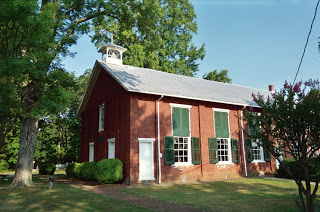
Hartwood Church was my first stop. I was driving north on highway 17 just north of Fredericksburg, when I noticed a sign that said Hartwood. Just after that a large truck pulled out in front of me, forcing me to slow down. The next road was Hartwood Church Road, so I had to make a quick stop. The church was the site of an engagement between Confederate and Union cavalry forces on February 25, 1863. Confederate Brigadier General Fitzhugh Lee, with elements of the 1st, 2nd and 3rd Virginia Cavalry, conducted a raid on the Union encampment here. He thoroughly surprised the Union forces, capturing over 150 men and numerous horses before escaping unscathed back across the Rappahannock. The best description of the engagement that I’ve seen is in Eric Wittenberg’s The Union Cavalry Comes of Age. It was nice to get to see the place after reading about it; it hadn’t occurred to me that it might still be intact. Although it was damaged severely over the course of the war, it was repaired and is still intact today as illustrated by the picture below.

My next stop was Harper’s Ferry, one of the planned halts. I’d hoped to find out more information on the breakout of the Union cavalry forces during the siege of the town by Jackson’s forces just prior to the battle of Antietam. I found the place rather disappointing, but this may have been because I was there for a specific purpose and they didn’t have what I was looking for. It just seemed to me that there wasn’t a great deal of energy amongst the staff there, and that given the history of the site there was potential for a lot more. If I was advising a traveler, I’d have to recommend it as a possible side trip, but not a destination.

The next leg was the fun part of the drive, from Harper’s Ferry to the Antietam battlefield. It was here that I missed my wife’s presence the most. I was so busy looking at the historic buildings in Boonsboro that I missed my turn. This actually turned out to be fortunate, as I realized that I’d missed it when I reached the site of the battle of Funkstown. Seeing the site gave me a better appreciation for the battle, as did the brief stop at the site of the cavalry skirmish at Boonsboro on my way back to the missed turn. The countryside is very pretty around there, well worth the drive even if one isn’t looking for skirmish sites.

I really enjoyed Antietam, and think it is one of the best Civil War battlefields to visit, along with Chickamauga and of course Gettysburg. It was great to see it in such good condition. Alas, I didn’t get the chance to meet Ranger Mannie, but the tips Brian Downey sent for touring the battlefield proved to be a great help. Thanks again, Brian.

Putting Antietam behind me, I turned my trusty steed towards Gettysburg. Not always one for the shortest distance between two points, I also stopped on South Mountain, and was surprised to discover that it’s only 1200’ high. I’d thought it was bigger for some reason.

Upon arrival at Gettysburg, I visited South Cavalry Field for the first time. I’d never quite made it there on previous visits. I managed to find all of the Regular cavalry markers, even the two down in the low ground off of Ridge Road. And I finally got a picture of my own of the 6th Pennsylvania Cavalry monument nearby.

After my visit to South Cavalry Field, I stopped at the Nat ional Cemetery to find the graves of the 6th Cavalry troopers buried there. I don’t know where the few men killed from the other regular cavalry regiments are buried, but I couldn’t find a record of them there. I did find an intriguing reference to a diary of a 6th Cavalry soldier that I hadn’t heard of before, but I’m still in the process of trying to track it down.

A brief visit to the bookstore across the street at the visitor center revealed that Gettysburg’s Forgotten Cavalry Actions is indeed sold out, and has been for some time. Eric, if you still have a few copies stashed away, you might want to send them their way. It sounds like the book is missed on the bookshelves there.

I made a quick tour of the battlefield, trying to get pictures of all of the cavalry monuments. I didn’t make it to East Cavalry Field this time, but I think I already have pictures of those from my last trip. The only one from the rest of the battlefield that I know that I missed is the marker for Company A, 1st Pennsylvania Cavalry, as I ran out of film. I even found the markers for the 5th New York and the 1st Vermont that bloggers were discussing last week. I’ll have an entry soliciting votes for the best Gettysburg cavalry monument in the near future.

After dinner, I was able to walk Gamble’s and Devin’s lines as the sun set before returning to my hotel. It was a full day, but a very enjoyable one. The rest of the trip was faster, but not nearly as much fun.

The Journey Begins

02 Thursday Aug 2007

Posted by dccaughey in Uncategorized

≈ Leave a comment

Well, the horse being fixed, my foot being fixed, and the last of the silly Army paperwork over with, I shall start for home today. Despite the previous bad luck, I will once again attempt the Harper’s Ferry/ Antietam/ Gettysburg trip today (the differences between foolishness, stubbornness and perseverance seem to be in the eyes of the beholder). Posting is liable to be infrequent through the weekend as I make my way back to Colorado, but hopefully I’ll have some good pictures to post next week.

Thoughts on Cavalry Raids

22 Sunday Jul 2007

Posted by dccaughey in Uncategorized

≈ Leave a comment

I was reading David Evans’ excellent work Sherman’s Horsemen this morning when I started pondering the differing natures of cavalry raids between opposing sides and the different theaters over the course of the war.

During the Atlanta campaign, Sherman made excellent use of his cavalry to force the Confederate forces in front of him to extend their lines or reposition. He often had difficulties getting his subordinate cavalry leaders to do what he wanted them to, but I freely admit I hadn’t given him credit for the adept use of his mounted arm. Their immediate objectives were generally destructive in nature (bridges, railroads, factories, mills, etc), but his objectives for them was to shift enemy forces so he could maneuver his army. The differences between tactical and strategic objectives, to use the proper terminology.

Confederate raids in the western theater seem to me to have focused on destruction of supplies and infrastructure to inconvenience their opponents, but lacking this strategic focus. Forrest’s, Morgan’s, and Wheeler’s raids all caused damage, but I can’t recall their actions being tied to strategic moves by their higher headquarters. Admittedly, this is not my area of expertise. Please feel free to speak up if you think I’m in error.

The raids conducted by the cavalry of the Army of the Potomac also at first glance appear to be nearly universally destructive or combative in nature. Stoneman’s raid, Sheridan’s raids and his Valley campaign all targeted destruction of infrastructure or enemy forces. Like those of Sherman’s subordinates, they were tied to strategic objectives of the army’s commander. In Hooker’s/ Stoneman’s case, they weren’t necessarily well thought out, but they did have a strategic objective.

Grant’s use of his cavalry during the Overland Campaign of 1864 seems similar to Sherman’s, though I haven’t to date examined it from the army’s standpoint instead of the cavalry’s. (But I’d like to: any suggestions for a good single-volume source on the campaign?) Certainly Grierson’s raid earlier in the war was planned and executed with a higher purpose in mind.

The “raids” of the cavalry of the Army of Northern Virginia, however, seem different to me. I can’t think of a single one that was not tied to strategic decisions and/or moves to be made by the army. They almost invariably seem to be focused on reconnaissance, however, and not on destruction of enemy forces or equipment. Yes, the odd supply dump was looted when encountered in the course of a raid and extra mounts were always desirable, but that generally wasn’t the object of the raid in the first place. True, later in the war they were generally fighting better-equipped, more numerous foes. I can’t help wonder, however, what might have happened had Stuart attempted earlier in the war what Sheridan did in early 1864 — seek out the enemy’s cavalry for the purpose of forcing a fight and defeating it. He didn’t, of course, so the point is moot.

I’ll stray briefly from the original purpose of this post to pursue one more thought. I wonder if a case could be made that the Union cavalry came of age because they were allowed to. I don’t think they were ever specifically targeted by Lee or Stuart. Given the perceived dominance of Stuart’s cavalry going into the winter, there would appear to have been an opportunity there, even with the rotation of some brigades to other areas for better forage. While there was a great deal of self-imposed rigor, as they were strung out over dozens of miles of pickets for the army’s main body, I don’t think they were harassed or attacked much by Confederate forces at all. Indeed, this is one of the reasons why Fitzhugh Lee’s raid at Hartwood Church was so effective.

Enough fuzzy musings for now, back to research.

Bates letters, March 1861

17 Tuesday Jul 2007

Posted by dccaughey in Uncategorized

≈ Leave a comment

Fort Smith, Ark. March 8, 1861

Dear Parents,

When I wrote my last letter to you I did not think that it was to be my fate to become what I now am, a General prisoner, but here I am in a cell 10 feet long by 4 wide, and my feet connected with a chain eighteen inches long and about as many pounds in weight.

And what, you say, have I done!! I will tell you. I have acted like a man, and an action which no honest one would blame me for has made me what I am, a prisoner.

The night before last some of the secessionists in town hoisted a flag opposite of the gate of the fort bearing for a device 8 stars and a pistol and bowie knife crossed. This appeared to be an insult to the soldiers and union so I went out and pulled it down and on being ordered by my captain to put it up again I tore it into ribbands the dirty flag that’s what I am in for chained like a murderer.

But I can’t write any more now so goodbye
My love to all

Pray for your most unfortunate
Charles

Updated Links

17 Tuesday Jul 2007

Posted by dccaughey in Uncategorized

≈ Leave a comment

Finally got around to updating the Related Links section of the blog. I realized last night that there were several sites that I’ve been visiting for months that I always access from someone else’s page. This has now been corrected, though there are more updates to be made.

No, I haven’t been stalling just to tease, these job search things take time. The first Bates letter will be posted later today.

Introducing Charles E. Bates, 4th US Cavalry

15 Sunday Jul 2007

Posted by dccaughey in Uncategorized

≈ Leave a comment

In the course of my explorations of the Virginia Historical Society, I encountered the Civil War letters of Charles E. Bates. I’ve decided to periodically post his letters in the interest of improving the human interest aspect of this blog. Bates’ observations are entertaining and often humorous, and his squadron served in both theaters over the course of the war.

Born in 1844 in Connecticut, nearly all of the correspondence is with his parents. He apparently ran away and enlisted in the cavalry in 1858, at age 14. The first letters that I found are from Secretary of War John B. Floyd to the Honorable W.D. Bishop, a Connecticut member of the House of Representatives. Mr. Isaac Bates, one of his constituents, had sent him an application for a discharge from the Army for his son, who was a minor. Orders were accordingly forwarded by Adjutant General Samuel Cooper to Fort Leavenworth on May 1, 1858 directing his discharge. I haven’t made up my mind yet on what the continued service of a 14 year old says about the army of the time. The charitable will assume he was large and mature for his age.

The directed discharge apparently didn’t happen. The next item I found was a set of orders dated March 27, 1861 from Adjutant General Lorenzo Thomas to the commanding officer of Fort Smith, Arkansas. These orders directed the discharge of “Charles E. Bates, private, Company E, 1st Cavalry, who was enlisted when a minor, without the consent of his parent or guardian.” The order went on to list the various conditions enabling the commanding officer to suspend the discharge, and directed him to immediately report all of the facts pertaining to the case to the War Department. Unfortunately for Bates’ parents, Charles had met one of those criteria before his discharge orders reached Fort Smith.

More Regular Volunteers

14 Saturday Jul 2007

Posted by dccaughey in Uncategorized

≈ Leave a comment

I continue my efforts to track down as many as possible of the soldiers from volunteer units who transferred to the Regular Cavalry in 1862, primarily from infantry units. I spent some time yesterday and today with a few Pennsylvania and Ohio regiments, and found another 31. Not all of them from the 6th, of course, but the idea is to work on all six regiments.

Rather than work completely at random, I decided to make a list of the regiments in the Army of the Potomac from about this time period (the majority seem to be November-December 1862). I was helped in my choice by the remarks section for two privates from the 28th Pennsylvania Infantry: “wounded at Antietam, transferred to US Cavalry.” The timeframe being about right, I quickly navigated my way over to Brian Downey’s excellent Antietam On the Web site and checked his order of battle listings for the Army of the Potomac. To be sure, all of the AoP didn’t fight at Antietam, but it’s a solid starting point.

Using this listing, I’ve since been chasing muster roll lists. The best site for this that I’ve found is Pennsylvania in the Civil War. The organization and detail of the site is absolutely fantastic. I really like the format, and will likely use something similar as I complete each regiment. I found a good Ohio site as well, but haven’t had any luck as yet with the New York regiments.

Not all regiments had people volunteer for the cavalry, though they appear to have been targeted by particular branches of service. In the 27th Pennsylvania, for example, every soldier but one who volunteered for Regular service chose the artillery (1st or 2nd Regiment) except one. In the 28th, nearly all chose the cavalry. In several Ohio regiments, many transferred to the navy.

It’s slow and tedious, but progress is being made. And I’m almost happy with the officer database format. Other than that, I’ve simply been transcribing a number of manuscripts, but that’s a post for another time.

Fiddler’s Green: Curwen B. McLellan

12 Thursday Jul 2007

Posted by dccaughey in Uncategorized

≈ Leave a comment

Curwen Boyd McLellan was born on April 7, 1829, in Merton Hall, Wigtonshire, Scotland. He immigrated to the United States by 1849, enlisting as a private in Company B, 3rd US Infantry on November 17th of that year.

He progressed from private to corporal to sergeant to first sergeant in Company B before transferring to Company A, 1st US Dragoons. On August 7, 1854, he transferred to Company H, 2nd US Cavalry as a private. He was promoted to sergeant in the same company and served there until June 11, 1861.

He received an appointment as a second lieutenant in Company B of the newly forming 3rd Cavalry on May 14, 1861, and accepted the appointment on June 11th. He joined his company in Bladensburg, Maryland on August 26, 1861, according to the regimental muster rolls. His company commander was one Captain August V. Kautz.

McLellan served as the regimental adjutant from October 1 to November 30, 1861 before a transfer to Company C. He commanded the company from January to February 1862 in the absence of the assigned captain and first lieutenant. He accompanied the regiment when it deployed to the Peninsula campaign in March, temporarily assigned to Company A from March to August 1862. and served there with distinction. He was made a brevet first lieutenant on May 5, 1862 for gallant and meritorious service at the battle of Williamsburg, where he was wounded. He was evacuated to a hospital in New York to recover from his wounds, where he remained until September. He was promoted to first lieutenant in Company L on July 17, 1862, and joined his company in October.

He was assigned to General Pleasonton’s staff in January 1863, returning to his company the following month. In March he was temporarily assigned to command Company C in the absence of all of its assigned officers. He was made a brevet captain on July 3, 1863 for gallant and meritorious service in the Gettysburg campaign, when he was once again on General Pleasonton’s staff through October. He eventually made his way back to the regiment.

McLellan received a brevet promotion to major for gallant and meritorious service at the Battle of Dinwiddie Court House on March 31, 1865. A few days later, during the battle of Sailor’s Creek, he was ordered to seize a strongly held group of log huts in a dismounted charge. Seeing his men hesitate, McLellan faced them and said, “Men, let us die like soldiers.” Every one of the men reportedly charged with him, and the huts were seized with a loss of only three wounded.

Curwen McLellan was promoted to captain in the 6th Cavalry on July 28, 1866. He married Susan E. Carmack in Frederick County, Maryland on Christmas day of the same year. He accompanied his regiment to the frontier, where he served with distinction. The first Mrs. McLellan died their without issue in 1869.

On July 6, 1870, Captain McLellan set out from Fort Richardson, Texas with a troop of 56 men from four companies of the 6th Cavalry. He was dispatched in pursuit of a group of Indians who had attacked a mail stage. On July 12th, he encountered a war party of approximately 250 Kiowas led by Kicking Bird near the north fork of the Little Wichita River. After a brief skirmish, McLellan led his men on a fighting retreat in the direction of the fort. He conducted this defensive engagement so skillfully that he lost only two men, and the Kiowas abandoned their chase of the badly outnumbered column the next day. Thirteen Medals of Honor were eventually issued for heroic conduct during the engagement.

McLellan married a second time in 1872, to Alice Gilbert. They had three children, two girls and a boy, before she died in Arizona in 1879. He was again recognized for an engagement with hostile Indians in the San Andreas mountains of New Mexico on April 7, 1880.

He was promoted to Major of the 10th Cavalry on December 30, 1881. He was made a brevet lieutenant colonel on February 27, 1890 for gallant service in actions against Indians near the Red River, Indian Territory and the aforementioned engagement in New Mexico. He was promoted to lieutenant colonel of the 3rd Cavalry on May 6, 1892, and transferred to the lieutenant colonelcy of the 1st Cavalry three weeks later.

McLellan retired from the army on April 7, 1893, with over 43 years of service. He married a third time, this time to Margaret Kelso, who bore him another son and daughter. He died August 24, 1898 in St. Louis, Missouri, and is buried in Arlington National Cemetery next to his wife Margaret.

Staff Woes

08 Sunday Jul 2007

Posted by dccaughey in Uncategorized

≈ Leave a comment

I came across a picture recently of General Alfred Pleasonton and his staff taken in Warrenton, Virginia in October of 1863 (the picture itself can be found at CivilWarPhotos.net and the Library of Congress). I’m not personally a fan of Pleasonton, but as I read the caption something jumped out at me.

Of the 21 officers listed on his staff, 7 were Regulars. They included the Colonel of the 1st Cavalry (who surely had something better to do, like leading his regiment), 2 lieutenants of the 5th Cavalry, and a captain and 3 lieutenants of the 6th Cavalry. Additionally, there was a lieutenant colonel, a captain and a lieutenant from the 6th Pennsylvania Cavalry. To say the least, the Reserve Brigade was well-represented, composing half of his staff. No wonder the regular regiments were constantly short officers, as Pleasonton was hardly the only officer doing this.

Interestingly enough, he didn’t have any officers from his own regiment (as much as it pains me to admit it, he was an officer in the 2nd Cavalry throughout the war) on his staff at this time. I wonder why….

← Older posts
Newer posts →

Recent Posts

  • 5th U.S. Cavalry at the Stone Fence
  • Thomas Montgomery, 1st U.S. Cavalry
  • Thomas Corbett, 2nd US Cavalry
  • Charles W. Canfield, 2nd U.S. Cavalry
  • Michael Shaughnessy – 2nd U.S. Cavalry

Meta

  • Create account
  • Log in
  • Entries feed
  • Comments feed
  • WordPress.com

Blogs I Follow

  • Maine at War
  • Emerging Civil War
  • History Radar
  • A Meaningful Finale
  • The Task at Hand
  • Bull Runnings
  • Army at Wounded Knee
  • Crossroads
  • Campaigns of the U. S. Civil War
  • Irish in the American Civil War
  • To the Sound of the Guns
  • Daydreams of the Soul

Enter your email address to follow this blog and receive notifications of new posts by email.

Join 195 other subscribers

Regular Cavalry in the Civil War

Regular Cavalry in the Civil War

Buy a copy of my book!

From McFarland & Company or contact me directly.

Enter your email address to follow this blog and receive notifications of new posts by email.

Join 195 other subscribers

Don

dccaughey@aol.com
1-719-310-2427

Blog at WordPress.com.

Maine at War

Maine at War explores the Civil War as experienced by the men and women from Maine who lived during the tumultuous period.

Emerging Civil War

Providing fresh perspectives on America's defining event

History Radar

A Meaningful Finale

A 28-year Army veteran takes to the Appalachian Trail to contemplate a life well served & the road ahead

The Task at Hand

Powered by Human Intelligence

Bull Runnings

A Journal of the Digitization of a Civil War Battle

Army at Wounded Knee

A blog dedicated to documenting through primary sources, the Army's actions at Wounded Knee

Crossroads

Where history, scholarship, the academic life, and other stuff meet.

Campaigns of the U. S. Civil War

Campaigns of the U. S. Civil War

Irish in the American Civil War

Exploring Irish Emigration in the 19th Century United States

To the Sound of the Guns

Military History

Daydreams of the Soul

  • Subscribe Subscribed
    • Regular Cavalry in the Civil War
    • Join 65 other subscribers
    • Already have a WordPress.com account? Log in now.
    • Regular Cavalry in the Civil War
    • Subscribe Subscribed
    • Sign up
    • Log in
    • Report this content
    • View site in Reader
    • Manage subscriptions
    • Collapse this bar