• About

Regular Cavalry in the Civil War

Regular Cavalry in the Civil War

Category Archives: Fiddler’s Green

Fiddler’s Green: Edwin S. FitzHenry

18 Wednesday Mar 2009

Posted by dccaughey in 6th Cavalry, Fiddler's Green

≈ 3 Comments


Edwin Sawtell FitzHenry was born in Dublin, Ohio on July 24, 1835. He worked as a blacksmith prior to the Civil War.

Edwin was enlisted into Company B, 6th U.S. Cavalry on August 5, 1861 by Lieutenant Wade in Columbus, Ohio. His enlistment documents describe him as 5’ 6 ½” tall and 25 years old, with black hair, gray eyes and a sallow complexion. Interestingly, he signed into the regiment as Edwin S. Henry, dropping the “Fitz” from his name.
Private Henry trained with the new regiment at Bladensburg, Maryland and Camp East of the Capitol, Washing ton, D.C. through the fall and winter of 1861. He accompanied the regiment to the Virginia peninsula in March 1862 for the start of its first campaign as a company farrier.

Edwin seems to have avoided the disease that struck the regiment heavily after its arrival in Virginia. His first and only injury appears to have occurred at the battle of Hanover Court house on May 26, 1862. After the war he claimed to have been wounded in the left hand by a saber during the fight. There is no record of him in the regimental returns, either in the monthly return for June or the annual return for 1862. He did serve on detached service from his company at Cold Harbor with the regimental trains and hospital later that month, however, so there could be some credence to his claim. If he was injured, but not seriously enough to see one of the regiment’s assistant surgeons, there would not be a record of his injury. Regardless, he was back to duty with his company the following month.

Farrier Henry served through the rest of the campaigns of 1862 and 1863 without incident. He was one of the few soldiers in Company B who wasn’t killed, wounded or captured during the Gettysburg campaign in the regiment’s engagements at Fairfield or Funkstown. He continued to serve until the expiration of his term of service on August 6, 1864 at Light House Point, Virginia. The only change to his description is that his complexion had changed from sallow to ruddy, undoubtedly due to the many months outdoors and in the saddle during his enlistment.

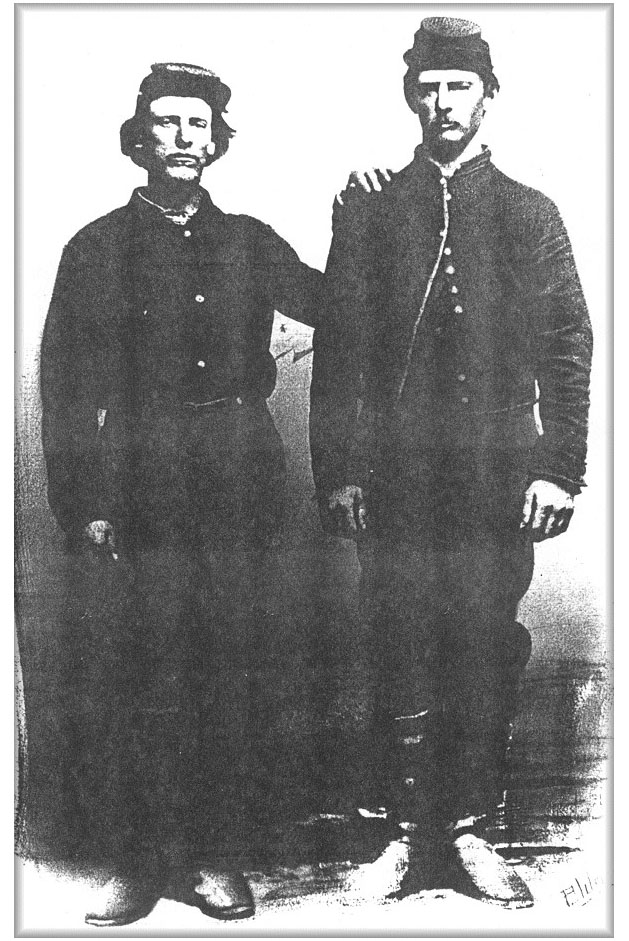
The attached picture is courtesy of the Fitz-Henry family collection and shows Edwin at some point during his service. The person on the right is most likely Francis Riggs Chapman, another soldier from Company B. Chapman was also born in Dublin, Ohio, and enlisted the same day as Edwin at age 23.

After his return from the war, Edwin married Sarah Jane Burns on October 30, 1866. They had seven children over the next eighteen years. They moved to Illinois in the spring of 1875, where they lived on a farm two miles north of Gibson City until mid 1883. In 1883, Edwin moved his family to Fairbury, Nebraska. The family lived in Nebraska only six months before Edwin died from heart disease on January 12, 1884. He is buried in the Fairbury cemetery.

Sarah Jane and her children returned to Illinois. At the age of 34, she was a widow with children ranging in age from 5 months to 15 years. She received a widow’s pension from the War Department for Edwin’s service in the Civil War. Mrs. FitzHenry died of pneumonia on March 21, 1911.

Special thanks to Ann FitzHenry for starting me down the path of Edwin’s career and to her and her family for allowing me to post Edwin’s photo.

Fiddler’s Green: William J. Palmer

13 Friday Mar 2009

Posted by dccaughey in Fiddler's Green

≈ 5 Comments

While William J. Palmer was not a cavalryman in a regular regiment, he was a cavalryman who rose to great prominence and distinction after the Civil War. He used his Civil war career as a springboard to an amazing career as a railroad pioneer and philanthropist, yet he is all but forgotten today outside the city that he founded. As today marks the 100th anniversary of his death, I thought it fitting to post a memoriam of his life and achievements.

William Jackson Palmer was born to a Quaker family in Leipsic, Delaware on September 17, 1836. The family left the small coastal town when he was five and moved to the Germantown section of Philadelphia. He was fascinated as a child by steam locomotives and learned all that he could about railroads. When he was 17, he went to work the Pennsylvania Railroad.. He was sent to England and France to study railroad engineering and mining. When he returned in 1856, he became the private secretary of the president of the railroad. From this position, he was exposed to the inner workings of the railroad industry, something that stood him in excellent stead in later years.

Palmer explained to the president of the PRR that coal could replace wood as a fuel source, based on his observations in England. Faced with shortages of wood along its right of ways, the company became the first American railroad to convert to coal as a fuel source. He spent the next several years focusing on associated problems with railroad engine power and combustion. Among those he worked closely with during this time was the railroad vice president’s assistant, Andrew Carnegie.

Although raised as a Quaker, Palmer was also an active abolitionist, and felt compelled to serve for the Union during the Civil War. He was appointed a captain of volunteers and recruited a troop of cavalry during October and November 1861 at Carlisle, Pennsylvania. The unit, known throughout the war as the Anderson Troop, was organized to serve as an escort for Major General Robert Anderson, commander of the Army of the Ohio. He was replaced before the troop reached the army, but they subsequently served as escorts for generals Sherman, Buell and Rosecrans.

The troop was very active as scouts and couriers, and commended by General Buell for their efforts following the battle of Shiloh. Their performance was so exemplary that Buell petitioned the secretary of war for permission to expand the troop to a full battalion of cavalry. Upon receiving this permission, Captain Palmer and several of his men were ordered back to Pennsylvania in July 1862 to recruit three additional companies. They opened recruiting offices in several locations across the state, and again established a camp of rendezvous at Carlisle. Recruiting was so successful that a full regiment was eventually raised, and designated the 15th Pennsylvania Cavalry. Although also known as the Anderson Cavalry, the original troop was never incorporated into the regiment.

Early in September 1862, the regiment’s drill and training were interrupted by the Army of Northern Virginia’s invasion of Maryland. While the rest of the regiment remained in place to defend the Cumberland valley if needed, two hundred fifty men were selected to move to the front under Captain Palmer. The group, still dismounted since the regiment had not yet received its horses, proceeded by rail to Greencastle, near the Maryland border. They procured a number of mounts locally, and picketed the roads leading into the town from the south. Skirmishing took place on the 12th and 13th, but the unit was able to hold its positions, convincing General Longstreet at Hagerstown that he had “swarms of Yankee cavalry” to his front. It was Palmer’s men that the tired troopers of the cavalry column from Harpers Ferry encountered with their captured wagon train just outside of Greencastle the morning after their escape. They were withdrawn two days later, and utilized for scouting during the battle of Antietam.

The day after the battle, Captain Palmer was sent across the Potomac to Virginia in civilian clothes as a scout to determine the disposition of the Confederate army. He was captured by Confederate cavalry shortly after crossing the river, however, and sent to Castle Thunder prison in Richmond. Four months later, he was exchanged for a political prisoner and sent north. Unbeknownst to him, he was promoted to Colonel of the 15th Pennsylvania Cavalry on September 8, 1862.

Upon his release, Colonel Palmer recuperated very briefly before moving west to rejoin his regiment. The unit at the time was in deplorable shape. Palmer’s capture had occurred at a critical time in the formation of the regiment, and left the unit without a number of key leaders. The problems culminated in December, when over half the regiment had refused to move to the front and fight at the battle of Stones River. The 200 men who fought in the battle gave a good accounting of themselves, and both majors were killed during the fighting. Colonel Palmer returned on February 7, 1863 to find part of his regiment praised in official reports of the battle and over 600 men in prison under death sentences for mutiny.
Within weeks the young colonel negotiated a settlement which reorganized the regiment and paroled the mutineers from the firing squad as long as there were no further incidents. The regiment was organized into twelve companies, and received it s full complement of horses and equipment. The regiment was reviewed by General Rosecrans on April 10th and deemed ready for action.

The regiment performed well in the Tullahoma campaign, with three companies retained at army headquarters as an escort for the commanding general. They spent the majority of July and August on scouting and mapmaking duty. They guarded flank roads during the battle of Chickamauga, and assisted in covering the army’s retreat. They were among several cavalry units detached from the army during the siege of Chattanooga. Once the siege was raised following the battle on November 25th, they led the column under Sherman sent to relieve Burnsides’ forces at Knoxville. They continued to distinguish themselves in various engagements during November and December of 1863.

On January 13, 1862, Colonel Palmer learned that Confederate General Vance, with a force of 300 cavalry and dismounted Indians, had advanced from North Carolina and captured a small wagon train and a number of prisoners near Sevierville. His regiment was at the time in camp, with a brigade of Confederate cavalry to its front. Leaving his pickets posted to the regiment’s front, Palmer assembled 125 men and took a mountain back road to cut off the raiders before they could reach Newport. Following a march of 30 miles, Palmer’s force overtook the Confederates. A successful saber charge netted them General Vance, 150 horses, 50 prisoners, and the entire wagon train. He successfully moved the entire party safely back to Sevierville. He was recommended for promotion for his gallantry in the affair by Elliott, Foster and Sturgis.

In late January, Palmer led a raid of his regiment and the 1st Tennessee Cavalry to the mouth of the Big Pigeon River, where they captured another small wagon train and a number of mules and prisoners. The remainder of the winter was spent in scouting and reconnaissance.

The winter’s hard campaigning had exhausted the regiment’s horses, and in May 1864 it was ordered back to Nashville to remount and re-equip. Due to supply shortages, it was August before all necessary equipment was received. The regiment was further delayed from rejoining the army in responding to raids by Confederate general Wheeler. The fall was spent in continuous scouting. At the end of the year, Palmer and his men joined in the relentless pursuit of Hood’s defeated Army of Tennessee following the battle of Nashville. On November 6, 1864, he was brevetted brigadier general of volunteers for meritorious service.

On January 14, 1865, at Red Hill, Ala., Palmer and his men attacked and defeated a larger force, capturing 200 Confederate soldiers and one fieldpiece without losing a man. Palmer was awarded the Medal of Honor for that action by Congress on February 24, 1894.

Before the spring campaign of 1865 was started, General Palmer was assigned command of the First Brigade of Gillem’s Division in the cavalry under General Stoneman. General Palmer continued to perform well, and succeeded Gillem in command of the division. At the end of April 1865, Palmer’s division was ordered to proceed south in an attempt to capture Jefferson Davis. While his men didn’t succeed in capturing Davis, they did capture General Braxton Bragg and over a million and a half dollars belonging to the various banks of Macon, Georgia. This capture was forwarded to army headquarters at Augusta without incident. Not long afterward, General Palmer and his regiment were mustered out of service on June 21, 1865.

After the war, Palmer resumed his railroad career. He was appointed managing director of the Kansas Pacific Railroad and was responsible for its extension to Denver. During this time, he met Dr. William Bell, an Englishman who became his friend and partner in most business ventures for the rest of his life. Once this line was complete, he and Bell co-founded the Denver & Rio Grande Railroad in 1870.

The young railroad entrepreneur met Mary “Queen” Mellen and her father while they were on a train trip to see the west. William and Mary were married in Flushing, New York on November 8, 1870. During their honeymoon in Great Britain, Palmer noticed the use of narrow gauge (3’ wide) railroading and recognized the advantages of using such a gauge on his own line. The narrower gauge enabled trains to take steeper grades and sharper curves, which was particularly useful in the mountains of Colorado. The majority of the D&RG railroad was built in narrow gauge. One 45 mile section, the Durango and Silverton Narrow Gauge Railroad, continues to operate today as a tourist line.

He also assisted in the establishment of Hampton University in Virginia. Typical of many traditionally black colleges and universities which trace their roots to the period immediately after the end of American Civil War, the school received much of its financial and leadership support from church groups and former officers and soldiers who had served in the Union Army. The new normal, or teachers’ school at Hampton was led by another former Union general, and Palmer gave substantial sums to help. “Palmer Hall” on the Hampton University campus was named in honor and gratitude of the his financial support.

The new railroad’s first section was an area line from Denver to Pikes Peak. Palmer loved the new area at the base of the mountain. In 1871, he acquired 10,000 acres of land east of the former territorial capital, Colorado City, and laid out and founded the new city of Colorado Springs. The city was centrally planned and developed by Palmer. Saloons and gambling houses were not permitted, and the production or sale of alcohol was illegal in the city until prohibition was lifted nationwide in 1933. Mrs. Palmer opened the first public school in the new town in November. Within two years the city had grown to over 1,500 people.
This city later became the focus of Palmer’s life. He built his dream home, which he called Glen Eyrie near Colorado Springs in the northwest foothills north of the Garden of the Gods rock formations which are today a city park. Dr. Bell built his home, called Briarhurst, at the southern end of the unique rock formation. Glen Eyrie was a 22-room frame house with a large carriage house. In 1881, the house was remodeled to include additional rooms and a tower. The house still stands today, and is owned by a group known as The Navigators. Tours of the main house can be arranged.

In 1879, he noticed a high demand for steel for rails, and constructed a large steel mill in the nearby town of Pueblo for the Colorado Coal and Iron Company. In 1892 the company merged with Colorado Fuel Company to become the state’s largest employer, and a company that dominated industry within the state for decades.

All of Palmer’s fortunes were not on the rise, however. His north-south railroad had conflicting right of way issues with the Atchison, Topeka and Santa Fe Railway. A long and bitter legal battle ended with a U.S. Supreme Court ruling against Palmer in 1880. Later that year, Mrs. Palmer suffered a mild heart attack and was advised to move to a lower altitude. She and their three daughters moved first to the East Coast, then to England. Mrs. Palmer died on December 28, 1894, and a grieving William Palmer went to England to return Mrs. Palmer’s remains and the girls to Colorado Springs.

In 1901, Palmer sold the Rio Grande Western Railroad and retired. He dedicated himself and the fortune he had amassed to charity. He enjoyed being the benefactor to the Colorado Springs community, and was well liked by the people.
William Jackson Palmer’s legacy is tremendous. He granted land to several institutions in Colorado Springs, including the Union Printer’s Home, the Colorado School for the Deaf and Blind, several churches in central Colorado Springs, and Cragmor Sanitarium, a tuberculosis sanitarium. He also provided land and funding for the creation of Colorado College and was one of its founding trustees. Palmer Hall, the main social science building on the Colorado College campus, is named for him. Two local high schools are also named for the general. Palmer Divide, the ridge north of the city, and Palmer Park in Colorado Springs, are also named in his honor. Queen Palmer Elementary School in Colorado Springs is named in honor of his wife.

In 1906, Palmer suffered a fall from a horse while on a ride with his daughters and a friend. He was paralyzed and confined to a wheelchair. Unable to travel in 1907, he paid for all the expenses of the 208 surviving veterans to come to his vast Colorado home for a three-day reunion and celebration.

William Jackson Palmer died at his home on March 13, 1909 at the age of 72. He is buried at Evergreen Cemetery in Colorado Springs, Colorado.

Sources for this entry are open sources too numerous to document, but which include Samuel P. Bates’ History of the Pennsylvania Volunteers, 1861-65, and an excellent article by Thomas P. Lowry which can be found online at http://www.historynet.com/william-j-palmer-forgotten-union-general-of-americas-civil-war.htm

Special thanks to Brian Downey at Antietam on the Web for permission to use the wartime photo of Palmer from his website.

Fiddler’s Green: Edward Fitzgerald

11 Wednesday Feb 2009

Posted by dccaughey in 1st/ 4th Cavalry, Fiddler's Green

≈ Leave a comment

Edward Fitzgerald was born in County Limerick, Ireland in 1837. He immigrated to the United States, and was working as a laborer in New York when he joined the army. He was enlisted into Company E, 1st U.S. Cavalry in Albany, New York by Lieutenant Johnston on January 9, 1858, at the age of 21. His enlistment documents describe him as 5’8 1/2” tall, with brown hair, blue eyes and a ruddy complexion.

Fitzgerald served in Company E with the 1st, then 4th U.S. Cavalry for the next five years, earning promotions to corporal, sergeant and first sergeant of the company. At the beginning of the Civil War, he served in a squadron consisting of his company and Company A in the Army of the Potomac until the winter of 1862. Once the peninsula campaign started, they served the majority of that time as the headquarters escort for the Army of the Potomac and Major General McClellan. As the company first sergeant, Fitzgerald was responsible for the company’s discipline. This was sometimes a less than popular position with his soldiers, as exhibited in one of Charles Bates’ letters here.

Fitzgerald’s enlistment expired at a camp near Falmouth, Virginia on January 8, 1863, shortly before the squadron returned to the rest of the regiment in the western theater. By the time the squadron reached the regiment, however, he was back in uniform.

First Sergeant Fitzgerald was appointed a second lieutenant in the 4th U.S. Cavalry on February 19, 1863, and assigned to Company I. He served with his company and regiment throughout the campaigns of 1863 and 1864, receiving a promotion to first lieutenant on May 9, 1864.

Lieutenant Fitzgerald was wounded while charging against a battery of three enemy guns at the front of his company on December 17, 1864 during fighting near Franklin, Tennessee. He never recovered from his wounds, and died on February 16, 1865.

Sources:

Heitman, Francis B. Historical Register and Dictionary of the United States Army (Washington: Government Printing Office, 1903), page 422.

Henry, Guy V. Military Record of Army and Civilian Appointments in the United States Army, Volume II (New York: D. Van Nostrand Publishing, 1873), pg 90.

Muster Rolls, 4th U.S. Cavalry, NARA, M744

U.S. Army Register of Enlistments, 1798-1914

Fiddler’s Green: Joseph Rendlebock*

06 Friday Feb 2009

Posted by dccaughey in 1st/ 4th Cavalry, Fiddler's Green

≈ Leave a comment

Joseph Rendlebock was born in Rickbinghaus, Prussia in 1823. He enlisted in Company A, Regiment of Mounted Rifles on May 22, 1851, at the age of 28. He served with the Mounted Rifles for the next five years, earning promotions to corporal, sergeant and first sergeant of the company prior to his discharge in May 1856.

A few months later, he was enlisted into Company G, 1st U.S. Cavalry at Fort Leavenworth by Lieutenant (later Confederate Major General) Robert Ransom, Jr. His enlistment documents describe him as 5’10 ½” tall, with brown hair, grey eyes and a florid complexion. Rendlebock served the majority of the rest of his career with this company.

Rendlebock was once again the first sergeant of his company when he was reenlisted at Fort Wise, Colorado Territory by Lieutenant Warren on July 13, 1861. This ended that winter, however, when he was appointed a second lieutenant in the same company of the 4th Cavalry on November 29, 1862 at Nashville, Tennessee. Sergeant Martin Murphy succeeded him as the first sergeant of Company G.

Lieutenant Rendlebock distinguished himself on several occasions during the rest of the war. He was active and mentioned in reports on the battle of Stones River in January 1863. He was brevetted first lieutenant for gallant and meritorious service in the cavalry action at Franklin, Tennessee on May 10, 1863. Leading his company’s charge, he succeeded in overrunning and capturing two guns of Freeman’s Battery. Unfortunately, the guns were spiked and lost later in the battle during a counterattack by Forrest. A few months later he was brevetted captain at McMinnville, Tennessee on October 4, 1863, again for gallant and meritorious service.

Joseph was promoted to first lieutenant in the 4th U.S. Cavalry on December 15, 1863. He continued to serve with his regiment through the remainder of the war. He was brevetted major in the regular army for gallant and meritorious services at the capture of Selma, Alabama on April 2, 1865.

After the war, Lieutenant Rendlebock accompanied the regiment to the frontier, where he served as the regimental quartermaster from August 20, 1866 to August 13, 1867. His promotion to captain freed him from this duty, and he returned to Company G as its commander that same day. He served the remainder of his career commanding his company in Texas.

Captain Joseph Rendlebock was retired on July 23, 1879 for disability incurred in the line of duty. He died ten years later, on March 13, 1889.

Sources:

Heitman, Francis B. Historical Register and Dictionary of the United States Army (Washington: Government Printing Office, 1903), page 823.

Hamersly, L. R. Record of Living Officers of the United States Army (Philadelphia: L.R. Hamersly & Co., 1884), page 428.

Henry, Guy V. Military Record of Army and Civilian Appointments in the United States Army, Volume II (New York: D. Van Nostrand Publishing, 1873), pg 328.

Muster Rolls, 4th U.S. Cavalry, NARA, M744

* Note: His last name is listed in various places as Rindlebock, Rindlebrook, Rendelbrock, Rendelbock and Rendlebrook.

Fiddler’s Green: John Peffer

12 Friday Dec 2008

Posted by dccaughey in 6th Cavalry, Fiddler's Green

≈ Leave a comment

I received a request for information on an ancestor in the comments section without any contact info, so I’ll post it here in hopes the requester will see it.

John Peffer originally enlisted in Company F, 8th Ohio Volunteer Infantry on June 22, 1861. Born in Buffalo, New York, he was 20 at the time of his enlistment. The following year, he was one of hundreds of volunteers who joined regular cavalry regiments.

John was enlisted into Company B, 6th US Cavalry in Knoxville, Maryland by Lieutenant Claflin on October 28, 1862 for the balance of his three year term. His enlistment documents describe him as 5’7 1/2″ inches tall, with dark hair, dark eyes and a light complexion. He was discharged at the expiration of his term of service in the field in virginia on June 22, 1864 as a private.

Fiddler’s Green: Theophilus F. Rodenbough

25 Tuesday Nov 2008

Posted by dccaughey in 2nd Dragoons/ 2nd Cavalry, Fiddler's Green

≈ 17 Comments

This is an entry that I’ve been working on for quite some time, off and on. Some of the sources were hard to find, and there were always “a couple more things” that I wanted to check on or delve deeper into before I posted it. So here at long last is the entry on someone whom I greatly admire.

Theophilus Francis Rodenbough was born on November 5, 1838 in Easton, Pennsylvania. He was the eldest of two sons of Charles Rodenbough, a wiring manufacturer, and Emily Cauffman of Philadelphia. He attended private schools, had private tutors, and completed a course of English literature and mathematics at Lafayette College in 1837.

At the outbreak of the Civil War, President Lincoln appointed Rodenbough a second lieutenant in the 2nd Regiment of Dragoons on March 27, 1861, at the request of Andrew H. Reeder. Reeder, a native and fellow resident of Easton, was prominent in the Republican Party for his service as the governor of Kansas in the late 1850s.

Lieutenant Rodenbough was initially assigned to Company E, but several months would pass before he joined the regiment. He served as the post adjutant and quartermaster of Carlisle Barracks, Pennsylvania until January 1862. He was promoted to first lieutenant in the 2nd Dragoons on May 14, 1861.

When he finally joined the regiment in January 1862, he was assigned to Company H. He immediately assumed command of the company as its assigned captain, Alfred Pleasonton, was on detached service. During the peninsula campaign he commanded Company H and often the squadron consisting of it and its sister company. He distinguished himself on several occasions, most notably during the battle of Gaines Mill. He was promoted to captain in the 2nd US Cavalry on July 17, 1862.

He and his company were part of Captain Thomas Hight’s squadron captured by Fitz Lee’s brigade following the second battle of Bull Run on August 31, 1862. He was paroled a week later, and exchanged on September 21, 1862 at Aiken’s Landing, Virginia for Samuel Y. Finley of the 6th Florida Infantry.

Recognized for his ability despite this setback, he was assigned to command one of the regiment’s two new companies, Company L, when they were authorized on September 24, 1862. He was sent north Pleasant Valley, Maryland to recruit and organize his company October 1862 to January 1863. He and his new company spent the remainder of the winter on picket duty near Falmouth, Virginia.

Captain Rodenbough and Company L participated in Stoneman’s Raid, during which he led a column of nearly 300 members of his own regiment and the 5th U.S. Cavalry to destroy a bridge over the South Anna River near Louisa Court House. The following month, he was slightly wounded and had two horses shot out from under him at Beverly Ford during the battle of Brandy Station on June 9, 1863.

When regimental commander Wesley Merritt was promoted to brigadier general later that month, Rodenbough assumed command of the regiment. This left his company without officers, as he had been the only officer present since Stoneman’s Raid. Captain Gordon returned to take command of the regiment on July 6th. Rodenbough served with distinction throughout the Gettysburg campaign, including actions at Upperville, Williamsport, Boonsboro, Funkstown, Falling Waters, Manassas Gap and again at Brandy Station at the end of July.

He accompanied the regiment and the rest of the brigade to Camp Buford at Giesboro Point for refitting in September, where he finally received additional officers for his company. His first lieutenant was a guest at Libby Prison, but his second lieutenant, Charles McMasters, was previously featured in a Fiddler’s Green entry. Captain Rodenbough spent the winter of 1863 performing picket duty with his regiment near Brandy Station. At times during the fall and winter, he performed as an “acting field officer,” according to the regimental muster rolls.

Rodenbough was again in command of his regiment for the beginning of Sheridan’s cavalry campaign in the spring of 1864. He was commended for his performance at Todd’s Tavern, as well as fighting in engagements at Culpeper Court House and Old Church during the spring.

Captain Rodenbough led the advance of the Regular Brigade with his regiment at the battle of Trevillian Station on June 11, 1864. He was wounded during the battle, and turned command of the regiment over to Captain David Stanley. In 1893, he was awarded the Medal of Honor for the battle. His citation reads “for distinguished gallantry in action at Trevillian Station, Va., June 11, 1864, where he was severely wounded while handling his regiment with skill and valor.”

Rodenbough was back in command of his regiment several weeks later, and led his regiment in the great charge that decided the battle of Opequon or Third Winchester on September 19, 1864. He was severely wounded in the right arm and his horse killed while leading the regiment’s charge. His right arm was amputated later that day.

First Sergeant Conrad Schmidt of Company K rode forward and rescued his wounded commander, earning a Medal of Honor. The citation reads “Went to the assistance of his Regimental Commander, whose horse had been killed under him in a charge, mounted the officer behind him, under a heavy fire from the enemy, and returned him to his command.” First Sergeant Schmidt’s actions served as the inspiration for the painting “Sergeant’s Valor” by Don Stivers.

Captain Rodenbough was brevetted major, regular army, for gallant and meritorious services during this battle. Following the battle, he served on general recruiting service in Philadelphia until April 1865 while recuperating from his wounds.

Rodenbough was brevetted lieutenant colonel on March 13, 1865 for gallant and meritorious service during the war, and colonel on the same date for gallantry and meritorious service in the battle of Todd’s Tavern, Virginia. He was further brevetted brigadier general, regular army, for gallant and meritorious service in the battle of Cold Harbor. In his recommendation for this brevet, General Sheridan wrote the following:

“Colonel Rodenbough was one of the most gallant and valuable young officers, under my command, in the Cavalry Corps, Army of the Potomac. He was constantly in the field with his regiment, the 2d U.S. Cavalry (a portion of that time in command of it), from the spring of ’62 up to the time of his being wounded whilst gallantly leading his regiment at the battle of the Opequan, September 19, 1864.” On April 13, 1865, he was brevetted brigadier general of volunteers for gallant and meritorious service during the war.

Rodenbough was granted a leave of absence from the regular army at the recommendation of General Sheridan to accept the colonelcy of the 18th Pennsylvania Cavalry on April 29, 1865. Rodenbough was transferred from the regiment to command the 3rd Provisional Cavalry (Pennsylvania), a provisional brigade consisting of regular and volunteer units, on June 24, 1865. He served there and in command of the district of Clarksburg, West Virginia until honorably mustered out of volunteer service on October 31, 1865.

Returning to his regular army rank of captain, Rodenbough served on Major General Dodge’s staff during the winter of 1865 as the inspector general for army forces in Kansas and the territories at Fort Leavenworth, Kansas. He then rejoined his regiment at Fort Ellsworth, Kansas in May 1866 and was employed with his company constructing Fort Harker until September 1866.

Upon the reorganization of the army in the summer of 1866, he was promoted to major of the new 42nd US Infantry on July 28, 1866. He was involved in organizing the regiment from September to November 1866, then commanded the post of Plattsburg Barracks until the following December. He subsequently commanded the post of Madison Barracks, New York until 1869.

Major Rodenbough also served on boards for the selection of a magazine fed gun, the examination of officers, and reportedly “the investigation of the case of the first colored cadet at West Point.” I assume this indicates the court martial of Lieutenant Henry O. Flipper of the 10th U.S. Cavalry in 1870, but could not locate verification of this.

Rodenbough retired from the army at his own request at the rank of colonel on December 15, 1870, “with the full rank of the command held when wounded.” He was retired again, as a Brigadier General, U.S.A., on April 23, 1904, according to that year’s Army Register.

Theophilus Rodenbough married Elinor Frances Foster in New York City on September 1, 1868. Their eldest daughter died in childhood. His son, James Foster Rodenbough, was living in Easton and working as a civil engineer with the Lehigh Valley Railroad Company at the time of his father’s death. His daughter, Nina, married and lived in New York City.
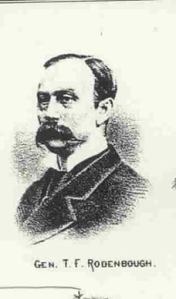
Following his retirement, Rodenbough became the most prominent American cavalry historian of the 19th Century. His books began with a history of his regiment with From Everglade to Canyon with the Second Dragoons in 1875. Other works included Afghanistan or the Anglo-Russian Dispute (1882), Uncle Sam’s Medal of Honor (1887), The Bravest Five Hundred of ‘Sixty-one (1891), August Leaves from Family Trees (1892), and Sabre and Bayonet (1897). The Bravest Five Hundred and Sabre and Bayonet were revisions of his earlier work on Uncle Sam’s Medal of Honor. His most ambitious work culminated in 1896 with the release of The Army of the United States: Historical Sketches of Staff and Line with Portraits of Generals-In-Chief, which he edited with active duty Major William Haskin. He also authored several articles in the Cavalry Journal, and served on the editing committee of the history of the 18th Pennsylvania Cavalry published in 1909. His final literary efforts were in editing several volumes of the ten volume Photographic History of the Civil War, published in the year of his death.

In addition to his writing, Rodenbough held many prominent positions following his retirement. He served as the Deputy Governor of the U.S. Soldiers’ Home in Washington, D.C. through the end of 1871. He then worked as the General eastern Agent of the Pullman Car Company from 1872 to 1873. From 1876 to 1877, Rodenbough was the Associate Editor of the Army and Navy Journal and the Corresponding Secretary of the Society of the Army of the Potomac in 1878. He was an assistant inspector general for the state of New York from 1879 to 1882. He worked from 1878 to 1893 on the Journal of the Military Service Institution of the United States as secretary, then editor and vice president. He was also the Chief of the Bureau of Elections for the city of New York from 1890 to 1892.

Theophilus F. Rodenbough died in New York City on December 19, 1912. He is buried in Easton, Pennsylvania.

Sources:

Heitman, Francis B. Historical Register and Dictionary of the United States Army (Washington: Government Printing Office, 1903), page 529.

Henry, Guy V. Military Record of Army and Civilian Appointments in the United States Army, Volume I (New York: D. Van Nostrand Publishing, 1873), pg 434.

Pierce, Frederick Clifton. Foster Genealogy. New York: Press of W.B. Conkey Company, 1899. Pages 973-974.

Rodenbough, Theophilus F. Autumn Leaves from Family Trees. New York: Clark & Zugall, 1892. Pages 153-155.

Rodenbough, Theophilus F. From Everglade to Canyon with the Second United States Cavalry (New York: D. Van Nostrand, 1875)

Rodenbough, Theophilus F., ed. History of the Eighteenth regiment of cavalry, Pennsylvania volunteers New York: Wynkoop Hallenbeck Crawford Co., 1909.

Wittenberg, Eric J. Glory Enough For All. Washington, D.C.: Brassey’s, Inc., 2002.

Wittenberg, Eric J. The Union Cavalry Comes of Age. Washington, D.C.: Brassey’s, Inc., 2003.

Fiddler’s Green: Isaac M. Ward

04 Tuesday Nov 2008

Posted by dccaughey in 6th Cavalry, Fiddler's Green

≈ Leave a comment

Isaac M. Ward was born in Scott County, Kentucky in 1834. He attended local schools and worked as a bootmaker prior to his enlistment in the army. Isaac was enlisted into Company A, 1st US Cavalry by Lieutenant Riddick in Decatur, Ohio on January 26, 1857. His enlistment documents describe him as 5’6” tall, with light hair, hazel eyes, and a fair complexion.

Ward served for the next four years on the frontier in Company A, receiving promotions to corporal and sergeant. At the outbreak of the Civil War, he accompanied his regiment as it moved to Washington, DC. After Company A reached Washington, he was appointed a second lieutenant in the 6th US Cavalry on October 23, 1861. The 6th US Cavalry’s acting commander, Lieutenant Colonel William Emory had commanded the 1st Cavalry at the outbreak of the war, and may have had something to do with the appointment.

Lieutenant Ward joined his new regiment that same month, and was assigned to Company A. The following month he was assigned to Company F, where he served through the peninsula campaign. He trained with the regiment throughout the winter of 1861, and accompanied them to the peninsula for their first campaign the following March.

In August 1862, Lieutenant Ward was assigned as an aide de camp to General Pleasonton, on whose staff he served until the following April. Ward was promoted to first lieutenant on October 20, 1862. He returned to his regiment in April 1863, just in time to command Company A during Stoneman’s raid.

Lieutenant Ward was killed at the head of his squadron of Companies A and M near Beverly Ford during the battle of Brandy Station on June 9, 1863. The squadron was charging in support of a flanked line of the regiment’s skirmishers. He was shot through the chest while attempting to capture a Confederate battle flag in close fighting. He is buried at Culpeper National Cemetery in Culpeper, Virginia.

Sources:

Carter, From Yorktown to Santiago, pages 86

Crouch, Richard E. Brandy Station, page 241

Enlistment documents, Isaac M. Ward

Heitman, page 1001

Henry, Volume II, page 215

Fiddler’s Green: Thomas Hight

31 Friday Oct 2008

Posted by dccaughey in 2nd Dragoons/ 2nd Cavalry, Fiddler's Green

≈ Leave a comment

Thomas Hight was born in Indiana, and appointed to West Point from there in July 1849. He graduated 9th in his class on July 1, 1863 and was promoted to brevet second lieutenant of dragoons. He served as an instructor at the Cavalry School for Practice at Carlisle, Pennsylvania until the following year.

Hight was promoted to second lieutenant in the 2nd US Dragoons on May 24, 1854. he joined his new regiment at Jefferson barracks, Missouri, then accompanied them on frontier duty from Fort Leavenworth for the next two years. He participated in an expedition against the Sioux and one into New Mexico. When the army formed two new cavalry regiments in 1855, he was offered a position as a second lieutenant in the 1st US Cavalry, which he declined. He served on recruiting duty in 1856 and was promoted to first lieutenant in the 2nd Dragoons on February 2, 1857. From 1857 to 1860, he participated in the Utah Expedition and a march to Oregon.

Lieutenant Hight was on a leave of absence when the war broke out, but rejoined the regiment and was promoted to captain on May 13, 1861. He spent the summer at Camp Knox in Rockland, Maine, where he was the mustering officer for seven of the state’s initial ten volunteer regiments. He was detached from 2nd US Cavalry to serve as the lieutenant colonel of the 1st Maine Cavalry on October 19, 1861, but resigned from volunteer service to rejoin his regular regiment on March 14, 1862.

He commanded a squadron during the peninsula campaign, and was captured with his squadron by Confederate General Fitzhugh Lee’s brigade during a reconnaissance following Second Manassas. His squadron was so small that General Stuart reported it as a single company in his official report on the campaign. He was paroled after Stuart linked up with General Jackson’s forces two days later.

Captain Hight served in Washington, DC during the winter of 1862. He resigned on April 27, 1863, after being absent without leave since January 21st.

After his resignation, he joined the 31st Maine Infantry as a lieutenant colonel of volunteers on March 12, 1864. The regiment was mustered in on April 17th, and immediately pushed forward to Virginia. He was promoted to colonel on April 29th, and commanded the regiment during the Wilderness and Overland campaigns. The regiment lost heavily in the Wilderness, and then lost a further 195 killed, wounded and missing at Spotsylvania Court House on May 12th. He was honorably discharged after the battle of Cold Harbor on July 2, 1864.

Thomas Hight returned to Augusta, Maine following his discharge, where he worked as a druggist until his death on August 17, 1867, at the age of 38.

Sources:

Cullum, George W. Biographical Register of the Officers and Graduates of the U.S. Military Academy, Volume 2 (Boston: Houghton, Mifflin and Company, 1891), pgs 527-528.

Heitman, Francis B. Historical Register and Dictionary of the United States Army (Washington: Government Printing Office, 1903), page 529.

Rodenbough, Theophilus F. From Everglade to Canyon with the Second United States Cavalry (New York: D. Van Nostrand, 1875)

More on Charles Farrand

19 Friday Sep 2008

Posted by dccaughey in Fiddler's Green

≈ Leave a comment

I didn’t think to check the Cullum entry for Charles Farrand when I did his Fiddler’s Green entry. Here’s a little more detail on his wartime and post-war service. His Cullum number is 1795, for anyone who wants to check into him more on their own.

Farrand commanded C Company, 2nd Dragoons in General Lyons’ campaign in Missouri from July to August 1861. Following that campaign his company conducted picket duty and scouting based out of Paducah, Kentucky until February 1862. He commanded a cavalry squadron during Grant’s Tennessee campaign until April 1862. He continued to command C Company, 2nd Cavalry during the Mississippi campaign, fighting at Iuka and Corinth. He was briefly taken prisoner during a skirmish near Corinth in September 1862, but escaped before reaching a Confederate prison. He commanded General Rosecrans’ escort and served as a volunteer aide de camp during the battle of Corinth October 3rd and 4th, 1862.

Following the battle, he served on mustering and secret service duty in the vicinity of Corinth until October 1863. Captain Farrand served as the acting Assistant Inspector General on the staff of General Eugene A. Carr at Little Rock, Arkansas from November 1863 to February 1864. He then served as the Chief Mustering and Disbursing Officer for the Military division of West Mississippi until September 1865.

Farrand served in the garrisons assigned to Richmond and Danville, Virginia until August 1866. After this was over a year on recruiting service at Fort Columbus, New York and New York City until October 1867. He rejoined his regiment at Newport Barracks, Kentucky (across the Ohio River from Cincinnati, Ohio) and served with them there until January 1868 when they were transferred to Shreveport, Louisiana.

He moved with the regiment to Baton Rouge the following year, and from there to Fort Snelling, Minnesota in June 1869, where he remained until he was honorably mustered out of service on January 1, 1871.

Fiddler’s Green: Michael Cooney

15 Thursday May 2008

Posted by dccaughey in 1st/ 4th Cavalry, 6th Cavalry, Buffalo Soldiers, Fiddler's Green

≈ 2 Comments

As I was working on the Williamsburg skirmish post, the name of one of the participants caught my eye. It took me a few days to remember where I’d seen it, but here is a bit more information on the first sergeant cited for bravery in that engagement.

Michael Cooney was born in Muroe, County Limerick, Ireland on May 1, 1837. He immigrated to the United States in 1856, and enlisted in the 1st U.S. Dragoons on December 4th of that year. He was assigned to Company A and promoted to corporal and sergeant before his enlistment expired in 1861.

Cooney enlisted as a private in Company M, 6th U.S. Cavalry on December 18, 1861, and quickly rose to the rank of first sergeant. Cited numerous times for gallantry in action, he was serving as the regimental quartermaster sergeant by 1864. On January 1, 1865, Cooney was commissioned as a captain in the 5th U.S. Colored Cavalry. He served with the regiment until it mustered out on March 16, 1866.

Michael was appointed a first lieutenant in the 9th U.S. Cavalry when it formed on July 28, 1866. He found several familiar faces among the officers there. Lieutenant Colonel Wesley Merritt, his brigade commander during the Civil War, was the regiment’s executive officer. Major James F. Wade and Captain James S. Brisbin from the 6th U.S. Cavalry were also among the regiment’s initial complement of officers. He moved west from New Orleans with the regiment into Texas, the beginning of long and arduous service in the southwest.

Lieutenant Cooney was promoted to captain on January 1, 1868 and assigned to command of Company A, 9th U.S. Cavalry. He and his company fought against Kiowa and Comanche Indians in Texas for the next several years, most notably on April 20, 1872 near Howard’s Well. During the late 1870s and early 1880s, he was very active campaigning in New Mexico against Mimbres and Mescelero Apache Indians.

Captain Cooney was promoted to major on December 10, 1888 and assigned to the 4th U.S. Cavalry, where he spent the majority of the rest of his career. He left briefly when promoted to lieutenant colonel of the 7th U.S. Cavalry June 2, 1897. In two years, however, he returned as the regiment’s commander, promoted to colonel on June 9, 1899.

Colonel Michael Cooney retired on September 4, 1899 after more than 42 years of service. He and his family moved to Washington, D.C. following his retirement. He was advanced to brigadier general on the retired list on April 23, 1904. He died on September 10, 1928.

Sources:

Heitman, Francis B. Historical Register and Dictionary of the United States Army (Washington: Government Printing Office, 1903), page 677.

Leckie, William H., The Buffalo Soldiers (Norman, University of Oklahoma Press, 1967).

Thrapp, Dan L., Encyclopedia of Frontier Biography: In Three Volumes (Lincoln: University of Nebraska Press, 1991)

6th U.S. Cavalry Regimental Muster Rolls, M744, NARA

← Older posts
Newer posts →

Recent Posts

  • 5th U.S. Cavalry at the Stone Fence
  • Thomas Montgomery, 1st U.S. Cavalry
  • Thomas Corbett, 2nd US Cavalry
  • Charles W. Canfield, 2nd U.S. Cavalry
  • Michael Shaughnessy – 2nd U.S. Cavalry

Meta

  • Create account
  • Log in
  • Entries feed
  • Comments feed
  • WordPress.com

Blogs I Follow

  • Maine at War
  • Emerging Civil War
  • History Radar
  • A Meaningful Finale
  • The Task at Hand
  • Bull Runnings
  • Army at Wounded Knee
  • Crossroads
  • Campaigns of the U. S. Civil War
  • Irish in the American Civil War
  • To the Sound of the Guns
  • Daydreams of the Soul

Enter your email address to follow this blog and receive notifications of new posts by email.

Join 195 other subscribers

Regular Cavalry in the Civil War

Regular Cavalry in the Civil War

Buy a copy of my book!

From McFarland & Company or contact me directly.

Enter your email address to follow this blog and receive notifications of new posts by email.

Join 195 other subscribers

Don

dccaughey@aol.com
1-719-310-2427

Blog at WordPress.com.

Maine at War

Maine at War explores the Civil War as experienced by the men and women from Maine who lived during the tumultuous period.

Emerging Civil War

Providing fresh perspectives on America's defining event

History Radar

A Meaningful Finale

A 28-year Army veteran takes to the Appalachian Trail to contemplate a life well served & the road ahead

The Task at Hand

Powered by Human Intelligence

Bull Runnings

A Journal of the Digitization of a Civil War Battle

Army at Wounded Knee

A blog dedicated to documenting through primary sources, the Army's actions at Wounded Knee

Crossroads

Where history, scholarship, the academic life, and other stuff meet.

Campaigns of the U. S. Civil War

Campaigns of the U. S. Civil War

Irish in the American Civil War

Exploring Irish Emigration in the 19th Century United States

To the Sound of the Guns

Military History

Daydreams of the Soul

  • Subscribe Subscribed
    • Regular Cavalry in the Civil War
    • Join 65 other subscribers
    • Already have a WordPress.com account? Log in now.
    • Regular Cavalry in the Civil War
    • Subscribe Subscribed
    • Sign up
    • Log in
    • Report this content
    • View site in Reader
    • Manage subscriptions
    • Collapse this bar