• About

Regular Cavalry in the Civil War

Regular Cavalry in the Civil War

Category Archives: 6th Cavalry

Fairfield dead – John Pattinson

03 Thursday Jun 2010

Posted by dccaughey in 6th Cavalry, battle of Fairfield

≈ 1 Comment

I’ve decided to do a brief series on the soldiers of the 6th U.S. Cavalry who were killed at the battle of Fairfield, PA on July 3, 1863. The first of these is Sergeant John Pattinson of Company M.

John Pattinson was born in Westmoreland County, England. He immigrated to the United States with his family, settling on a farm in Pennsylvania. He was working on the family farm in Carbon creek, Erie County, Pennsylvania according to the 1860 census.

He was enlisted into Company M by Captain Hays in Pittsburgh, PA on September 23, 1861. His enlistment documents describe him as 22 years old, 5’ 7 ½ “ tall, with brown hair, grey eyes, and a florid complexion. Pattinson earned promotion to Sergeant prior to the fight at Fairfield. He was wounded during the battle and later died of his wounds.

Sergeant Pattinson is buried in the National Cemetery at Gettysburg.

Brandy Station letter

09 Tuesday Jun 2009

Posted by dccaughey in 6th Cavalry, battle of Brandy Station

≈ 1 Comment

In honor of the 146th anniversary of the Battle of Brandy Station, I decided to post this little known letter from one of the Regular participants. Lieutenant Christian Balder of the 6th U.S. Cavalry fought with the Reserve Brigade on the Beverly Ford side of the battle. After reading the letter several times, I still don’t know why he’s so upset with the 6th Pennsylvania cavalry, save perhaps that they received more honors in the newspapers. Lieutenant Balder would be killed just a few weeks later on July 3rd, at the battle of Fairfield, where his friend Lieutenant Paulding was captured.

Camp 6th Cavalry Near Catletts Station, Va.
June 12th, 1863

My dear Paulding

As I have today a few moments to spare, I will drop you a few lines. You have undoubtedly read in the Chronicle of yesterday the account of our fight with the rebs. Don’t believe the half of it. I for one will never believe newspaper accounts for they are all stating falsehoods either directly or indirectly. It appears from the Chronicle that the 6th Pa. supported by the 6th Regulars done all the hard licks, when the Pa.s “god save mark” ran like sheep.

I will try to give you an account of as much as came under my observation. Col. Davis’s Brig. went over the river first. They had little difficulty in crossing, because the rebs were a little surprised and did not expect us. Davis drove them slowly but poor fellow, he was nearly one of the first who were killed. The rebs contested every inch of ground manfully, and the fight grew beautifully larger & larger. The Reserve Brig. And Elders Battery had a position in an open field with thick heavy woods to our front and left, and being subjected to a heavy fire from a hill to our right and front. That hill should have been occupied by us, and we could have gotten it very early in the day but “somebody” thought it was of no consequence. We remained in this field till after 12. Elders Battery fireing but little. In coming from water with Co. F. Priv. Viall had the top of his head carried away by a round shot from a battery on the hill above alluded to. He died instantly. Finally we were ordered to advance through the woods to our front. Brisbine & Claflin’s Squadron having been sent to some other point we had only four squadrons remaining. The 2d. Cav. took the lead, then followed the 6th Pa. then our Regt. I being Off. Of Day brought up the rear with 15 men of the guard. The 1st Cav. Did not cross the river till late in the afternoon. The 5th was on some other part of the field. We advanced through the woods in column of squadrons. When I got half ways through the woods. I heard cheering & shouting as if the infernals had broke loose from the lower regions. Now, thinks I, my bravy Mackerals are giving it to the rebs. On emerging from the woods I saw about one Regt. Of Cav. I thought they were our men, for they were dressed the same. They soon thought me different, however, when they commenced firing at me and my brave Mackerals, and then they made several attempts to but did not do it. I looked in vain for the 2d, 6th Pa. and ours, but they had commenced a hurried advance towards Washington. The 6th Pa. had indeed made a charge, so I heard but a great many jumped into a ditch, got stuck and were taken prisoners. Why the 2d & 6th Regulars run is impossible for me to say, and I think it is a great shame. On my retreating in the woods I seen cavalries without hats, scratched noses, and the axes of our pioneers bumping against their backs like forty. The rebs were shelling the woods all the time and Madden was wounded by a shell, not dangerous, and he is now in Washington doing well. Kerin was taken prisoner. On arriving again in our first field, I found the 6th had partially rallied and I went to my squadron. What little accidents occurred from then to about 2 O’clock is not worth mentioning. We were continually skirmishing and having little charges repeatedly with more or less success. The rebs fought bravely. At one place the 2d had about 1 good squadron charging a host of rebs, driven them for a while and then the rebs driving them. Brisbine having by this time joined, he and Wade tried them with their squadrons, but with little better success. I and Ward went in next, drove the rebs from the place, then they drove us back. We rallied drove them again to near the edge of a wood, they firing a shower of bullets at us and we at them, being only about 30 yards apart. My mare was hit through her hind leg, but not hurt her much. My blood got up. I wanted my squadron to charge with me. Ward & Tupper done the same, but could not get those cowboys to come on. They all fight very well with the carbine & Pistol, but have no confidence in the sabre. I was in front of the squadron, waving my sabre, and entreating and cursing them alternately, trying to get them on, when all of a sudden, a rebel officer came dashing at me, at full speed, making a tremendous right cut at me, but fortunately, I just perceived him in the nick of time. I parried his cut successfully and striking his sabre clean out of his hand. He fled by me, and one of my men shot him through the heart. We stood fully 15 or 20 minutes opposite each other, the rebs afraid to charge, and only firing at us. I then seen about a regiment of rebs coming through a field on our right and I thought it time to retire. But poor Ward had been killed. He worked like a Trojan to get his men to go in with the sabre, but could not succeed. About half an hour after that Stoll was killed while skirmishing with a part of that Regt. I had seen coming on my right. So you see we lost about 1/3 of our officers in killed, wounded & missing. Out of about 280 men, we lost about 50. I never gave the rebs so much credit before, but I must now say, they go in with a will. Is it not strange now that the papers never say anything about the 2d and 6th who fought fine in the afternoon, no matter, what they done in the morning. Their list of killed & wounded speak for themselves.

My Dear Paulding, I must now stop. Write to me soon. My love to Nichols.

Yours truly

Balder

Fiddler’s Green: John Savage

04 Thursday Jun 2009

Posted by dccaughey in 6th Cavalry, Fiddler's Green

≈ Leave a comment

Another of the lesser known officers of the 6th U.S. Cavalry was Captain John Savage of Company H. He is yet another cavalry officer native to Philadelphia, a city that spawned many prominent cavalry leaders during the Civil War. He remains a mystery in many ways. While many “wants” have been found, there are precious few “whys.” Thanks to Jim Jones for permitting me to edit this and post it here.

John Savage, III came from a very prominent Savage family line who settled in Philadelphia during the late 18th century. His great grandfather was Edward Savage, who became a famous painter and engraver. He painted the first panorama in Philadelphia, The Congress Voting Independence, and many other political and historical paintings. His grandfather, John Savage, was a shipowner and through his trades became a very wealthy merchant. He settled in Philadelphia, and was very active in his community, including service as a chief justice and a manager of the Almshouse.

John Savage, III was born in 1832 in Washington County, Maryland. His father, John Savage, II of Philadelphia and his mother , Adelaide H. Hughes of Maryland, were married in Washington County, Maryland on December 30, 1830. According to census records, by 1850 the family had moved to Philadelphia, along with nine other person sin the household. Savage’s father died in 1853, leaving his entire estate to his son, minus an annuity for his wife.

John, III married Isabella Swift Fitzhugh of New York in 1855. Isabella was the daughter of Dr. Daniel Hughes Fitzhugh, who was a surgeon in the fleet of Commodore Perry at the battle of Lake Erie, and also a pioneer of Bay City, Michigan. Prior to the Civil War, the couple had two children: John Savage, IV in 1857 and Anne Dana Savage in 1859. In 1860, his mother Adelaide was living with him along with eight other persons, who held such job titles such as domestic, waiter, and coachman. John’s occupation was listed as “Gentleman,” and his total estate value was $250,000 dollars! (a hefty sum by 1860 standards).

At the outbreak of the Civil War, John secured himself a commission as a captain in the newly forming 3rd U.S. Cavalry Regiment (later to be renumbered the 6th) on May 14, 1861. He immediately began recruiting for his Company H at the Girard House on Chestnut Street in Philadelphia. He quickly obtained his quota of men, and, therefore, was also the first company to reach the regiment’s second camp at Bladensburg, Maryland. At Bladensburg, he was officially assigned to and took command of his company on August 21, 1861. As the first two companies to complete recruiting, his company, along with Captain August V. Kautz’ Company B, was denoted the 1st Squadron. They were also selected as the flank squadron, which was the only squadron in the regiment initially equipped with carbines and acted as the advance squadron during regimental movements. The remaining squadrons were armed only with pistols and sabers.

Captain Savage trained with his regiment through the winter of 1861 at Camp East of Capitol, D.C., near the Congressional Cemetery. He accompanied the regiment upon its initial campaign in March 1862, and served uninterrupted until July 21, 1862, when he took five days of leave. His company, under the squadron command of Captain Kautz, literally led the advance of the Army of the Potomac on its advance from Yorktown toward Richmond as the advance squadron the army’s advance guard. After his return from leave, he served during the remainder of the Peninsula Campaign. On September 9, 1862, as the regiment departed the peninsula, he took sick leave. In October and November, he was listed as “supposed to be in Philadelphia,” and in December, he was listed as “absent without leave since October 10, 1862”on the regimental returns. What the regiment was unaware of was that Captain John Savage resigned on December 23, 1862. The reason for his resignation is a mystery, as he doesn’t appear to have distinguished himself in an overly positive or negative fashion during the campaign. A third child, Daniel Fitzhugh Savage, was born to the family at some point during his service. Perhaps he simply didn’t care for the rigors of active campaigning in the cavalry. The regiment didn’t learn of his resignation until February 1863, while at winter camp. His name doesn’t appear again in records during the war. His mother released her claim to her annuity to John in December 1863.

In 1868, John sold his inherited estate. By June 10, 1870, according to census records, the family moved to Bay City, Michigan – the city her father helped create – and settled at 412 North Jackson Street. John was listed as “without occupation,” and a net worth of $11,000, which if not invested in property likely did not reflect the money from the sale of his estate. A fourth child, Adelaide Hughes Savage, was born in 1867, perhaps named after his mother.

By June 1880, John and his family, along with his mother were living together. His youngest daughter, Anne, died on January 5, 1879. John also employed one elderly servant lady. John was listed as “retired.”
In 1890, John was living at 908 North Jackson Street and employed as the county register. He is listed on the Veteran’s Schedule of Bay City as a captain in the 6th U.S. Cavalry. Interestingly, it listed him as having been captain of company B, and having served a full three years, from May 24, 1861 to May 24, 1864.

John, III died in Bay City, Michigan on April 18, 1896. His wife died in the same city seven years later, on October 27, 1903. John Savage, John II and his wife Adelaide, John III and his wife Isabella, and their daughter Anne Dana Savage, were all buried at Ronaldson’s Philadelphia Cemetery, Philadelphia, Pennsylvania. This cemetery was removed in the 1920s to Forrest Hills, 101 Byberry Road, Philadelphia, and denoted the Philadelphia Cemetery.

Fiddler’s Green: George C. Cram

26 Tuesday May 2009

Posted by dccaughey in 6th Cavalry, Fiddler's Green

≈ Leave a comment

Jim Jones has done a fantastic job sleuthing out the details of the life of one of the lesser known officers of the 6th (and 4th after the Civil War) U.S. Cavalry, George Cram. Although not terribly popular, and likely would have been voted most likely to be captured by his peers, there are nonetheless many items of interest in his career. Any errors are undoubtedly due to my editing, as Jim turned up a wealth of detail that I had to whittle down to something small enough to post. Unfortunately, George Cram is one of the few remaining officers we have been unable to find a picture of.

George Clarence Cram was born on June 13,1830 in New York City, New York. He was the youngest of five siblings born to Lydia Tucker and Jacob Louis Cram, a distinguished lawyer in New York and perhaps the founder of the law firm “Cram & Cram,” which resided at 65 Wall Street.

On 12 July 1855, George applied for his passport application in which he was described as 5’8” tall, with grey eyes, a straight nose, medium mouth, small chin, square face, high forehead, brown hair, and a fair complexion. This application implies that he travelled abroad between July 12, 1855 and June 25, 1860.

In 1860, George was living with his elderly parents and working as a lawyer in New York, according to census data.3 In 1861, he married his wife, Francis. Their time together for the next few years was to be short; overpowered by the outbreak of the Civil War.

On May 14, 1861, George secured a commission as a captain in the newly authorized 3rd U.S. Cavalry, where he was assigned command of Company I. He immediately set up his recruiting office in Rochester, New York, and between July 24th and September 29th, he recruited 79 men for his regiment (57 men for his own company, 17 men for Company G, one man for Company K, one man for the regiment’s Field &Staff, and three recruits who deserted).

In order to simplify the tracking of the large number of volunteer units being formed during the war, Congress had enacted, on 3 August 1861, that all mounted regiments should henceforth be known as cavalry. Army General Order No. 55, dated August 10, 1861, prescribed that the 3rd U.S. Cavalry would now be enumerated the 6th U.S. Cavalry.

On October 4, 1861, Captain Cram joined the regiment at Bladensburg, Maryland. Here, the regiment received its horses, and its first lessons in the saddle. On October 12th, the regiment broke camp at Bladensburg and marched to its new camp, East of Capitol. Here, the regiment would endure an intensive training regime, mounted and unmounted, and the company commanders would have the occasion to sharpen their men. Unfortunately, Captain Cram would not seize this opportunity. On November 27th, he took leave, and in February, he was absent, sick in Washington, D.C.

On March 10, 1862, the regiment broke camp and embarked with Major General McClellan on the famous Peninsula Campaign of 1862, where Captain Cram would serve in every engagement of the campaign. On May 30, 1862, during an action on the Pamunkey River, Major Williams mentioned in his report:

“At 12 o’clock on the night of the 28th Lieutenant Kerin left the camp with about 20 men, and successfully fired and destroyed the county bridge about 200 yards above the railroad crossing. He was assisted in both operations by Lieutenant Coats, and both deserve the highest praise for the effectual manner in which they discharged their duty. Another bridge was also burned by Captain Cram. This was a bridge which Rush’s Lancers had fired on the 27th, but owing to the suddenness of their having withdrawn from the front were unable to entirely complete the destruction.”

The regiment then marched into the brutal Maryland Campaign, remembered most famously for the battle of Antietam. Upon the closing of the campaign, Brigadier General Pleasonton, in making his report of the operations resulting in driving Lee’s army back into Virginia, said:

“The services of this division (cavalry) from the 4th of September up to the 19th were of the most constant and arduous character. For fifteen successive days we were in contact with the enemy, and each day conflicts of some kind were maintained, in which we gradually but steadily advanced. The officers and men have exerted themselves to insure the success of every expedition and these efforts have been fortunate. The officers entitled to mention for gallant services are….Captains W.P. Sanders commanding, and Capts. George C. Cram and Henry B. Hays, and Lieut. Albert Coats, adjutant.”

On October 31, 1862, Captain Cram was assigned to duty at Washington, D.C. Meanwhile, the regimental command had changed hands many times due to most of the senior officers receiving higher commands within the volunteer forces. After returning to his company and settling into winter camp, Captain Cram assumed command of the regiment on December 13, 1862, now the senior regimental officer.

Captain Cram appears to have been despised by the men in his regiment. One private wrote:

“He was a curious, capricious man, seeming to almost delight when the men most feared him. A perfect sign of terror held sway over the guards. The new regimental commander would come down to the guardhouse at all hours of these winter nights, sometimes wearing his sidearms and at other times without them, and then, in violation of all regulations, the guard and prisoners were obliged to turn out and fall into line – the latter in their bare feet and drawers – that he might be saluted according to rank. A little hatred towards him was developed throughout the entire regiment. Whenever a soldier had occasion to speak of him, his name was invariably coupled with uncomplimentary phrases. The universal desire was often thus briefly expressed, except for the religious:
“Damn Cram!”
Thus religious wore off the round edge of a curse:
“Darn Cram!”
While the young men from the country, who still retained a wholesome fear of profanity, contended themselves with:
“Gol darn Cram!”
All sorts of violent deaths and untimely ends were pictured as in store for the unfortunate Cram. Few of the men seemed to believe that he ever allowed himself to become sober while in command of the regiment that winter.”

However much he may have been disliked by his men, Cram was diligent in attempting to see to the welfare of the men and their mounts. During the early part of January, the following letters were sent by Captain Cram, at a time when the strength of the cavalry should have been husbanded with great care for the coming spring campaign:

“Headquarters 6th U. S. Cavalry,
January 16th, 1863.
SIR: – I have the honor to report for the information of Brigade Headquarters, that the three squadrons of my regiment now on picket duty have the strength of 505 enlisted men. The three companies now in camp awaiting will turn out to-morrow 121 enlisted men. Present, absolute available strength mounted of the six troops and the three in camp, of which my command consists, 426.
There are three troops on detached service at General Sumner’s and General Pleasanton’s headquarters. Of ineffectives I shall leave in camp, mostly dismounted, 292. From the above it will be perceived that I can march with one-hundred and seventy-one men as the strength of my three disposable companies. I succeeded in getting thirty-six carbines and sabres from Pennington’s battery to-day. To-morrow I shall be obliged to send out two days’ forage and three days’ rations to my six companies on picket; this is essential to provide for their substance and forage. It requires six wagons for them to return during the day (they must be lightly loaded), which will cripple my transportation seriously, should I have to use it for general purposes to-morrow.
Very respectfully, Your obedient servant,
(Signed) G. C. Cram,
Captain, 6th U. S. Cavalry, Commanding.
To Lieutenant MAHNKEN,
Acting Assistant Adjutant-General,
2d Cavalry Brigade.”

“Headquarters 6th U. S. Cavalry,
January 21st, 1863.
SIR: – I have the honor to request to be informed whether I am at liberty to run out forage to the six companies of my regiment, now on picket; their forage is out this morning; also whether I can start my train to depot for forage. I have a scant two days’ in camp ahead for the whole command, and forage must be sent this morning to the detail on picket.
My entire command in rationed for three days, from this morning, in their haversacks. Am I to construe the circular received this morning as a standing order to run out the necessary transportation daily, to my detail on picket, with one day’s rations, without further orders, as it is only by that, that I can keep them three days ahead?
Very respectfully, Your obedient servant,
G. C. Cram,
Captain, 6th U. S. Cavalry.
To Lieutenant H. MAHNKEN,
Acting Assistant Adjutant-General,
2d Cavalry Brigade.”

“Headquarters 6th U. S. Cavalry,
Camp near Falmouth, Virginia, January 29th, 1863.
SIR: – I have the honor to transmit herewith approved requisitions for six wagons and requisitions for tools rendered absolutely necessary under orders from Headquarters 2d Cavalry Brigade, Cavalry Division, January 28th, 1863, requiring me to employ the troops under my command to construct and keep in repair the bridges on the road between General Hooker’s headquarters and ‘Stoneman’s switch.’ I have the honor to officially state my belief that, unless I am furnished with the means called for in such requisitions, it will be impossible for me to perform the duty assigned to me under the above-noticed order, as my regimental resources are already insufficient for the purposes of foraging and rationing my command. I have also the honor to very respectfully request to be informed if it is intended to retain this regiment on the roster for picket while discharging this duty of road and bridge construction and police, and if, while assigned to such fatigue duty, it will also be required to do its usual outpost duty. The requisitions are based upon a careful survey and examination made to-day of the roads and line of country assigned me.
******************************************************************************
I am, sir, very respectfully,
Your obedient servant,
(Signed) G. C. Cram,
Captain, 6th U. S. Cavalry, Commanding.
To Lieutenant H. MAHNKEN,
Acting Assistant Adjutant-General,
2d Cavalry Brigade.”

In the months of winter camp in 1863, the cavalry underwent major changes. Major General Joseph Hooker took command of the army, relieving General Burnside after his failure at Fredericksburg the previous November. One of General Hooker’s changes was to organize the various cavalry regiments into a massive mounted service designated the Cavalry Corps, Army of the Potomac. Under this new organization, the regiment remained with the rest of the regular cavalry regiments in the Reserve Brigade, now acting as an independent brigade. While the structure of this fledgling cavalry corps was beginning to take shape, Captain Cram was assigned command of the brigade on February 16, 1863. One soldier who was stationed at brigade headquarters noted in his diary:

“Monday, 16
Rainy some this morning. Cleaned up about 10 o’clock. Capt. Cram is in command of the Brigade. Handsome Brig. Genl. but he can’t command a corporal guard. (unr) that ain’t mutiny.”

Meanwhile, Brigadier General Buford, who was then the chief of cavalry, requested to command the reserve brigade under this reorganization. Thus, in March, Captain Cram was relieved of command of the Reserve Brigade, and resumed command of the 6th U.S. Cavalry.

The regiment, Captain Cram commanding, broke winter camp on April 13, 1863 and participated in the expedition known as “Stoneman’s Raid.”

On May 12,1863, while in camp at Hartwood Church, Captain Cram, accompanied by Assistant Surgeon William H. Forwood and two enlisted orderlies, rode to General Buford’s headquarters, about a mile and a half distant. Towards evening, they started back to camp, and while passing along a country road, were suddenly surrounded and compelled to surrender by about thirty of Colonel Mosby’s men, under Lieutenant Fairchild.

The guerrillas had ridden close to the camps, under cover of a dense forest, and, secreting their horses in the underbrush, had posted themselves on both sides of the road and captured several troopers passing back and forth between the camps.

Captain Cram and Assistant Surgeon Forwood were not armed, and both were entirely unsuspicious of any danger until confronted with a demand for surrender, backed up by cocked carbines. It was a daring ambush, laid in the midst of the cavalry corps, on a piece of road supposed to be covered by patrols and pickets.

The captors mounted and conducted their prisoners through the forest to a house, which appeared to be their headquarters. Here, Lieutenant Fairchild offered to release them if they would give their parole. Captain Cram and the enlisted men were released on parole, after being deprived of their horses and equipments, and started to camp.

Since medical officers on both sides had the right to be released without parole if captured, Assistant Surgeon Forwood declined to sign the parole, and insisted upon his right, as a medical officer, to be released. This was refused, and he was turned over to a guard to be taken to some interior point as a prisoner of war. The guard started after midnight, the prisoner being placed on foot between mounted detachments in front and rear. While passing through a dense growth of pines, the gallant surgeon made a dash for liberty and escaped without injury from the carbine and pistol shots that resounded through the forest.

The escaping prisoner floundered along over fallen timber and through swamps until nearly daylight, when he succeeded in reaching the main road, where Captain Cram and his party had already arrived, and at that point not far from General Buford’s headquarters. This ordeal caused Captain Cram considerable embarrassment, and though unproven, is probably why the gallant surgeon spent the rest of the month on detached duty at the Cavalry Corps’ dismount camp near Dumfries. Surgeon Forwood rejoined the regiment just prior to the battle of Brandy Station and continued to share its fortunes with the same daring spirit that dictated his dash into the dark forest amidst the flying bullets of the guerrillas.

Considerable controversy arose over this capture, and the result was a general order published by the War Department forbidding the acceptance of parole under such circumstances. The order referred to, dated 3 July 1863, contains the following language:

“It is understood that captured officers and men have been paroled and released in the field by others than commanders of opposing armies********
Any officer or soldier who gives such parole will be returned to duty without exchange, and, moreover, will be punished for disobedience of orders. It is the duty of the captor to guard his prisoners, and if, through necessity or choice, he fails to do this, it is the duty of the prisoner to return to the service of his Government.”

It appears that Captain Cram wasn’t any more beloved by the officers of his regiment than he was by the enlisted men. In a letter dated the same day of Captain Cram’s capture, Captain Brisbin wrote to his wife:

“***I am now again in command of the regiment much to the delight of all in it. The Rebels got Cram, Body and Breeches. I am only sorry that they did not kill the son-of-a-bitch, but we are all rid of him and thats all we need care for.***”

Nonetheless, Captain Brisbin’s sentiment would not hold true, for after “officially” being paroled on June 2, 1863, Captain Cram again assumed command of the regiment, if only for a short time.

On June 9th, the battle of Brandy Station took place, in which Captain Cram can easily be commended for the way he handled his regiment in battle. He received a brevet promotion to major for gallant and meritorious service his actions during the battle.

The following day, June 10th, Major Samuel H. “Old Paddy” Starr was appointed to the 6th U.S. Cavalry and would have assumed command of the regiment. However, Major Starr was immediately given command of the brigade, replacing Major Whiting, his junior, while Captain Cram remained in command of the regiment.

Major Starr was a veteran of the old army and known to be a strict disciplinarian, which he rigidly exercised towards all – officers and men. One private would remember:

“There was one feature in MAJ Starr’s administration that in a measure compensated the men for their suffering and humiliation. That was the poorly concealed terror and hate with which he was regarded by the subordinate regimental officers. CPT Cram especially seemed to be an object of Major Starr’s terrific disciplinarian efforts. Under the watchful eyes of the major, poor Captain Cram seemed to have dropped from the pinnacle of happiness to the depths of despair. In his presence, Captain Cram appeared heavily ill at ease. His trepidation was visible to everyone, and a smile was sure to pass along the line on such occasions. Whenever the cold blue eyes of his senior were turned upon him, his manifest trepidation was expressibly gratifying to those who had been subject to Captain Cram’s caprices while at the previous winter camp.”

The regiment continued the march, and on June 21, 1863 participated in the battle of Upperville. On the 23rd, while camped near Aldie, Captain Cram submitted his official report, which is very interesting and given in more detail than is usual in such cases. This is likely because of Major Starr’s vociferous displeasure of the performance of the brigade during the battle. After the brigade’s brief stay at camp near Aldie, it continued the march, chasing after General Lee’s army.

On June 29, 1863, the command reached Frederick City, Maryland, where newly appointed Brigadier General Wesley Merritt assumed command of the brigade, relieving Major Starr. Starr assumed command of the 6th U.S. Cavalry, which in turn, relieved Captain Cram of command of the regiment and returned him to his company.

The command soon reached Emmitsburg, Maryland, where it went into camp. On July 3rd, the brigade commander received information that a Confederate wagon train was very near and guarded by a weak force. Sensing it was ripe for the taking, Brigadier-General Merritt ordered the 6th U.S. Cavalry to the task.

As the regiment marched into Fairfield, Pennsylvania, Major Starr ordered Captain Cram, commanding the 1st Squadron, to take his men and follow the course of an unfinished railroad that lay at the foot of the mountains on the western side of the valley. Captain Cram set off on his reconnoiter, while the rest of the regiment continued towards Cashtown. The battle which ensued, known as the battle of Fairfield, saw the regiment utterly routed by the Confederate force guarding the wagon train, which turned out to be an entire Confederate brigade, under the command of General William “Grumble” Jones. Captain Cram, hearing the firing from the engagement, quickly rushed his 1st Squadron toward the scene. His squadron charged the enemy, but his horse was shot out from underneath him, and he was captured. The remaining few men of the regiment retreated back towards Cashtown.

That afternoon, Captain Cram, along with the other prisoners, set off on the long march south towards the Confederate prisons at Richmond. After a long and rainy march, the prisoners camped some distance away from the battlefield. Now prisoners, and after a long, rainy, cold, hungry, and weary march, these Federal men were not only defeated on the battlefield, but also in spirit. One private noted:

“Grim jokes about ”cordwood brigades,” “Company Q,” and “put a nosebag on him” were occasionally heard, but there was no absolute disrespect shown by the men. Even Captain Cram, with all the different phases of common hate assumed toward him, escaped insult.”

The long march south resumed, and continued for the next few days. Shortly before daylight of July 7th, the men halted near a place called the Mountain House, and here remained until late in the afternoon. Here Captain Cram was once again illegally paroled. The parole was not recognized by the Federal government to be binding, as all prisoner exchanges required the delivery of prisoners to Vicksburg or City Point. He received parole, complaining of gout in his feet from the tremendous amount of marching.

This same day, Brigadier-General Neill reported that:

“***Captain [George C.] Cram, now a prisoner of war at Monterey, states that the discipline of the enemy seems to be very much relaxed. In the last two days I have taken a great many prisoners, or, rather, deserters from the rebels.***”

After this second unauthorized field parole, near Monterey, he was granted 20 days of leave starting on the 24thfor reason of being a paroled prisoner. He then extended his leave for 60 days and subsequently was put on duty as an inspector of cavalry horses at Washington, D.C. on November 6, 1863. On February 20, 1864, he again took leave. On March 10, 1864, he was assigned as a mustering and disbursing officer at Harrisburg, Pennsylvania. In September, he transferred to his home ground of New York City, still working as a mustering and disbursing officer. In November, he was listed as “sick in New York City,” and on November 16th he was ordered to join his regiment, yet managed to avoid rejoining throughout the remainder of the war. Perhaps the reason for his numerous leaves was that his wife was pregnant, and in 1865, she bore a son, which they named Jacob Cram, probably after George’s father.

At this point, it should be noted that Captain Cram was the only one of the original company commanders in the regiment that had not received some sort of higher command, whether in the regular army or more commonly the volunteer service. However, this was finally about to change, for while in New York, and perhaps the reason for his avoidance to join his regular regiment, he secured an appointment as Colonel of the 22nd New York Cavalry. Unfortunately for Cram, this appointment was rescinded upon the return of the original commander, Lieutenant-Colonel Horatio B. Reed.

Having failed to secure his volunteer command, he must have been compelled to rejoin his regiment, reporting sometime in May of 1865. Yet again, he took leave and was absent on June 16, 1865. In July, he was again reported present for duty, and was assigned special duty as the acting provost marshal at Frederick, Maryland. Yet again, he took leave on August 21, 1865, but was back on duty near Frederick, Maryland by September.

The regiment received hundreds of recruits during the summer, and now at full strength, was ordered to duty in Texas. The regiment broke camp at Frederick, Maryland on October 15, 1865 and proceeded by rail to Battery Barracks, New York, where it embarked , October 19th, on the steamship “Herman Livingston” for New Orleans. The steamer sailed the next morning, and when off the coast of Hatteras, during the 23rd and 24th, encountered a violent storm. One of the sad incidents of this trying voyage was the loss of horses, thrown overboard to lighten the ship. The ship weathered the severe gale which sent many vessels to the bottom, and reached Key West on the night of the 27th, and New Orleans on November 2nd.

The regiment remained in camp near New Orleans until the 10th, when it sailed on the steamer “Clinton” for Galveston, arriving there on November 12th. Austin, Texas, was reached on the 29th, and Camp Sanders was established half a mile west of town. During this month, Captain Cram was listed as present, but sick. By December, he was assigned on detached service as provost marshal at Major-General Custer’s Headquarters in Austin, Texas. On January 24, 1866, he was assigned as the acting inspector general at the same headquarters, until February 1st, when he rejoined his regiment. On March 16th, he was put on special duty attending the general court marshal of a soldier, per Special Order No. 65, and was relieved of that duty on April 22, 1866, yet reported sick. On May 3, 1866, Captain Cram reported to duty, and with his company was on detached service at Jacksboro, Texas.

During early 1867, he went on a scouting expedition after Indians. It is not known what happened on that expedition, but on April 5, 1867, he was listed as joined from that expedition and “in arrest,” since that date. On April 28th, he and his company transferred from Jacksboro to Fort Belknap, where he remained in arrest until June at that post. In June, the returns list him as “from present in arrest to absent in arrest since June 20, 1867, attending his trial before General Court Marshal at Austin, Texas.” Meanwhile, his company was transferred to Camp Wilson. On October 24, 1867 he reported from “absent in arrest to present in arrest” at Camp Wilson “by permission to delay joining his company until the decision of his trial is made known per instructions from the 5th Military District, dated 11 October 1867.”

In a baffling turn, Captain Cram was promoted to Major the next day, October 12, 1867, and assigned to the 4th U.S. Cavalry, and was ordered to report to his new regiment on November 19, 1867. In December, he was en route to Fort Clark, Texas to assume command of that post. He did not stay in command long at Fort Clark, for on January 20, 1868, Major Cram transferred and assumed command of Fort Verde and the regiment. In March, he led his regiment on a movement to transfer to Fort Concho, Texas, and assumed command of that post April 3, 1868.

For the next few months, Major Cram commanded the regiment and post to which he was assigned, until August 18, 1868, when he relinquished command and reported for detached service as a member of a military commission per Special Order No. 3, Headquarters, 5th Military District, dated August 12, 1868. He left the regiment on the 20th for this duty, and by October 2nd, his duty was complete, as he went on leave and travelled to his home in New York City. His leave there was extended for three months per Special Order No. 250, dated October 19, 1868.

On January 9, 1868, Major Cram was recommended for promotion to a lieutenant-colonelcy by Brigadier-General George Stoneman, now a Colonel in command of the 21st U.S. Infantry. Stoneman wrote the following recommendation on behalf of Major Cram:

“Petersburg, Virginia
January 9th, 1868
Hon. Secretary of War,

Sir,
I have never troubled the War department with many recommendations for promotion or preferment, and when I have done so it has ever been done with a knowledge of the person, his claims, and his merits, and because I really thought he was justly entitled to what was asked for him.
The case I now beg the privilege of bringing to the attention of the Department, and through it to the President, is that of one of the most gallant and deserving Officers in the Army — Major G.C. Cram, 4th U.S. Cavalry, and what is asked for him by myself and through me by his friends who have written me on the subject, is that he may be brevetted a “Lieutenant Colonel in the Army for gallant and meritorious conduct at the engagement of Fairfield, Pennsylvania, July 3d, 1863.”
The circumstances are as follows, His Regiment the 6th Cavalry was taken into the action by Colonel Starr, who being wounded early in the engagement, the Command of the Regiment devolved upon major Cram — who in extricating his Regiment and saving the Regimental Colors, had his Clothing and saddle perforated with bullets in many places, his horse killed under him, and himself wounded — when being afoot he was captured by the enemy — who recognizing and appreciating his gallantry, paroled him and turned him loose.
It is to be presumed that the reason why his name and claims have never been presented for consideration is that no Official report was ever made of the engagement by Colonel Starr, (for reasons unnecessary here to mention,) and I hope it is not now too late to do justice to a brave Soldier, gallant Officer, and thorough Gentleman,
I am, Sir,
Very Respectfully,
Your Obedient Servant
George Stoneman
Colonel 21st U.S. Infantry and
Brevet Major General U.S.A.”

It is obvious that Major Cram stretched the truth to favor himself for a promotion. It need only be mentioned that Private George C. Platt, of Company H, was the soldier who rescued the regimental colors from falling in the hands of the enemy, and for which action he became the regiment’s first Congressional Medal of Honor recipient. Even though Major Cram was commanding the 1st Squadron (which consisted of companies B and H), it proves at the very least he was trying to take credit for one of his soldier’s actions.

This concoction of Major Cram’s would ultimately backfire, for at the time, promotions required a letter of endorsement from the commander of the soldier at the time of their actions: Major Samuel H. Starr! Major Starr was currently stationed in Texas with the 6th U.S. Cavalry, and upon receiving Major Cram’s recommendation to lieutenant-colonel, wrote the following:

“Post of Mount Pleasant, Tex.
February 17th 1868

Respectfully returned to HeadQuarters of the Army. I believe General Stoneman does not claim to know anything personally about the actuion mentioned by him in the within communication as he was not serving in the Army of the Potomac at the time: the first paragraph of his letter is intended, I presume, merely to remind the Department of his habitual course, from which, in this case, for sufficient reasons, he chooses to depart. There are several erros of fact in the General’s communication which, as it is referred to me, it is my duty to correct, and I will do so in the order they appear — I was wounded some hours after the action began and after its close, while the regiment was in retreat through a narrow defile (a country road) and not “early in the engagement.” — Major Cram certainly was not during any part of the action in command of the regiment — The regiment being weak and attacked by two brigades of the enemy’s cavalry, under the rebel Generals B.H. Robertson and Jones, was much cut up, routed and disorganized, it is true, but was reformed several miles from the field of action by Lt. Louis H. Carpenter (now Captain, 10th U.S. Cavalry) and not by Maj. Cram. Capt. Carpenter is my informant in this. — Major Cram had nothing to do with “extricating the regiment.” — I never heard that Major Cram saved the standard, I think this is a mistake — I did not know that he was wounded in that action, or that his saddle or clothing was spoiled — major Cram with his squadron was detached by me on the morning of the 3rd July, the day of the action, before the enemy was discovered, to look after his (the enemy’s) foragers reported by the people to be robbing barns in the neighborhood of Fairfield; and he did not rejoin the regiment, at least not till after the action was over and the regiment was in full retreat; he took no part in the action up to that time; he was however captured. I have heard, and paroled because he was unable to walk from gout in his feet. He did not, I believe, serve again in the field during the war on account of some complications about his exchange.
The remark of General Stoneman in the last paragraph, written in parentheses, to wit “for reasons unnecessary here to mention,” requires notice: The reason no official report was made of the action by me was that in the retreat I lost my right arm near the shoulder while marching through the defile above mentioned — myself the last man in the column. I add the last clause because it seems to me the remark quoted is calculated to injure me, it is at least liable to misconstruction.
S.H. Starr
Maj. 6th Cav. Bvt Col USA”

The remarks from Army’s commanding general were characteristically brief:

“Gen. Stoneman’s recommendation is not approved.
U.S. Grant
General
Hdqrs. Army
March 7, ‘68”

Needless to say, Major Cram never received the promotion, and perhaps from this denial he chose to resign. His resignation was accepted per Special Order No. 23, Headquarters, Army, Adjutant-General’s Office, Washington, D.C., January 28, 1869, to take effect January 26, 1869.

While on leave in New York City, and after resigning, George C. Cram most likely entered schooling at Stamford, Connecticut. However, within the same year of his resignation, and on August 22, 1869, George Cram died. It is unknown what he died from, but still more puzzling is who wrote the following obituary, posted in the New York Times, 26 August 1869:

“The death is announced of Major George Clarence Cram, at Stamford, Conn., on Sunday last, the 22nd inst. Major Cram was a son of the late Jacob Cram, and brother of Henry A. Cram, Esq., and of Mrs. James Watson Webb. He entered the army in 1861, his first commission as Captain of the Sixth Regular Cavalry having been dated May 14, of that year. In this regiment he served throughout the war. In the latter part of 1862, Captain Cram found himself in command of his regiment, being the senior officer on duty with it, and early in 1863 the regular cavalry of the Army of the Potomac was organized into a brigade, the command of which was retained by him, although his rank was not increased. In both these positions he won the praise of his superiors, and the cordial likings of his inferiors in rank by his soldierly qualities and courteous, gentlemanly bearing. While commanding the brigade he kept open the communications of General STONEMAN’S expeditionary force with the main army, on which service he taught the guerillas a much needed lesson. June 9, 1863, he was brevetted Major, and was afterward on duty here as Provost Marshal, and was also sent on a tour of inspection through the North. October 12, 1867, he was commissioned Major of the Fourth Cavalry, and resigned on the 26th of January, 1869. He was in his fortieth year, and much beloved and respected by the many who knew him. His death will be sincerely mourned by a large circle of friends, and by none more sincerely than by his old comrades of the Army of the Potomac.”

Sources:

The Cram Sourcebook, Vol. II, Michael A. Cram.

Passport application of George Clarence Cram, filed 12 July 1855, New York City.

1860 Federal Census, District No. 2, 18th Ward, New York, New York, Page No. 81, Family entry 353.

General Order No. 33, Adjutant-General’s Office, 18 June 1861.

6th U.S. Cavalry database, compiled by Jim Jones.

Official Records to the War of the Rebellion.

Special Order No. 158. Returns for Regular Army Regiments, 6th U.S. Cavalry.

Returns for Regular Army Regiments, 6th U.S. Cavalry, October through December 1862.

Common Soldier, Uncommon War: Life as a Cavalryman in the Civil War, Sidney M. Davis.

From Yorktown to Santiago with the Sixth U.S. Cavalry, Lieutenant Colonel William H. Carter.

The Union Cavalry Comes of Age, Eric J. Wittenberg.

The diary of Randolph R. Knapp, housed at the Gettysburg Library.

Letter to Jane, his wife, by James S. Brisbin, housed at the Iowa Historical Society.

List of Officers of the Army of the United States from 1779 to 1900, William Henry Powell.

Special Order No. 348, Adjutant-General’s Office, War Department, Washington, D.C.

Special Order No. 358 and Special Order No. 494, Adjutant-General’s Office, War Department, Washington, D.C., respectively.

Special Order No. 84, Adjutant-General’s Office, War Department, Washington, D.C., dated 20 February 1864.

Special Order No. 114, Adjutant-General’s Office, War Department, Washington, D.C., dated 10 March 1864.

Special Order No. 398, Adjutant-General’s Office, War Department, Washington, D.C.

From Rochester to Winchester: The Regimental History of the 22nd New York Cavalry, Michael G. Burns.

Returns for Regular Army Regiments, 6th U.S. Cavalry.

Special Order No. 8, Adjutant General’s Office, Washington, D.C.

Special Order No. 190, Headquarters, 5th Military District, dated 19 November 1867.

Order No. 228, Headquarters, Department of Texas, dated 28 December 1867.

Special Order No. 7, dated 10 January 1868.

Returns for Regular Army Regiments, 4th U.S. Cavalry.

Who’s In This Photo?

21 Thursday May 2009

Posted by dccaughey in 6th Cavalry, photos

≈ 1 Comment


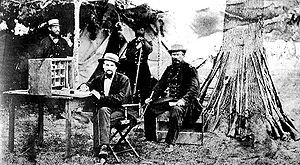
This photo was taken at 6th U.S. Cavalry Headquarters circa 1862. From right to left: standing; unknown; Major Laurence A. Williams. Sitting; 2nd Lieutenant Samuel M. Whitside; Captain William P. Sanders. I found this photo on a Wikipedia search for Samuel Marmaduke Whitside, although I believe the original is housed at the Fort Huachuca, Arizona Museum.

Jim Jones and I have been trying to figure out who our mystery man is in the above photo, and decided to post this in hopes that a reader may see or know something that we do not.

What are our clues?

From the regimental records, we know that the regiment took to the field on 10 March 1862. Additionally, Major Williams left the regiment on 26 June 1862. Therefore, the photo must have been taken between 10 March and 26 June 1862.

Given our collection of 6th U.S. Cavalry officer photos, it is easy to eliminate whom this photo does not depict. To this, one can also take in consideration the date/time of the photo, eliminating any officers assigned after 26 June 1862. Thus, the potential candidates are:

CPT Savage (commander, Co H,present all three months)
CPT Cram (commander, Co I, present all three months)
1LT Brown (present)
1LT Hutchins (signed March ’62 return as acting adjutant April 15th, also commander, Co E, present march-May, sick in June ’62)
1LT Claflin (may have been present)
1LT Dodge (absent April-May ’62)
1LT Johnson (present)
1LT Tucker (present)
1LT McLean (commander, Co F, present all three months)
2LT Spangler (regimental quartermaster, present all three months)
2LT Kerin (present)
2LT Coats (signed April retrun as acting adjutant May 1st, acting adjutant, April-May ’62, present all three months)
2LT Balk (present)
2LT Madden (present April-May, absent May-June)
2LT Ward (present)
2LT Stoll (present)
2LT Balder (present or entry illegible)

Additional thoughts: At the time of the photo, Williams and Sanders are the two senior officers assigned to the regiment. It could be a regimental headquarters photo (the three named are from different companies, eliminating that possibility). Whitside filled in at times as an acting adjutant. If we make this assumption, the most likely candidates are Spangler as the RQM or the regimental sergeant major at the time. Given the appearance of the epaulets in the photo, however, it’s most likely an officer.

Any ideas?

Fiddler’s Green: Edwin S. FitzHenry

18 Wednesday Mar 2009

Posted by dccaughey in 6th Cavalry, Fiddler's Green

≈ 3 Comments


Edwin Sawtell FitzHenry was born in Dublin, Ohio on July 24, 1835. He worked as a blacksmith prior to the Civil War.

Edwin was enlisted into Company B, 6th U.S. Cavalry on August 5, 1861 by Lieutenant Wade in Columbus, Ohio. His enlistment documents describe him as 5’ 6 ½” tall and 25 years old, with black hair, gray eyes and a sallow complexion. Interestingly, he signed into the regiment as Edwin S. Henry, dropping the “Fitz” from his name.
Private Henry trained with the new regiment at Bladensburg, Maryland and Camp East of the Capitol, Washing ton, D.C. through the fall and winter of 1861. He accompanied the regiment to the Virginia peninsula in March 1862 for the start of its first campaign as a company farrier.

Edwin seems to have avoided the disease that struck the regiment heavily after its arrival in Virginia. His first and only injury appears to have occurred at the battle of Hanover Court house on May 26, 1862. After the war he claimed to have been wounded in the left hand by a saber during the fight. There is no record of him in the regimental returns, either in the monthly return for June or the annual return for 1862. He did serve on detached service from his company at Cold Harbor with the regimental trains and hospital later that month, however, so there could be some credence to his claim. If he was injured, but not seriously enough to see one of the regiment’s assistant surgeons, there would not be a record of his injury. Regardless, he was back to duty with his company the following month.

Farrier Henry served through the rest of the campaigns of 1862 and 1863 without incident. He was one of the few soldiers in Company B who wasn’t killed, wounded or captured during the Gettysburg campaign in the regiment’s engagements at Fairfield or Funkstown. He continued to serve until the expiration of his term of service on August 6, 1864 at Light House Point, Virginia. The only change to his description is that his complexion had changed from sallow to ruddy, undoubtedly due to the many months outdoors and in the saddle during his enlistment.

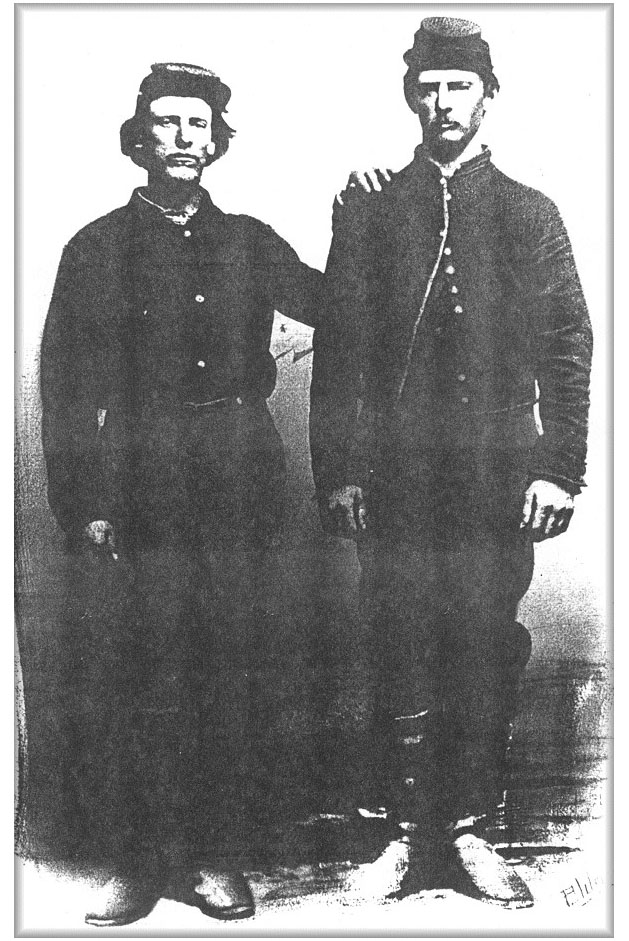
The attached picture is courtesy of the Fitz-Henry family collection and shows Edwin at some point during his service. The person on the right is most likely Francis Riggs Chapman, another soldier from Company B. Chapman was also born in Dublin, Ohio, and enlisted the same day as Edwin at age 23.

After his return from the war, Edwin married Sarah Jane Burns on October 30, 1866. They had seven children over the next eighteen years. They moved to Illinois in the spring of 1875, where they lived on a farm two miles north of Gibson City until mid 1883. In 1883, Edwin moved his family to Fairbury, Nebraska. The family lived in Nebraska only six months before Edwin died from heart disease on January 12, 1884. He is buried in the Fairbury cemetery.

Sarah Jane and her children returned to Illinois. At the age of 34, she was a widow with children ranging in age from 5 months to 15 years. She received a widow’s pension from the War Department for Edwin’s service in the Civil War. Mrs. FitzHenry died of pneumonia on March 21, 1911.

Special thanks to Ann FitzHenry for starting me down the path of Edwin’s career and to her and her family for allowing me to post Edwin’s photo.

Sergeants Major of the 6th US Cavalry

17 Tuesday Feb 2009

Posted by dccaughey in 6th Cavalry

≈ 12 Comments

Jim Jones was kind enough to donate the following article on the sergeants major of the 6th US Cavalry during the Civil War. Much of this was originally posted in comments, but I felt that it truly deserved more visibility. Jim has conducted hundreds of hours of research on the members of the regiment, and has the most complete roster in existence of the regiment’s members during the war.

The majority of these men were subsequently commissioned, and their biographical sketches have either already been posted to Fiddler’s Green or will be in the near future. Any errors or perceived gaps in the account are due to my editing and not Jim’s research.

Although authorized one sergeant major per battalion in addition to the regimental sergeant major by General Order #16, A.G.O., 1861, none of the regular cavalry regiments appear to have done so.

The regiment’s first sergeant major was the famous Samuel M. Whitside, serving as sergeant-major from August 1, 1861 to November 4, 1861. He was subsequently appointed as a second lieutenant in the 6th U.S. Cavalry (Returns from Regular Army Regiments, NARA, Microfilm #744, Roll 61, page 11).

The second regimental sergeant major was James F. Jackson, appointed from Company B . He served in the position until December 8, 1861, when he was discovered to be “Charles” Jackson, a deserter from the General Mounted Service. Jackson had deserted from the General Mounted Service, probably at Carlisle barracks, on August 21, 1861, and enlisted in the 6th US Cavalry on August 30th. Apparently he was favored by the regiment, as he was not court-martialed. He was, however, demoted to the rank of private per Special Order #189, and served in Company K through the remainder of his enlistment (Ibid, page 13. Also, The U.S. Army Register of Enlistments, 1798-1914).

He was succeeded by Sergeant Major John Lee, who served as sergeant major until May 12, 1862. He was then appointed a second lieutenant in the 4th U.S. Cavalry, the second member of the 6th US Cavalry so honored (Hamersly, L. R. Record of Living Officers of the United States Army (Philadelphia: L.R. Hamersly & Co., 1884).

The fourth sergeant major was Tullius C. Tupper, who held the post through the remainder of the campaign on the peninsula until his appointment as a second lieutenant in the regiment on September 22, 1862 (Returns from Regular Army Regiments, NARA, Microfilm #744, Roll 61, pages 26 and 35).

The fifth sergeant major was not so fortunate. Martin Armstrong’s service as regimental sergeant major came to an abrupt end on December 1, 1862, when he was relieved after failing to properly inspect the arms of the pickets as they returned from duty. After their return to camp, one of them accidentally shot and killed his companion while playing around. The soldier was initially arrested, but subsequently returned to duty . Armstrong returned to duty in Company M (Ibid, page 37. Also: Davis, Sidney Morris. Common Soldier, Uncommon War).

Taking his place was Sergeant Major Hercules G. Carroll of Company B, who held the post from December 1, 1862 to June 23, 1863. While making his rounds inspecting the pickets near Aldie on the latter date, he was captured and sent to Libby Prison. Evidently no one in the regiment was aware that he’d been captured, as he was listed as a deserter on the regiment’s monthly returns. Carroll was subsequently paroled and worked as a clerk in the AGO in Washington, D.C. until after the war (Ibid, pages 41 and 59. Also The U.S. Army Register of Enlistments, 1798-1914).

Taking his place was SGM Patrick Cusack, also of Company B, who appears to have moved back and forth between the 6th US Cavalry and the 4th US Artillery during the first two years of the war. He was transferred back from the 4th U.S. Artillery on the day SGM Carroll went missing. Ironically, he held the position the longest of any during the war, serving until he was appointed a second lieutenant in the newly-organized 6th US Colored Cavalry on January 19, 1865 (Ibid, page 59. Also Hamersly, L. R. Record of Living Officers of the United States Army (Philadelphia: L.R. Hamersly & Co., 1884), and The U.S. Army Register of Enlistments, 1798-1914).

There was a brief interlude in SGM Cusack’s service, when he was allowed a brief furlough to see his family in November 1864. During his absence, regimental commissary sergeant Charles J. Garrard served as the sergeant major, but was not formally promoted to the position.

The final regimental sergeant major was Henry Orsay, sometimes spelled D’Orsay, who closed out the war in the position and subsequently accompanied the regiment to Texas. He served as sergeant major from January 19, 1865 to April 12, 1868 (Returns from Regular Army Regiments, NARA publication, Microcopy #744, Roll 61, page 59. Also The U.S. Army Register of Enlistments, 1798-1914).

Michigan Men, Part II

26 Monday Jan 2009

Posted by dccaughey in 6th Cavalry, Michigan

≈ Leave a comment

The Michigan troopers’ Civil war experiences were as varied as the men themselves. Unsurprisingly, they run the gamut of possibilities, excluding only re-enlistment.

One didn’t even make it to Washington, D.C. Benjamin F. Sweet was discharged for disability at the regiment’s second camp in Bladensburg, Maryland on October 1, 1861. Several others didn’t last until the regiment’s initial campaign on the Peninsula the following March. Warner C. Bradish died of disease at Camp East of the Capitol, Washington on January 31, 1862. Joseph J. Spence was also discharged for disability in Washington on February 10th.

The regiment’s duty on the Peninsula was costly for the Michigan troopers. On May 1, 1862, Ruel V. Rounds died of brain fever at Yorktown, VA. Nelson Benson and John G. Beavington deserted the following day. The group suffered its first combat losses at Slatersville, VA on May 9th. Abel A. Irish was killed in action, and Elisha J. Ellis was captured and confined in Richmond the next day. He was paroled on August 11th, but there is no further mention of him in federal records. There was an Elisha J. Ellis with Company G, 44th Indiana Infantry, so it’s possible he decided to try his fortune with the Army of the Ohio. John Dunmore deserted the day after the action at Slatersville. Wilber R. Allen was discharged for disability in Washington, D.C. on May 28th, and James H. Cory was discharged a few days later on June 3rd.

On July 6, 1862, Edgar R. Knapp, the sole doctor in the group, was appointed a hospital steward. He continued in this duty with the regiment until his discharge in 1864.

1862’s campaigns took their toll on the Michigan men during that winter. William M. Palmer was discharged for disability from Camp Banks, VA on December 31st, and Philemon Finch the next day. By the end of the month, a convalescent camp had been established for the Army of the Potomac, and two more Michigan men were discharged from it before the beginning of the spring campaign. George W. Haight was discharged for disability on January 31st, and Albert C. Waggoner on April 3rd. Frederick S. Ladd offically deserted on April 12th, but had been appointed a Second Lieutenant in Company C, 9th Michigan Cavalry over a week before on April 3rd. He achieved the rank of captain and command of Company C before he was killed in battle at Cypress Swamp, GA on December 7, 1864.

The Gettysburg campaign was hard on the men from Michigan as well. At Fairfield, Pennsylvania on July 3rd, Sergeant Theodore Fox and Private William Robinson were both wounded and captured. Corporal James P. Campbell, Private Robert Craig and Private Charles H. Miller were also missing in action after the battle. Sergeant Miles L. Ten Eyck was killed in action at Williamsport, Maryland on July 6th, and Randolph R. Knapp was wounded and captured the following day in the engagement at Funkstown. Randolph Knapp returned from parole on August 17th, and William Robinson on August 30th. Sergeant Fox returned to duty on August 24th, but was discharged for disability at Carlisle Barracks, Pennsylvania on December 10th. This was likely a result of his wound and imprisonment. The group’s only other 1863 loss was Charles Blossom, who was captured at Brandy Station on October 11th.

1864 saw the end of the group’s service. Beach B. Kennedy was discharged for disability on March 23rd. Charles Blossom died of disease while a prisoner at Andersonville Prison on May 22nd. Charles H. Miller also died there of disease on July 5th, after a year of imprisonment.

In September 1864, the remaining fourteen members of the group were discharged at the end of their terms of service. Not one re-enlisted. Four deserted and ten were discharged for disability. Seven of the thirty five men died during the war, or twenty percent of the total.

Michigan Men, Part I

20 Tuesday Jan 2009

Posted by dccaughey in 6th Cavalry, Company E, Michigan

≈ 1 Comment

Most histories of the 6th United States Cavalry note that the regiment was raised in Pennsylvania, New York and Ohio. What these histories don’t mention is the portion of Company E that was recruited in Adrian, Michigan during an eleven day period in September 1861.

Second Lieutenant Stephen S. Balk, newly commissioned from the ranks, arrived in Adrian on September 8, 1861. By the time he left town on the 19th, he had enlisted 35 men into the 6th US Cavalry. Over the next few days, we’ll conduct a micro-historical case study of these 35 men and their experiences before, during and in some cases after the war.

They are a fairly typical sampling of Union soldiers raised in the fall of 1861. Their median age was 22. The oldest was 35 at the time of enlistment, the youngest three were 18. They were predominantly (21) farmers, with 4 clerks, 3 carpenters, 2 blacksmiths, a mason, an engineer, a tinner, a painter and a medical doctor listed as their occupations. Atypically, only five were immigrants, two each from England and Ireland and one from Canada. Twelve were born in New York, ten in Michigan, six in Ohio, one in Pennsylvania and one in Massachusetts. The group included three sets of brothers or cousins. Their median height was 5’8″, with the shortest 5’4 1/2″ and the tallest 6’2″.

The names of the 35 are listed below. Their Civil War experiences will be related in the next post.

Allen, Wilber A.
Beach, Edward
Beavington, John G.
Benson, Nelson
Blossom, Charles
Bradish, Warner C.
Campbell, James P.
Cory, James H.
Craig, Charles
Craig, Robert
Dierdorff, Jonas
Dunmore, John
Ellis, Elisha J.
Finch, Philemon
Fox, Theodore
Haight, George W.
Hamilton, Samuel M.
Heckman, John
Irish, Abel A.
Kasson, William O.
Kennedy, Beach B.
Knapp, Edgar R.
Knapp, Randolph R.
Ladd, Frederick
Miller, Charles H.
Palmer, William M.
Parker, John
Robinson, William
Rounds, Ruel V.
Spence, Joseph J.
Sweet, Benjamin F.
Ten Eyck, Miles L.
Ten Eyck, William
Waggoner, Albert C.
Walker, William B.

Company F, 6th US Cavalry Roster, Part I

30 Tuesday Dec 2008

Posted by dccaughey in 6th Cavalry

≈ 1 Comment

Company F was recruited in Pittsburgh by Lieutenant Hancock T. McLean. By January 1862, he would command the company, as Captain Joseph H. Taylor had moved to Brigadier General E.V. Sumner’s staff in November 1861.

The company was officially organized on August 16, 1861 at Camp Scott, near Pittsburgh, Pennsylvania. Its captain was Joseph H. Taylor, nephew of former president Zachary Taylor. The first lieutenant was his first cousin, Hancock Taylor McLean. No second lieutenant was assigned until Isaac M. Ward was assigned to the company on November 5, 1861. Captain Taylor left the company that same month for a variety of staff positions, and McLean and other lieutenants commanded the company throughout the war. A total of 182 enlisted men served in the company during the war, 31 of whom joined from volunteer units in the fall of 1862. The majority of these soldiers came from the 3rd Wisconsin Infantry, the 1st Minnesota Infantry, and the 9th Pennsylvania Reserve Corps. 52 of them joined the regiment in the fall of 1864, many as draftees or their substitutes.

The roster below lists all of the enlisted men assigned to the company during the war. The rank listed is the highest rank achieved. The date listed is the date the soldier enlisted into the 6th US Cavalry. The officers are not posted, as they appear in separate Fiddler’s Green entries.

Brown, John M., First Sergeant, July 1, 1861. Enlisted as a private at Pittsburgh by LT McLean at age 23. Acting 1SG of Company F in March 1863. Discharged at the expiration of his term of service on July 1, 1864 at Lighthouse Point, Va.

Swartz, Emil, First Sergeant, 1861. Enlisted into Co E, 1st US Cavalry October 1, 1855 by Captain Sturgis in Harrisburg, PA. Re-enlisted into the same company by LT Ingraham at Fort Smith, AR on September 1, 1860. Transferred to 6th US Cavalry, date unknown. First Sergeant of company during Peninsula Campaign. Discharged for disability in camp near Falmouth, VA as a First Sergeant. Enlisted into General Service, Adjutant General’s Office, HQ Army by MAJ Williams on February 26, 1863. Discharged at the expiration of his term of service on February 26, 1868 in Washington, DC, a sergeant. Born in Berks County, PA. Originally enlisted at age 25, auburn hair, blue eyes, fresh complexion, 5’8″ tall. Former trade, butcher.

Wallace, Robert, First Sergeant, July 6, 1861. Enlisted in Pittsburgh by LT McLean. Discharged at the expiration of his term of service on July 6, 1864 at Lighthouse Point, VA as a sergeant.

Buckton, John, Sergeant, July 10, 1861. Enlisted in Pittsburgh by LT McLean. Discharged at the expiration of his term of service on July 10, 1864 at Lighthouse Point, VA, a sergeant.

Croy, Levi B., Sergeant, July 3, 1861. Enlisted at Pittsburgh by LT McLean, age 32. Promoted to sergeant September 1862. Captured at battle of Fairfield, July 3, 1863. Discharged in the field at the expiration of his term of service on July 3, 1864.

Everson, Richard, Sergeant, July 3, 1861. Born Newport, England. Enlisted in Pittsburgh by LT McLean, age 40. Described as short. Promoted to Commisary Sergeant before the Regiment reached Washington. Discharged at the expiration of his term of service on July 5, 1864 at Lighthouse Point, VA.

Hutchison, William, Sergeant, October 28, 1862. Enlisted in Knoxville, MD by LT Claflin. Reenlisted on February 9, 1864 at Camp 6th Cavalry, VA by LT Tupper. Discharged February 8, 1867 at the expiration of his term of service in Jacksboro, TX as a sergeant.

McMasters, Robert H., Sergeant, July 6, 1861. Enlisted in Pittsburgh by LT McLean. Discharged at the expiration of his term of service at Lighthouse Point, VA on July 6, 1864 as a sergeant.

Piedfort, Albert, Sergeant, August 15, 1863. Born in Havre, France. Enlisted in New York City by CPT Arnold. Discharged at the expiration of his term of service on August 15, 1868 at Fort Larned, KS as a sergeant.

Stinson, Sam’l. F., Sergeant, December 7, 1864. Enlisted in Philadelphia by CPT Rodenbough. Discharged at the expiration of his term of service on December 6, 1867 at Camp Wilson, TX as a sergeant.

Walsh, Michael, Sergeant, July 4, 1861. Enlisted in Pittsburgh by LT McLean. Discharged at the expiration of his term of service on July 4, 1864 at Lighthouse Point, VA as a sergeant.

Wiederway, Frank, Sergeant, August 8, 1861. Originally enlisted into Company G in Rochester, NY by CPT Cram. Transferred from Company G to Company F, February 27, 1864. Re-enlisted into Company F by LT Tupper at Brandy Station, VA as a private.

Bopenhagen, August, Corporal, July 3, 1861. Born in Germany. Enlisted in Pittsburgh by LT McLean at age 21. Discharged at the expiration of his term of service on July 3, 1864 at Lighthouse Point, VA.

Donaldson, James, Corporal, July 29, 1861. Captured at the battle of Funkstown, MD as a corporal on July 7, 1863. Discharged July 29, 1864 at the expiration of his term of service as a private.

Froben, Louis H., Corporal, July 3, 1861. Also Von Froben. Born in Germany. Enlisted in Pittsburgh by LT McLean, age 21. Discharged at Light House Point, VA July 3, 1864 at the expiration of his term of service. Enlisted into General Service by LT Carpenter in Washington, D.C. on August 10, 1864. Discharged September 20, 1866 per Special Order 464, Para. 1, HQ Army, AGO, September 18, 1866.

Simonet, Peter, Corporal, July 25, 1861. Enlisted in Pittsburgh by LT McLean. Discharged at the expiration of his term of service on July 25, 1864 as a corporal.

Slattery, Michael, Corporal, July 5, 1861. Enlisted in Pittsburgh by LT McLean. Discharged at the expiration of his term of service on July 5, 1864 as a corporal.

Closz, John, Bugler, July 22, 1861. Also Closs. Enlisted in Pittsburgh by LT McLean. Transferred Company F to regimental band November 6, 1861. Discharged July 22, 1864 at the expiration of his term of service at Camp 6th Cavalry, VA.

Curthin, John, Bugler, July 22, 1861. Enlisted in Pittsburgh by LT McLean. Discharged at the expiration of his term of service in the field on July 22, 1864 as a bugler.

Dietz, Frank A., Bugler, July 23, 1861. Enlisted in Pittsburgh by LT McLean. Discharged for disability on January 12, 1863 in Washington, DC, a bugler.

Adams, Benjamin F., Private, November 21, 1864. Born in Montreal, Canada. Enlisted in Cincinatti by CPT Gordon. Deserted October 15, 1865.

Aldrich, William, Private, November 7, 1862. Enlisted in Knoxville, MD by LT Coats. Discharged at the expiration of his term of service on June 20, 1864 as a private.

Archible, John, Private, July 29, 1864. Enlisted in Rochester by LT Simson. Deserted July 24, 1865.

Armbruster, Jacob, Private, July 9, 1861. Enlisted in Pittsburgh by LT McLean. Discharged July 9, 1864 at the expiration of his term of service, a private.

Bailey, Cloyed, Private, December 10, 1864. Enlisted in Cincinatti by LT Sweatman. Deserted January 31, 1865.

Bailey, George, Private, December 16, 1864. Enlisted in Cincinatti by LT Sweatman. Deserted January 29, 1865.

Baker, Archibald, Private, October 27, 1864. Enlisted in Cincinatti by CPT Gordon. Deserted December 10, 1865.

Balk, Stephen S., Private, July 1, 1861. Enlisted in Pittsburgh by LT McLean. Dropped by appointment as 2nd LT, 6th US Cavalry, August 26, 1861.

← Older posts
Newer posts →

Recent Posts

  • 5th U.S. Cavalry at the Stone Fence
  • Thomas Montgomery, 1st U.S. Cavalry
  • Thomas Corbett, 2nd US Cavalry
  • Charles W. Canfield, 2nd U.S. Cavalry
  • Michael Shaughnessy – 2nd U.S. Cavalry

Meta

  • Create account
  • Log in
  • Entries feed
  • Comments feed
  • WordPress.com

Blogs I Follow

  • Maine at War
  • Emerging Civil War
  • History Radar
  • A Meaningful Finale
  • The Task at Hand
  • Bull Runnings
  • Army at Wounded Knee
  • Crossroads
  • Campaigns of the U. S. Civil War
  • Irish in the American Civil War
  • To the Sound of the Guns
  • Daydreams of the Soul

Enter your email address to follow this blog and receive notifications of new posts by email.

Join 195 other subscribers

Regular Cavalry in the Civil War

Regular Cavalry in the Civil War

Buy a copy of my book!

From McFarland & Company or contact me directly.

Enter your email address to follow this blog and receive notifications of new posts by email.

Join 195 other subscribers

Don

dccaughey@aol.com
1-719-310-2427

Blog at WordPress.com.

Maine at War

Maine at War explores the Civil War as experienced by the men and women from Maine who lived during the tumultuous period.

Emerging Civil War

Providing fresh perspectives on America's defining event

History Radar

A Meaningful Finale

A 28-year Army veteran takes to the Appalachian Trail to contemplate a life well served & the road ahead

The Task at Hand

Powered by Human Intelligence

Bull Runnings

A Journal of the Digitization of a Civil War Battle

Army at Wounded Knee

A blog dedicated to documenting through primary sources, the Army's actions at Wounded Knee

Crossroads

Where history, scholarship, the academic life, and other stuff meet.

Campaigns of the U. S. Civil War

Campaigns of the U. S. Civil War

Irish in the American Civil War

Exploring Irish Emigration in the 19th Century United States

To the Sound of the Guns

Military History

Daydreams of the Soul

  • Subscribe Subscribed
    • Regular Cavalry in the Civil War
    • Join 65 other subscribers
    • Already have a WordPress.com account? Log in now.
    • Regular Cavalry in the Civil War
    • Subscribe Subscribed
    • Sign up
    • Log in
    • Report this content
    • View site in Reader
    • Manage subscriptions
    • Collapse this bar